

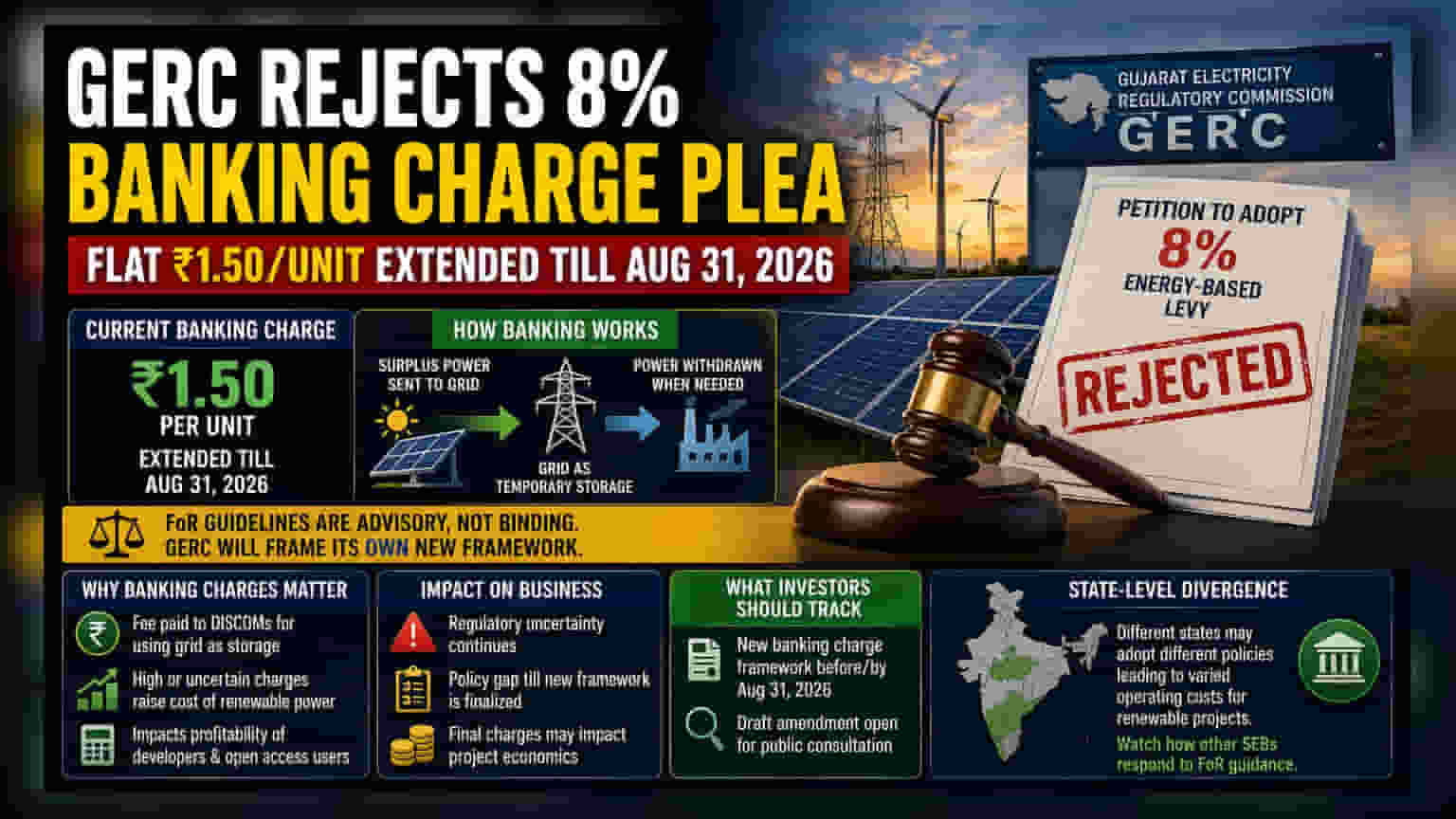
The Gujarat Electricity Regulatory Commission (GERC) has rejected a proposal by renewable energy developers to swap the fixed ₹1.50 per unit banking charge for an 8% energy levy. This decision keeps the current cost structure in place until at least August 31, 2026. The move highlights the regulatory independence of state commissions and maintains cost uncertainty for open-access renewable projects.
What Happened
The Gujarat Electricity Regulatory Commission (GERC) has denied a petition from renewable energy developers to replace the existing flat banking charge of ₹1.50 per unit with an 8% energy-based levy. Renewable energy companies had argued that the flat fee failed to cover the actual costs incurred by power distribution companies and that adopting the 8% model recommended by the Forum of Regulators (FoR) would provide better consistency.
However, GERC dismissed this request, stating that the FoR guidelines are advisory and not binding. The commission reinforced that it has the authority to set charges based on local network conditions and state-specific policy goals. As a result, the current ₹1.50 per unit banking charge has been extended until August 31, 2026, or until the commission finalizes its own new framework for these charges.
Why Banking Charges Matter
For investors, understanding banking charges is crucial for assessing the profitability of renewable energy projects. When companies or factories (open access consumers) generate their own renewable energy, they often need to use the state grid as a temporary storage facility—a process called 'banking.' They feed surplus power into the grid during the day and withdraw it when needed.
The 'banking charge' is essentially a fee paid to the distribution company for this facility. When these charges are high or uncertain, the cost of using renewable energy increases, which can lower the financial benefit for developers and their corporate clients. A switch to a percentage-based levy (like the 8% model) would have tied the cost to the energy generated, rather than a fixed rate, which developers argued would be more predictable.
Impact on Business and Regulatory Risk
The decision is a reminder of the regulatory uncertainty that can affect the renewable sector. By rejecting the uniform 8% model, GERC has asserted its independence in setting state-specific rules. This means that renewable energy companies operating in Gujarat must continue to plan based on state-specific regulations rather than assuming a standard, nation-wide approach.
The primary risk for companies here is the 'policy gap.' With the commission currently drafting a new framework for banking charges, investors and developers are left in a holding pattern. The financial impact of the final policy will depend on whether the upcoming framework is more or less expensive than the current flat fee of ₹1.50 per unit.
What Investors Should Track
Investors in the renewable energy space should monitor two key areas moving forward:
The new banking charge framework: The GERC has released a draft amendment for public consultation. The final rules, expected before or by August 31, 2026, will be the definitive guide on future costs for renewable developers and open access users in the state.
State-level divergence: As other states formulate their own policies, differences in grid regulations may create varying operating costs for renewable projects depending on their location. Market participants should watch for how other state electricity commissions respond to the national Forum of Regulators' guidance compared to GERC’s decision.