

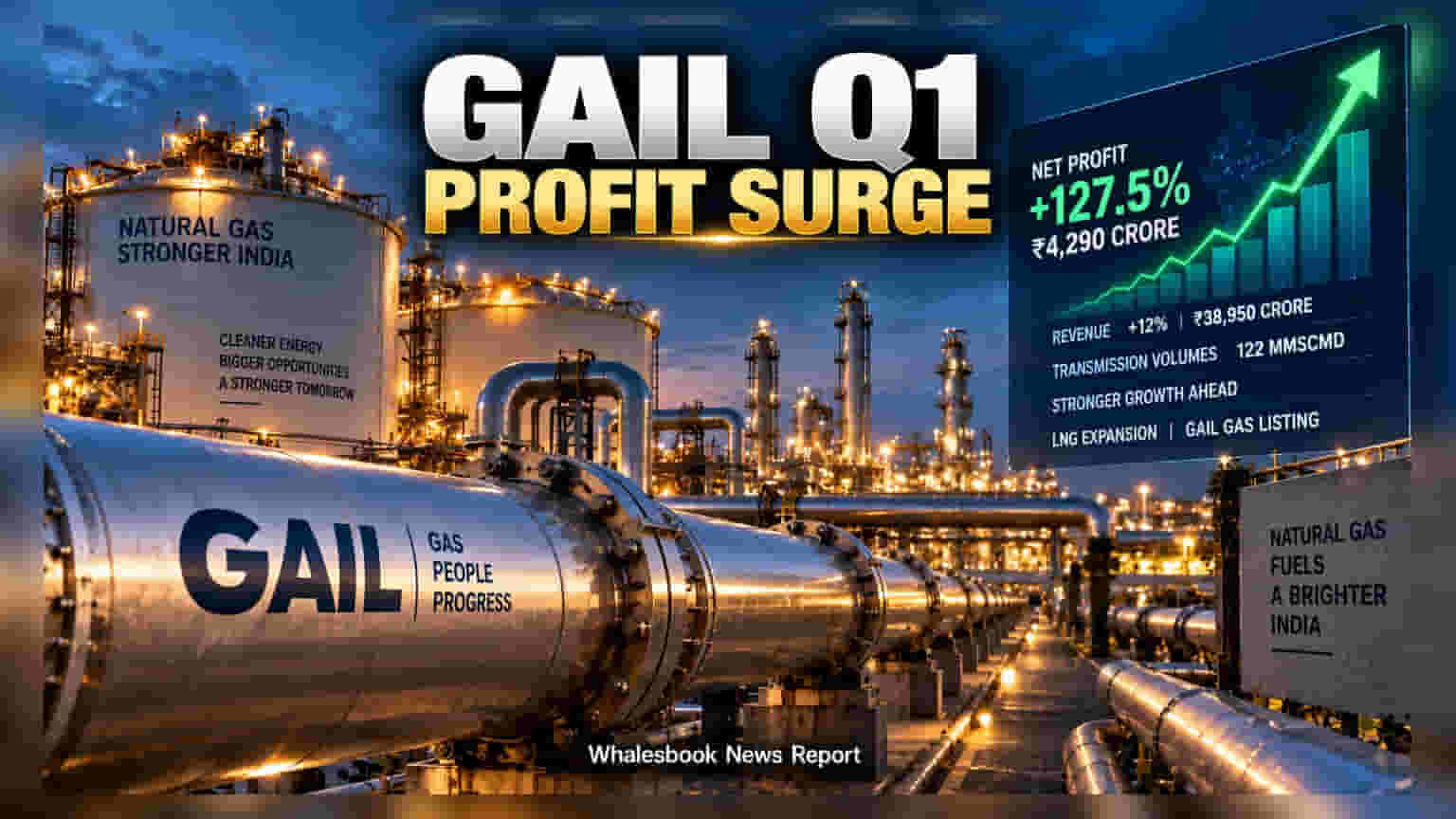
GAIL (India) reported a 127.5% year-on-year jump in net profit to ₹4,290 crore for the first quarter of FY27, driven by higher gas transmission volumes and a recovery in petrochemical margins. The company also raised its transmission volume guidance for the fiscal year, citing the full operationalization of major pipeline infrastructure.
GAIL (India) delivered strong financial results for the first quarter of FY27, as operational efficiency and higher transmission volumes boosted the bottom line significantly. The state-owned gas company’s adjusted net profit rose 127.5% to ₹4,290 crore, compared to the same quarter last year. Revenue for the period stood at ₹38,950 crore, marking a 12% increase year-on-year.
The gas transmission segment remains the primary driver of earnings. Following the full commissioning of the 1,707 km Mumbai-Nagpur-Jharsaguda Natural Gas Pipeline, GAIL increased its transmission volume guidance for the fiscal year to 123 million metric standard cubic meters per day (mmscmd), up from the initial projection of 119 mmscmd. With first-quarter volumes already reaching 122 mmscmd, the company is successfully utilizing its expanded infrastructure.
The petrochemical segment, which has historically been a volatile part of the business, showed signs of recovery during the quarter. EBITDA losses in this division narrowed to ₹11 crore, a significant improvement from the loss of ₹390 crore reported in the previous quarter. The PATA petrochemical complex is currently operating at full capacity, and the company is working on transitioning its feedstock reliance toward ethane to improve long-term profitability.
Looking toward future growth, GAIL is positioning itself to capture rising domestic gas demand, which is projected to increase substantially by 2030. To support this, the company is securing additional LNG supplies with a target of 7-8 million metric tonnes annually by 2030. Additionally, the potential listing of its subsidiary, GAIL Gas, is viewed by investors as a path to unlock shareholder value.
Investors should monitor several factors that could influence future performance. While current operational trends are positive, the company remains exposed to global geopolitical volatility, which can disrupt gas supply chains and impact commodity prices. Currency fluctuations and the cost of feedstock transition remain important variables. The sustainability of petrochemical margins will depend on the company's ability to maintain efficiency as it shifts to new feedstocks. The next critical update for shareholders will be the progress on the proposed GAIL Gas subsidiary listing and the achievement of LNG sourcing targets.