 Whalesbook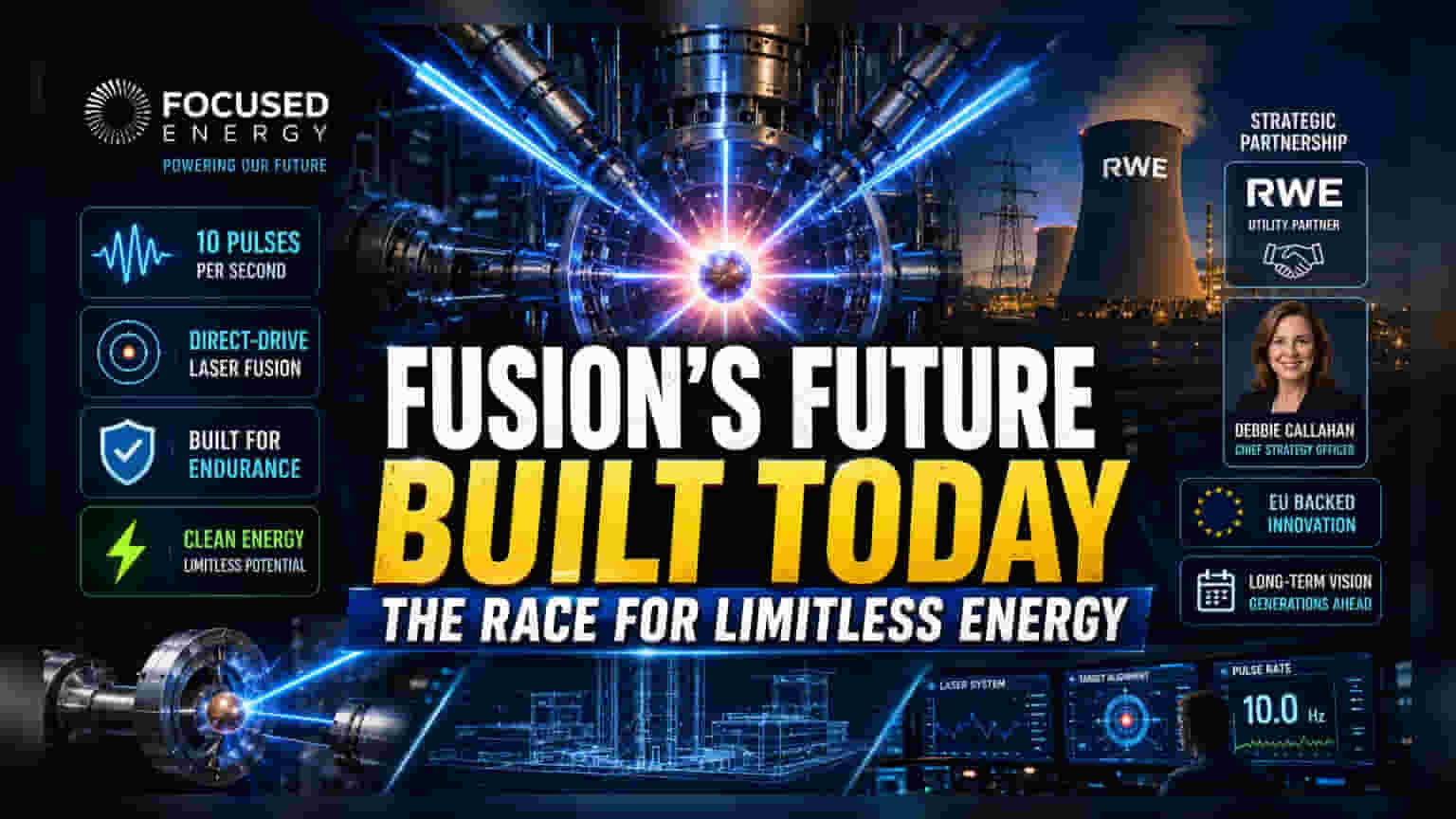


Scaling the Physics Gap
The recent capital influx for Focused Energy arrives at a critical juncture where the fusion industry is pivoting from theoretical viability to mechanical endurance. While the National Ignition Facility proved that controlled fusion is physically possible, the transition to a commercial utility model requires transforming a singular, low-frequency event into a sustained, high-cadence operation. The company's goal of achieving ten pulses per second represents a multi-order-of-magnitude increase in operational demand compared to the current experimental standards, placing the burden of proof squarely on their proprietary direct-drive laser architecture.
Strategic Alliances and Technical Hurdles
By securing backing from traditional utility heavyweights like RWE, the organization is effectively integrating itself into existing energy infrastructure, a move that distinguishes it from venture-only competitors. The appointment of Debbie Callahan as Chief Strategy Officer signals a shift toward addressing the primary bottleneck of inertial confinement: the complexity of target manufacturing. Moving away from the conventional hohlraum cylinder architecture toward a simplified direct-drive system is mathematically attractive but introduces significant complexities in laser-matter interaction and pellet symmetry, variables that remain volatile at high repetition rates.
The Forensic Bear Case
Despite the enthusiasm surrounding the fusion sector, investors must confront the reality of long-term capital intensity and regulatory opacity. Unlike established renewables such as wind or solar, fusion technology lacks a standardized regulatory framework, and the path to grid parity remains speculative. Furthermore, history is replete with fusion concepts that achieved laboratory success but collapsed under the weight of scaling costs and material degradation under neutron bombardment. While competitors like Type One Energy and Thea Energy are also attracting capital, the sector remains highly fragmented, creating a risk that Focused Energy may find itself in a technology race where the first to market is not necessarily the first to reach economic viability. The reliance on public grants alongside private venture capital also implies that the company remains vulnerable to shifts in European energy policy and government-backed innovation funding cycles.
Market Trajectory and Outlook
Long-term progress for the Lighthouse project will be judged not by funding rounds, but by the physical resilience of the reactor materials and the precision of the high-frequency laser delivery system. As the industry matures, the focus will likely shift toward supply chain security for fuel targets and the ability to integrate intermittent fusion pulses into the stable base-load requirements of a modern power grid. For now, the successful funding cycle suggests that institutional confidence in deep-tech energy solutions remains robust, even as the timeline for commercialization remains measured in decades rather than years.