 Whalesbook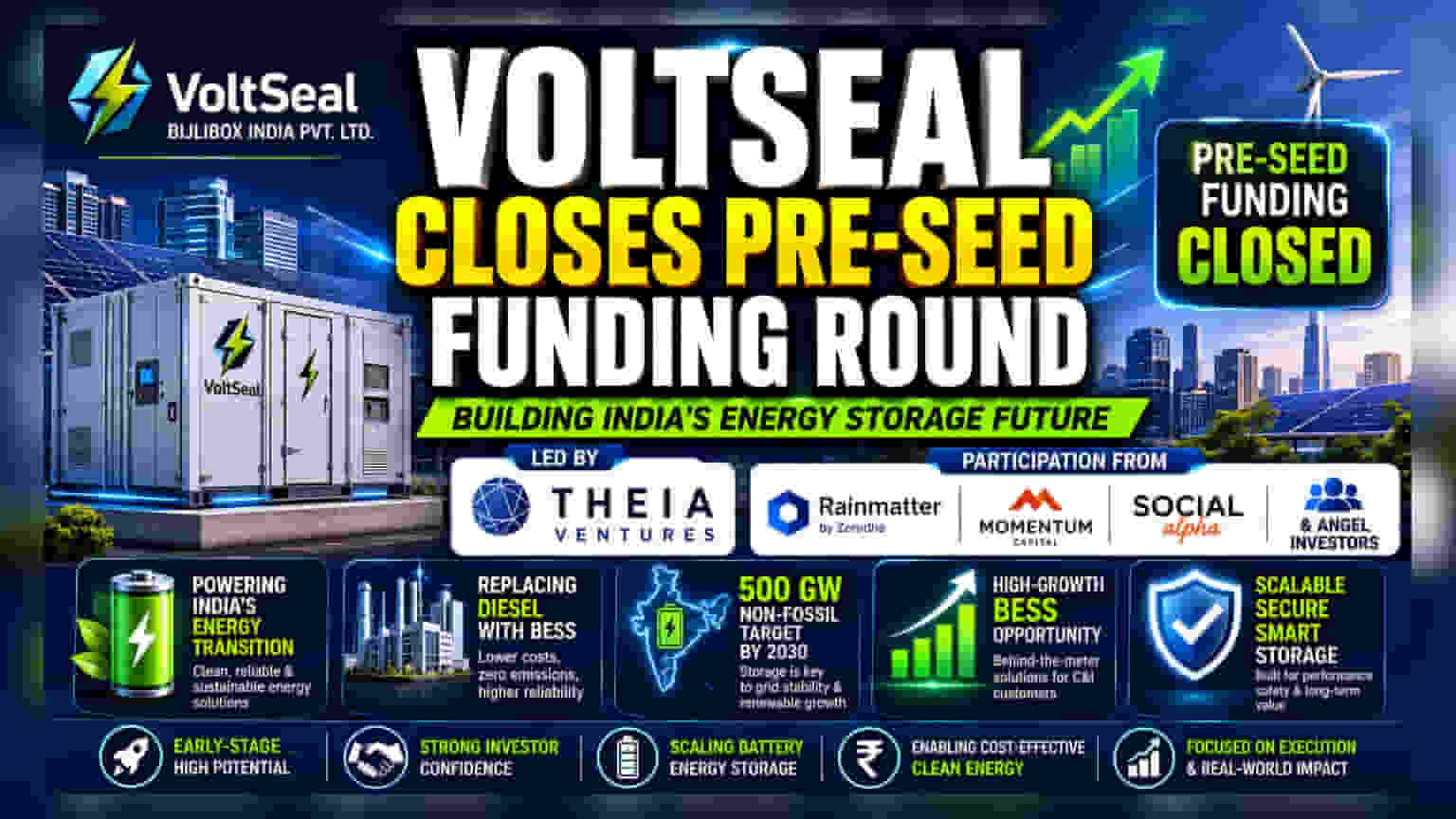


VoltSeal, known legally as Bijlibox India Private Limited, has secured pre-seed funding led by Theia Ventures. The startup focuses on distributed battery energy storage for commercial and industrial clients, aiming to reduce reliance on diesel power. This move highlights growing investor interest in India's energy storage infrastructure as the country pushes toward its renewable energy targets.
What Happened
VoltSeal, an energy technology company operating as Bijlibox India Private Limited, has successfully closed its inaugural institutional funding round. This pre-seed capital raise was led by Theia Ventures, an early-stage venture capital firm that specializes in energy transition and deep-tech investments. The round also saw participation from other notable investors, including Rainmatter by Zerodha, Momentum Capital, and Social Alpha, alongside a group of angel investors. TLH Advocates & Solicitors provided legal advisory services for the transaction.
Why This Matters For Investors
The funding marks a significant step for VoltSeal as it builds infrastructure for distributed battery energy storage systems (BESS). In India's energy sector, there is a clear shift toward decentralized power solutions. Many commercial and industrial (C&I) clients—such as large manufacturing plants, offices, and warehouses—have traditionally relied on diesel generators for backup or peak power needs. VoltSeal’s business model aims to replace these high-emission, high-cost diesel units with cleaner, more flexible battery storage.
For the broader energy sector, this investment reflects the urgent need for grid stability. As India integrates more solar and wind power, the demand for storage becomes critical. When renewable generation drops, or grid supply is interrupted, stored energy acts as a crucial cushion. Startups like VoltSeal are positioning themselves to provide these solutions, which are increasingly seen as essential for managing India's growing energy demand.
The Business Context
The Battery Energy Storage Systems (BESS) market in India is in a high-growth phase, fueled by the national target to reach 500 GW of non-fossil fuel power capacity by 2030. While large-scale grid storage projects often grab headlines, there is a growing niche for 'behind-the-meter' storage—systems installed directly at a business site to manage energy costs and improve reliability. By targeting the C&I sector, VoltSeal is entering a market that is actively seeking ways to move away from expensive diesel, though success will depend on their ability to offer cost-effective, durable technology.
What Could Go Wrong
While the sector is growing, it is not without risks. Startups in the battery storage space face several challenges that investors typically watch closely. First, there is significant execution risk; scaling hardware deployments across many sites is capital-intensive and logistically complex. Second, the cost of battery technology, particularly lithium-ion components, can be volatile, which directly impacts project margins. Furthermore, there are technical risks related to the heat and safety management of large battery arrays, and the regulatory environment for distributed energy storage is still evolving.
What Investors Should Track
For those watching this space, the key monitorables will be how VoltSeal deploys this capital to achieve scale. Investors will likely look for milestones regarding the number of commercial sites successfully converted from diesel to battery storage. Additionally, the company’s ability to manage maintenance costs, ensure long-term hardware reliability, and navigate potential policy changes regarding energy storage will be critical. As this is an early-stage (pre-seed) company, progress in pilot projects and customer adoption rates will be the primary indicators of business momentum moving forward.