

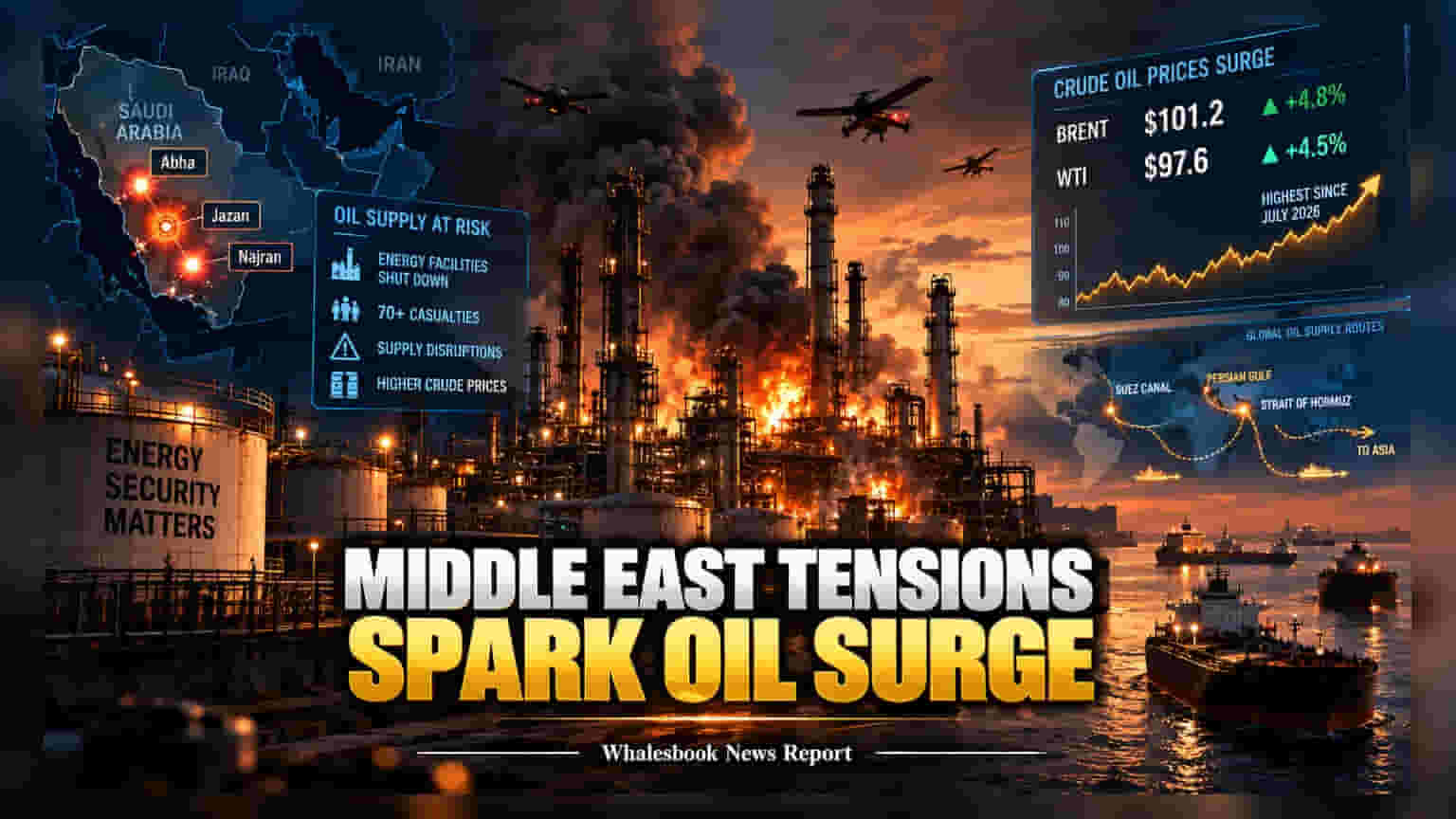
Global crude oil prices have reached multi-week highs following coordinated drone and missile attacks on key Saudi Arabian energy infrastructure. For Indian investors, this escalation creates a complex scenario. While upstream oil producers may see potential gains, oil marketing companies and aviation firms face risks from increased input costs and margin pressure. Investors are monitoring how long the disruption lasts and its potential impact on domestic fuel pricing and inflation.
Global oil markets are reacting sharply to renewed geopolitical instability in the Middle East. Recent intelligence reports have confirmed coordinated drone and missile attacks on critical Saudi Arabian energy infrastructure in regions including Abha, Jazan, and Najran. The attacks resulted in over 70 casualties and forced the temporary suspension of operations at several key energy facilities. As a direct consequence, Brent and WTI crude oil prices have surged to their highest levels since late July 2026, as traders price in the increased risk of supply disruptions.
For the Indian stock market, this volatility brings immediate attention to the energy and logistics sectors. The impact of higher crude prices is rarely uniform across the market, and investors often view it through the lens of individual business models. Upstream companies like ONGC and Oil India generally benefit from higher global crude realizations, as their revenue is directly tied to the price of oil. However, investors often watch whether the government adjusts the windfall tax on crude production in response to these price spikes, which can temper the potential gains for shareholders.
Conversely, Oil Marketing Companies (OMCs) such as IOC, BPCL, and HPCL face a more challenging environment when crude prices rise rapidly. If these companies cannot fully pass on the increased costs to consumers through higher retail petrol and diesel prices, their marketing margins may come under pressure. Investors typically track the daily pricing policy and any government intervention that could affect the profitability of these state-run retailers.
Beyond the oil sector, the broader market feels the ripple effects through input costs. Companies in the aviation sector, such as IndiGo, are particularly sensitive to these moves, as Aviation Turbine Fuel (ATF) costs make up a significant portion of their operating expenses. Similarly, logistics, shipping, and tyre manufacturing companies—which rely on crude-linked raw materials like carbon black and rubber—may see their profit margins face pressure if elevated energy prices persist. There is also a macro-level concern regarding the impact on India’s import bill, which can put downward pressure on the Indian Rupee and contribute to inflationary trends.
Looking ahead, the critical factor for investors will be the duration and scale of the operational disruptions in Saudi Arabia. As the geopolitical situation remains fluid, market participants will likely look for updates from the Saudi Ministry of Energy regarding the timeline for restarting suspended facilities. Additionally, any policy commentary from the Indian government regarding domestic fuel price management and energy security will be an important monitorable for stakeholders in the coming weeks.