

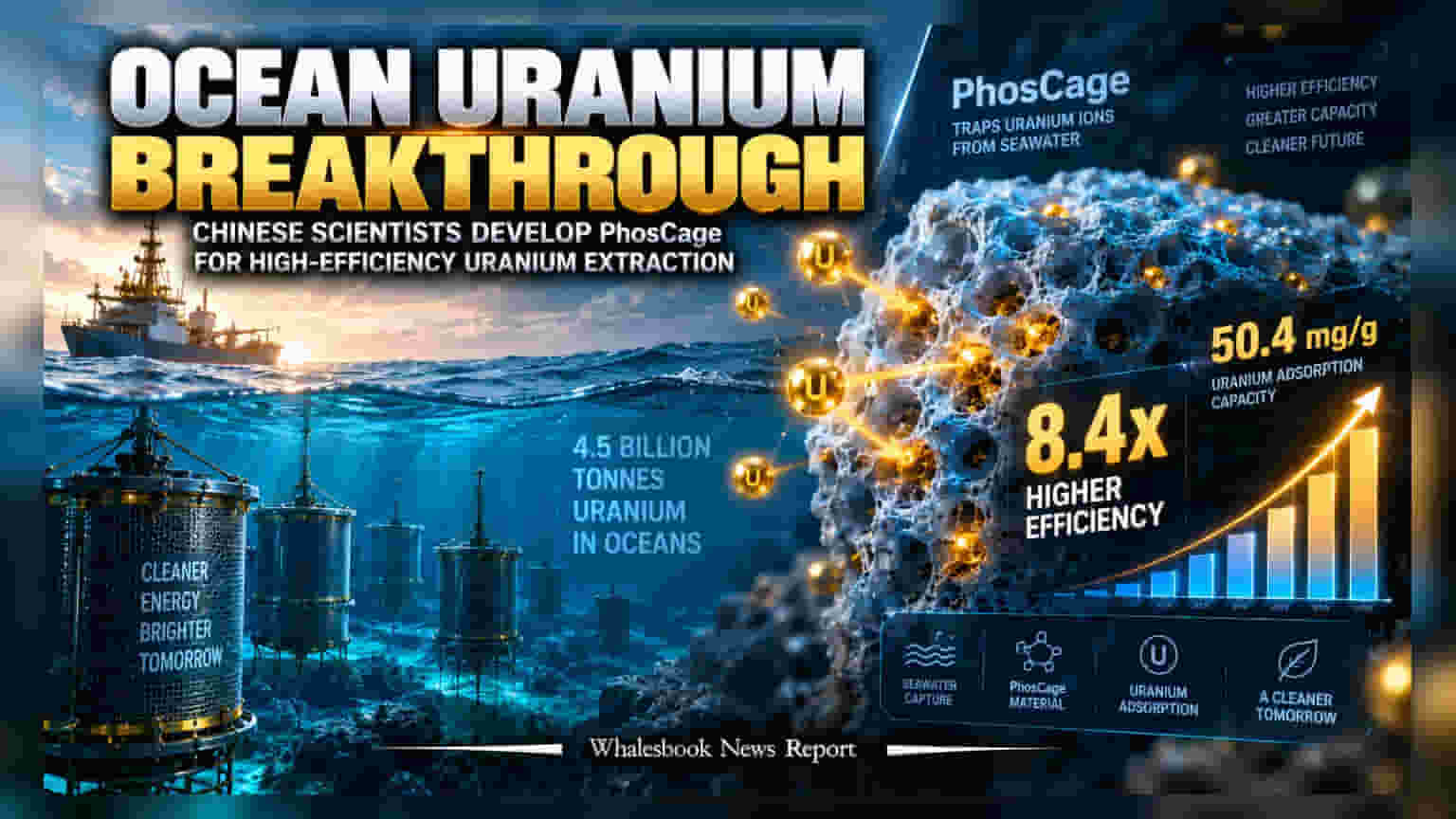
Researchers at the Chinese Academy of Sciences have developed 'PhosCage,' a new material that extracts uranium from seawater with significantly higher efficiency than current benchmarks. While this advancement aims to secure long-term nuclear fuel supplies, it remains in the early research phase. Investors should note that this is a scientific development with no direct link to any publicly traded company, and commercial viability remains unproven.
Scientists at the Chinese Academy of Sciences’ Qingdao Institute of Bioenergy and Bioprocess Technology have unveiled a new material called 'PhosCage' designed to extract uranium from seawater. This development is part of a long-term effort to tap into the 4.5 billion tonnes of uranium believed to be dissolved in the world's oceans. For the nuclear energy sector, finding a reliable way to access these reserves could eventually help countries reduce their reliance on traditional, land-based uranium mining.
Breakthrough in Extraction Efficiency
The laboratory performance of the new material has drawn attention for its speed and capacity. PhosCage utilizes phosphate groups within its molecular structure to trap uranium ions. In controlled tests, it achieved an adsorption capacity of 50.4 milligrams per gram (mg/g), which is reported to be more than eight times higher than the benchmarks set by the US Department of Energy. To make this practical for use in the ocean, researchers created a composite aerogel bead called AC-POC, which incorporates aramid nanofibers to withstand the harsh conditions of the open sea.
Separating Science from Market Reality
It is critical for investors to understand the difference between scientific research and commercial investment opportunities. This breakthrough is an academic achievement, not a product launch by a publicly traded corporation. There is no direct link between the developers of PhosCage and any stock market entity.
Investors should be cautious of potential confusion with similarly named companies, such as The Phosphate Company, which is completely unrelated to this scientific research. Misinterpreting this news as a growth trigger for stocks with similar names can lead to poor decision-making based on speculation rather than company fundamentals.
The Path to Commercial Feasibility
While the technical efficiency is a positive sign for nuclear fuel research, moving from a laboratory concept to industrial-scale application is a massive hurdle. Uranium exists in seawater at an extremely low concentration of approximately 3.3 parts per billion. This makes the cost of extracting uranium from the ocean significantly higher than mining it from land deposits.
For this technology to impact the energy market in the future, it must overcome three major challenges. First, it must prove that the operational costs—including the deployment, maintenance, and recovery of the filtering material—can compete with the market price of mined uranium. Second, the material must withstand long-term 'biofouling,' where microorganisms and marine life accumulate on the filter and reduce its performance. Third, the process must be scalable to the massive size required to supply fuel for nuclear power plants.
As the technology remains in the early stages of field testing, it does not currently change the immediate supply chain dynamics or commodity pricing for the nuclear power sector. The next important steps for researchers will be to demonstrate durability over extended, real-world deployment periods and to publish data regarding the total energy cost required to produce each unit of recovered uranium.