

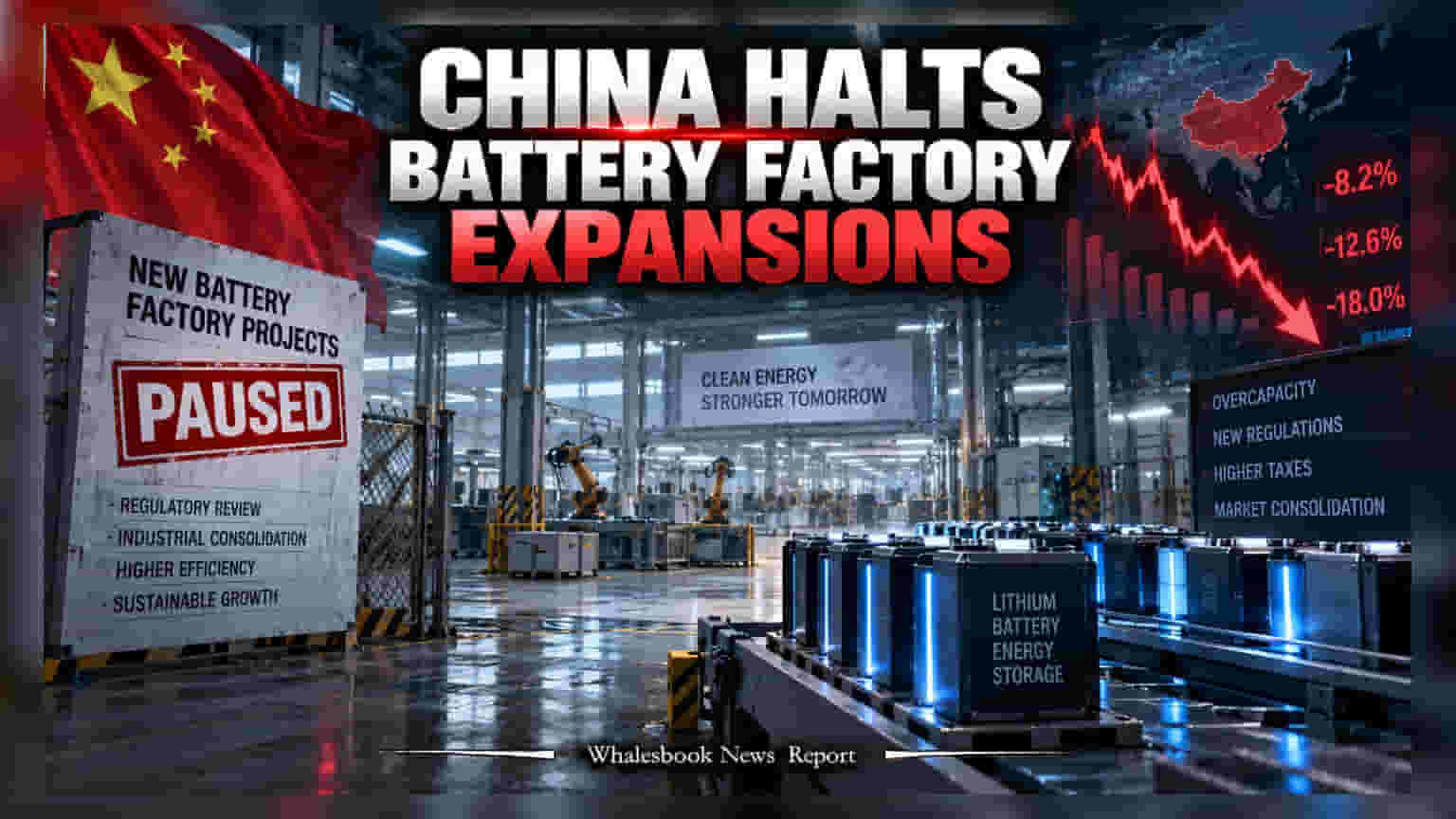
China has temporarily suspended approvals for new battery energy storage manufacturing projects to address sector saturation. This policy shift, paired with new consumption taxes and efficiency standards, aims to consolidate the industry. Investors may track potential impacts on global supply chains and battery pricing benchmarks.
China has implemented a temporary freeze on the approval of new manufacturing facilities for battery energy storage systems. This regulatory move marks a shift in the country's approach to the sector, moving away from rapid, state-mandated expansion toward a strategy focused on industrial consolidation and higher efficiency. The decision follows a period of intense capacity building that has led to market saturation and increased competition.
Industrial Overcapacity and Regulatory Shifts
The suspension comes against the backdrop of a cooling sector. Data from the first half of 2026 indicates that newly commissioned battery storage capacity in China declined by 18% compared to the previous year. To manage this landscape, the government is introducing a series of regulatory hurdles. A new consumption tax on lithium-ion and other battery storage technologies has taken effect in September 2026, starting at 2% and rising to 4% by September 2027. Additionally, strict national energy efficiency standards for the battery and photovoltaic value chains are set to become mandatory on January 1, 2027.
These measures are designed to force out smaller, less efficient manufacturers that have relied on subsidies or aggressive expansion to survive. By limiting new project approvals and raising the bar for efficiency, Beijing is aiming to create a more competitive environment where only manufacturers with strong technology and scale can thrive. This represents a significant change from previous policies that required renewable energy projects to pair their generation with storage facilities, which had previously driven massive, sometimes inefficient, capital deployment.
Impact on Global Markets
For international investors and downstream energy companies, this freeze introduces a new layer of uncertainty. China currently dominates the global supply chain for battery storage components. If the freeze on new factory construction remains in place, it could create supply chain bottlenecks for international buyers who rely on Chinese exports.
Furthermore, the combination of new taxes and a shift toward quality-focused production is expected to influence global battery pricing benchmarks. While the move is intended to stabilize the domestic market, the reduced pace of new factory additions could lead to price volatility in the short term. The focus for market participants will now shift toward how quickly manufacturers can adapt to the new efficiency mandates and whether these cost increases are passed on to global customers. Investors and industry analysts will likely monitor global pricing data and company-specific updates on compliance with the upcoming efficiency standards as key indicators of sector health.