 Whalesbook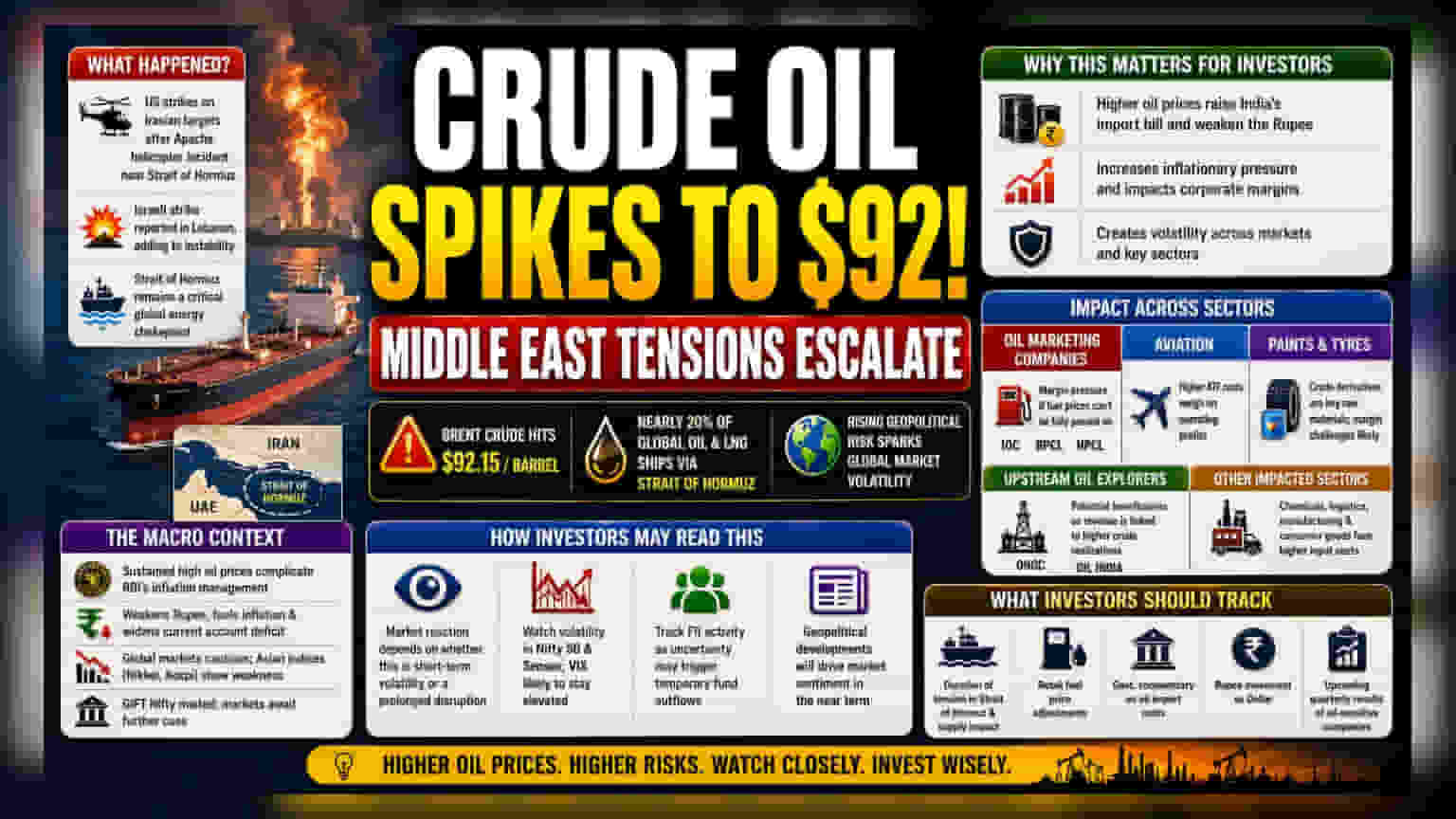


Brent crude has surged to $92.15 a barrel amid escalating Middle East tensions following US-Iran clashes near the Strait of Hormuz. As Indian markets brace for a muted opening, investors are assessing the impact on inflation, the rupee, and sectors sensitive to energy costs, such as aviation, paints, and oil marketing companies.
What Happened
Brent crude oil prices have jumped to $92.15 a barrel, driven by a sharp rise in geopolitical tensions in the Middle East. This price increase follows reports of US strikes on Iranian targets after a US Army Apache helicopter was involved in an incident near the Strait of Hormuz. Adding to the regional instability, reports of an Israeli strike in Lebanon have further unsettled global markets. The Strait of Hormuz is a critical global chokepoint, as nearly one-fifth of the world’s crude oil and liquefied natural gas shipments pass through this narrow waterway.
Why This Matters For Investors
India is a major importer of crude oil, meaning higher global prices often have a direct impact on the domestic economy. When oil prices spike, it typically leads to an increase in India’s import bill, which can put downward pressure on the Indian Rupee. A weaker rupee often increases the cost of imports and can fuel inflationary pressures. For investors, this creates a ripple effect across various sectors, as companies often struggle to maintain profit margins when input costs rise suddenly.
Impact Across Sectors
Investors usually monitor the oil price trend for its varying impact on different industries. Oil Marketing Companies like Indian Oil Corporation, BPCL, and HPCL often face profit margin pressure during periods of high crude volatility if they are unable to fully pass the increased costs to consumers at the fuel pump. Similarly, the aviation sector, which relies heavily on Aviation Turbine Fuel, often sees higher operating costs that can weigh on bottom-line profits.
Sectors like paints and tyre manufacturing are also highly sensitive to crude oil prices, as crude derivatives are key raw materials for their products. Companies in these spaces may face margin challenges if they cannot raise product prices to offset the spike in raw material costs. Conversely, upstream oil exploration companies, such as ONGC and Oil India, may see potential benefits, as their revenue is often linked to global crude oil realizations.
The Macro Context
Historically, sustained periods of high oil prices have been a concern for the Reserve Bank of India, as they complicate the inflation management process. If energy prices remain elevated for an extended period, it may influence the central bank's stance on interest rates. While global markets are reacting with caution, with Asian indices like the Nikkei and Kospi showing signs of weakness, domestic investors are watching whether these geopolitical developments will lead to sustained selling pressure or if the market will absorb the news as a temporary event.
How Investors May Read This
The market reaction will likely depend on whether this oil price spike is viewed as a short-term volatility event or the start of a prolonged supply disruption. Investors are keeping a close watch on the volatility in the Nifty 50 and Sensex, as indicated by the muted signals from the GIFT Nifty. Market participants often track FII activity during such geopolitical events, as uncertainty can sometimes lead to temporary fund outflows from emerging markets.
What Investors Should Track
The most important factor to track is the duration of the tension in the Strait of Hormuz and whether it leads to actual supply constraints or is primarily driven by sentiment. Investors should watch for updates on retail fuel price adjustments, official commentary from the government regarding oil import costs, and any shifts in the rupee's valuation against the dollar. The upcoming quarterly results will also be key, as they will reveal how effectively companies in oil-sensitive sectors are managing these rising input costs.