

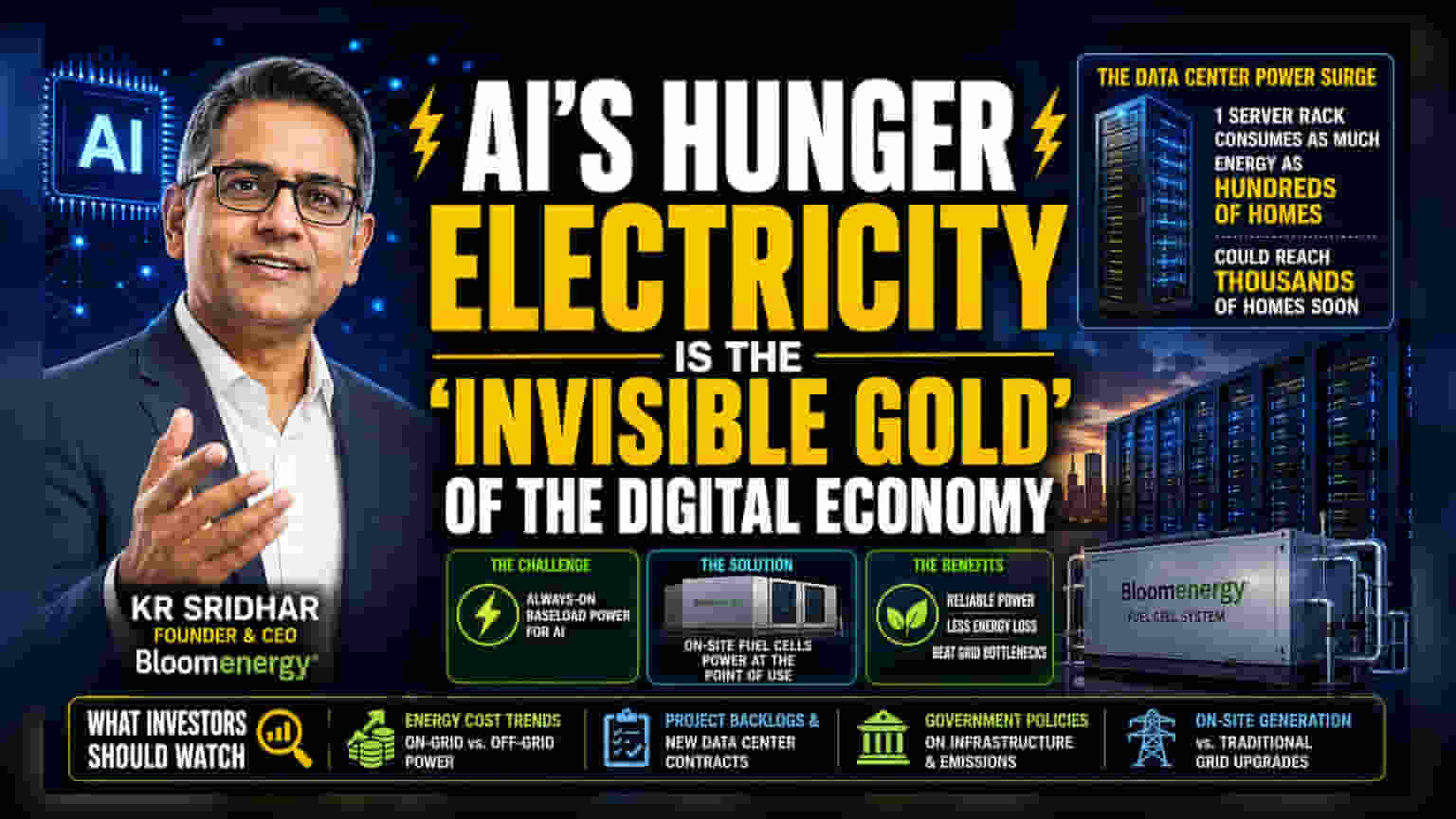
Bloom Energy CEO KR Sridhar has labeled electricity the 'invisible gold' of the AI era, highlighting that data centers require significantly more power than traditional infrastructure. As AI hardware demand surges, the challenge of providing reliable, continuous electricity is reshaping the energy sector. Investors are weighing how this shift impacts energy technology firms versus traditional grid infrastructure providers.
What Happened
Artificial Intelligence (AI) is transforming electricity into the most critical resource of the digital economy, according to Bloom Energy Founder and CEO KR Sridhar. In recent comments, Sridhar highlighted that the computing power required for AI is creating an unprecedented spike in energy consumption. He described electricity as the "invisible gold" of this era, noting that AI is effectively a manufacturing process where intelligence is the output, and electricity and data are the key inputs.
The Data Center Energy Challenge
The core issue is the density of power required by modern AI server racks. According to Sridhar, a single server rack today can consume as much energy as hundreds of homes, with projections suggesting this could soon climb to thousands. Data centers require "always-on" or baseload power, meaning they cannot afford interruptions. This creates a massive stress point for traditional power grids, which were often built for lower, more predictable loads.
Business And Technology Impact
Companies like Bloom Energy argue that the solution lies in generating power directly at the point of consumption rather than relying entirely on a public grid that may be slow to upgrade. Bloom Energy’s fuel cell technology is designed to produce electricity on-site. This approach aims to reduce energy loss caused by transmitting power over long distances and bypass the grid bottlenecks that often delay data center construction.
However, the business model faces competition. While fuel cells offer reliability, they are a capital-intensive solution. Whether companies choose on-site generation through fuel cells, battery storage, or traditional grid expansion depends on cost, fuel availability, and local regulations.
Risks And Sector Pressures
Investors should note that the power-for-AI thesis involves significant risks. First, fuel cells often operate on natural gas or hydrogen. If fuel costs rise, the economic advantage over standard grid electricity can shrink. Second, the energy industry is not waiting for new technology; traditional utility companies and grid equipment makers are heavily investing to upgrade infrastructure to handle the load.
Furthermore, there is a risk of execution. Building out on-site energy solutions for thousands of data centers is expensive and time-consuming. Regulatory environments regarding emissions and fuel usage also change, which could impact the long-term viability of specific energy technologies.
What Investors Should Track Next
Moving forward, the primary monitorable is the speed at which utilities can upgrade the grid versus how fast data center operators adopt alternative power solutions like fuel cells or microgrids. Investors may track the following:
- Energy cost trends for data centers (on-grid vs. off-grid power).
- Company updates on project order backlogs and the size of new data center contracts.
- Government policies on energy infrastructure and carbon emissions, which impact the adoption of clean-burning fuel technologies.
- Whether data center operators prefer capital-intensive on-site generation or if they continue to rely on traditional grid utility upgrades.