

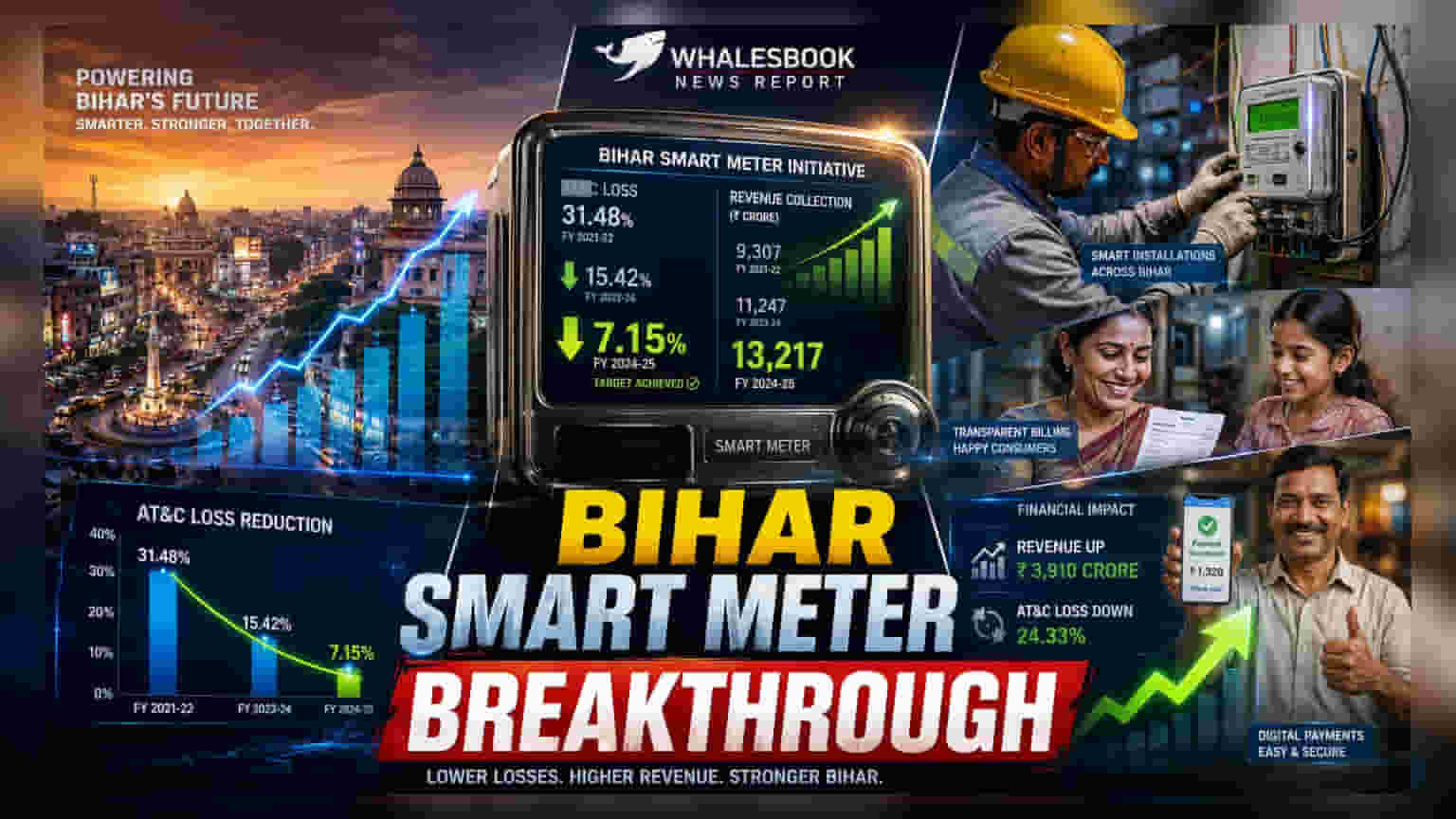
Bihar has installed over 4 million smart meters in eight months, bringing the total to 9.2 million. The deployment has significantly cut technical losses and doubled utility revenues, marking a major shift in state power distribution finances.
What Happened
Bihar has reached a major operational milestone in its energy sector by installing over 4 million smart meters in just over seven months. As of July 1, 2026, the state’s total smart meter count stands at nearly 9.2 million. This initiative is part of a larger, state-wide project budgeted at ₹16,900 crore over a five-year period. The rapid installation, driven by state-run distribution companies, has transformed the financial metrics of the regional power sector, positioning Bihar as a leader in India’s national goal of installing 250 million smart meters by 2028 under the Revamped Distribution Sector Scheme.
Financial Impact on State Utilities
The shift toward smart metering has directly improved the financial health of the South Bihar Power Distribution Company Limited (SBPDCL) and the North Bihar Power Distribution Company Limited (NBPDCL). Aggregate Technical and Commercial (AT&C) losses—which measure the gap between electricity supplied and revenue collected—have plummeted. SBPDCL reduced its losses from 37.02% in FY21 to 15.39% in FY26, while NBPDCL saw a reduction from 24.13% to 12.45% in the same timeframe. This efficiency gain has helped combined utility revenues climb to ₹19,036 crore in March 2026, nearly double the ₹10,099 crore recorded five years earlier.
Improved Operational Discipline
Beyond revenue, the move to digital metering has improved operational discipline. Accumulated losses for these utilities dropped from a peak of ₹19,800 crore in March 2023 to ₹16,500 crore by March 2025. Improved billing and collection efficiency have allowed the state to make timely payments to power producers, often qualifying for cash discounts. The crackdown on power theft, which resulted in 50,208 identified cases and the recovery of ₹92.05 crore in FY26, further underscores the impact of replacing traditional meters with smart, pre-paid technology.
Why This Matters for the Power Sector
For investors and sector analysts, Bihar’s model provides a measurable proof-of-concept for the national Revamped Distribution Sector Scheme. Many state-run distribution companies (DISCOMs) across India have historically struggled with high debt and poor collection efficiency. The successful reduction in losses through digital intervention suggests that similar programs, if executed with high public participation, could improve the financial viability of power distribution businesses nationwide. Increased revenue and reduced leakages strengthen the balance sheets of utilities, which in turn benefits the entire power value chain, including power generation and transmission companies.
What Investors Should Track
Investors monitoring the power sector should look for data on the national pace of smart meter deployment under the central government’s scheme. Continued success in reducing distribution losses will be a primary monitorable for assessing the future financial stability of state power boards and the potential reduction in government subsidies required to keep these utilities afloat. Further updates on billing and collection efficiency across other states will also indicate the scalability of the Bihar model.