

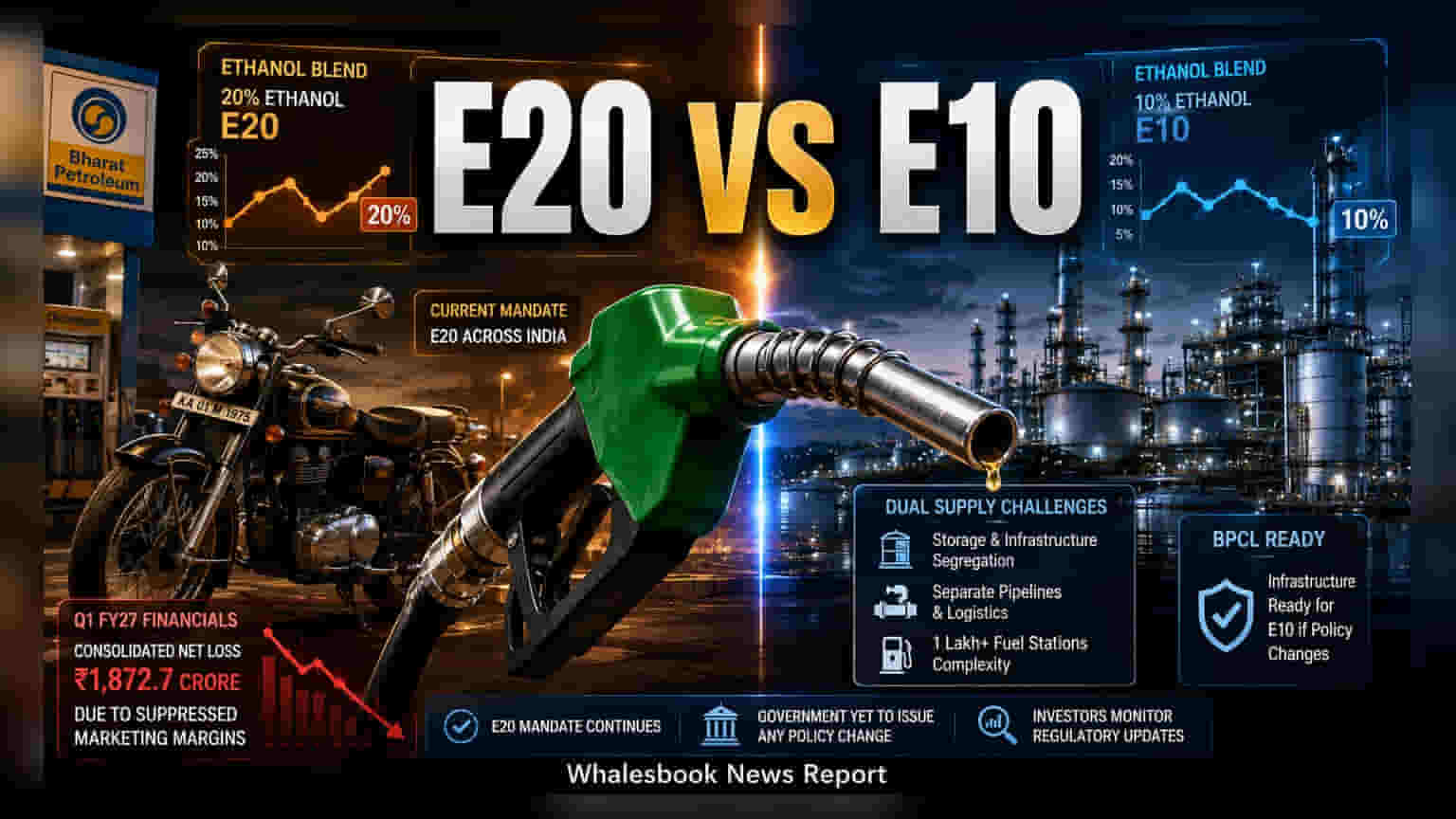
Bharat Petroleum (BPCL) has clarified that its infrastructure can support a potential return to E10 fuel if the government mandates it, despite the current E20 policy. While no official change has been announced, investors are monitoring this amidst debates over fuel compatibility for older vehicles and the company's recent Q1 FY27 financial performance.
Bharat Petroleum Corporation Limited (BPCL) has addressed market concerns regarding potential fuel policy changes, stating that its infrastructure is capable of supporting E10 fuel supply if the government decides to deviate from the current E20 (20% ethanol) mandate. This clarification follows ongoing public and policy-level debates about whether older, non-compliant vehicles require lower-blend ethanol options.
While the current national mandate requires the distribution of E20 petrol, experts and policymakers have discussed the possibility of introducing E10 as a parallel option to protect the existing legacy vehicle fleet. BPCL officials emphasized that while the company is technically prepared to manage such a transition, the operational reality of running a dual-fuel supply chain—offering both E10 and E20 across India’s network of over one lakh fuel stations—presents significant logistical and storage complexity. Maintaining segregated pipelines, storage depots, and retail outlets would require a substantial overhaul of existing distribution systems, a challenge the government has historically approached with caution.
This discussion unfolds during a period of financial pressure for the oil marketing company. In the first quarter of FY27, BPCL reported a consolidated net loss of approximately ₹1,872.7 crore. This performance was largely attributed to suppressed marketing margins, even as refining margins remained a point of focus. For investors, the potential for a mandate shift is significant; should the government move toward requiring parallel fuel streams, it could introduce new costs or capital allocation requirements for fuel retailers already managing tight margins.
The government has not issued any formal directive to revert from E20 for the general market, and the current infrastructure readiness statement remains a contingency plan rather than an indication of an imminent policy pivot. The company continues to operate under the E20 blending targets, which it successfully sustained throughout the latter half of the previous fiscal year. Shareholders and market observers should monitor forthcoming regulatory announcements regarding fuel standards, as any decision to introduce secondary fuel tiers could directly impact operational expenses and distribution efficiency for the company.