

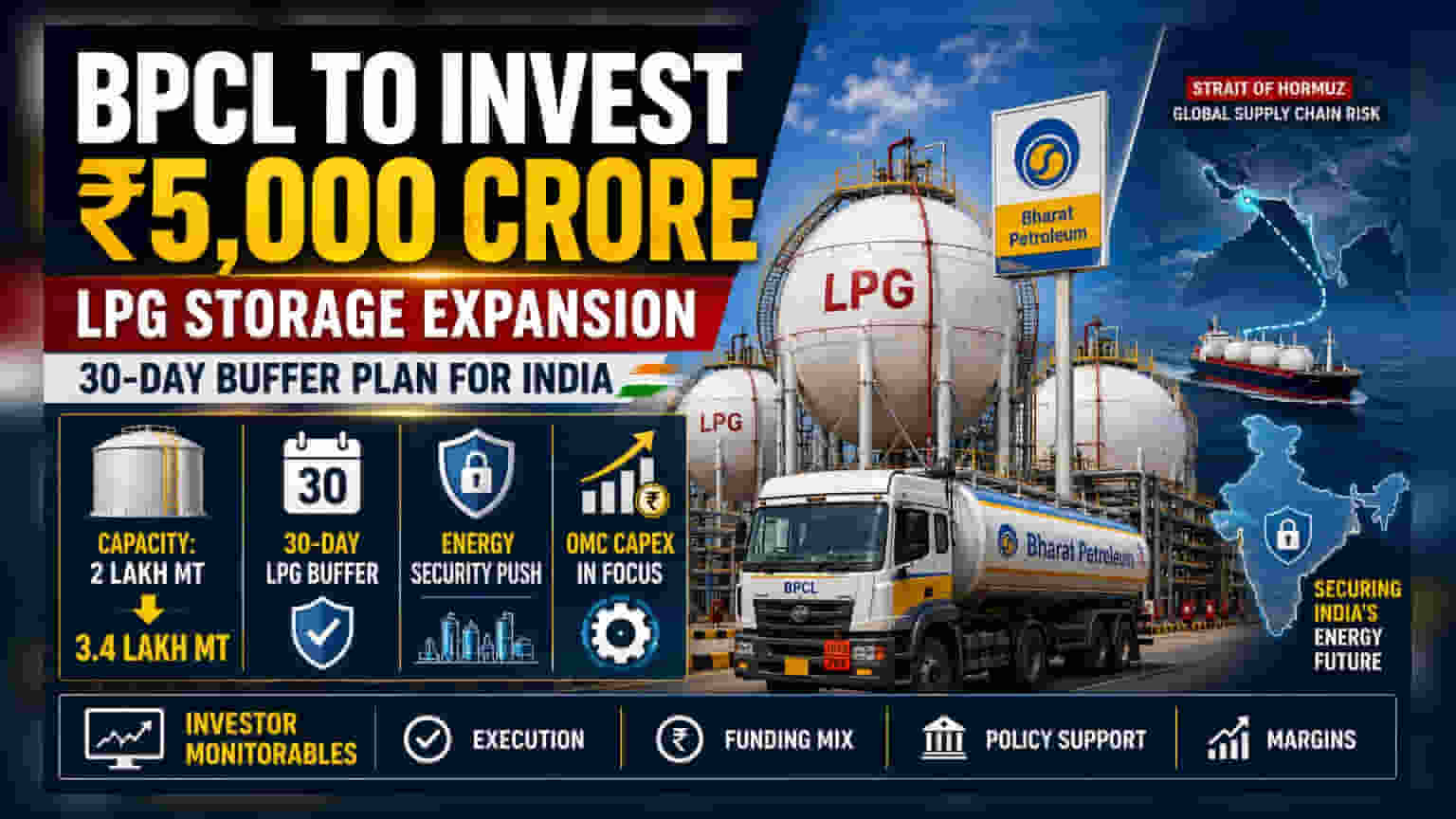
Bharat Petroleum (BPCL) is planning a ₹5,000 crore investment to nearly double its LPG storage capacity, aiming for a 30-day strategic reserve. This directive from the government seeks to insulate India’s energy supply from geopolitical risks in the Middle East. Investors should track how this significant capital expenditure impacts the company’s balance sheet and cash flow amid ongoing pressure on profit margins.
What Happened
Bharat Petroleum Corporation Limited (BPCL) has initiated plans to expand its Liquefied Petroleum Gas (LPG) storage capacity as part of a broader government directive to secure the nation's energy supply. The company has proposed an investment of approximately ₹5,000 crore to increase its storage capacity from roughly 200,000 metric tonnes to 340,000 metric tonnes. This move is a direct response to recent geopolitical tensions in West Asia, specifically disruptions in the Strait of Hormuz, which highlighted the country's vulnerability to supply chain shocks. The government has directed state-run oil marketing companies—BPCL, Indian Oil Corporation (IOC), and Hindustan Petroleum Corporation Limited (HPCL)—to establish a minimum 30-day LPG buffer stock to ensure uninterrupted availability for households.
Strategic Buffer vs. Commercial Inventory
For years, India’s oil marketing companies maintained only enough inventory for routine operations, typically covering a few days of demand. The new directive moves beyond this operational model by mandating a strategic reserve. Unlike commercial stock, which is cycled regularly for sales, this strategic buffer is designed as a safety net. India has historically relied heavily on imports from the Gulf region, with nearly 90% of LPG imports transiting through the Strait of Hormuz. By expanding storage and diversifying import sources to include suppliers from the US and other regions, the government aims to reduce the risk of sudden shortages caused by maritime bottlenecks.
The Capital Expenditure Challenge
For BPCL and its peers, this project represents a significant capital expenditure. While these investments are vital for national energy security, they come at a time when the sector is already managing complex financial pressures. Refining and marketing companies often face volatility in global crude and gas prices, which can impact profitability if costs cannot be fully passed on to consumers.
Investors may note that funding a project of this scale requires a careful balance between debt and internal cash flow. While the long-term benefit is a more resilient supply chain, the immediate impact of such spending is a reduction in available cash. The financial markets will likely assess how BPCL funds this expansion—whether through internal accruals, additional borrowing, or government-backed financing models—and how it affects the company’s return ratios over the coming years.
Peer and Sector Context
This expansion is not an isolated move but part of a sector-wide shift. Oil marketing companies (OMCs) serve over 30 crore domestic connections, making LPG a critical utility rather than just a commercial product. Because of its social importance, pricing is often sensitive to government policy. When international import costs spike, OMCs have historically absorbed part of the burden to protect households, which can lead to volatility in quarterly earnings. The push for 30-day reserves is essentially an attempt to create a buffer against the pricing and supply shocks that occur when the global energy market is unstable.
What Investors Should Track
Moving forward, the success of this initiative will depend on more than just the announcement of the investment. Investors may monitor several key areas:
- Project Execution: Timelines for land acquisition and construction of the new storage facilities, including whether the company chooses underground caverns or above-ground tankage, will affect costs and completion dates.
- Funding Mix: How the company manages its debt-to-equity ratio while undertaking this heavy capital spending.
- Government Policy: Any updates on financial support or subsidy mechanisms that may help OMCs recover the costs associated with maintaining these strategic reserves.
- Operational Margins: Continued monitoring of how these companies balance the cost of building reserves with the fluctuations in global LPG import prices.