

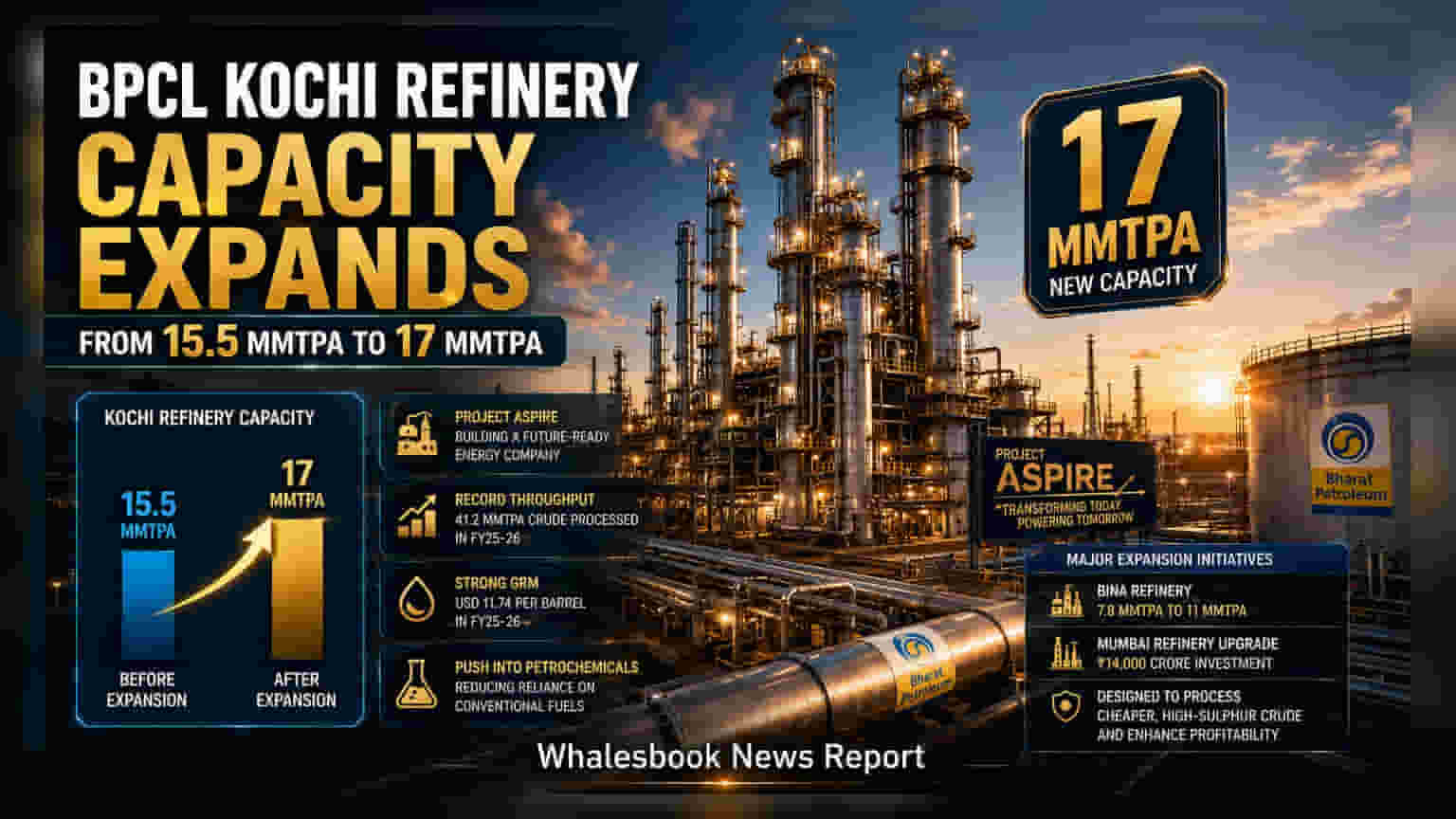
Bharat Petroleum Corporation Limited has announced plans to raise the capacity of its Kochi refinery to 17 million metric tonnes per annum. This expansion, part of the company's five-year Project Aspire, focuses on increasing high-value petrochemical production to diversify revenue sources.
Bharat Petroleum Corporation Limited (BPCL) has announced a significant capacity expansion for its Kochi refinery, raising its processing capability from 15.5 million metric tonnes per annum (MMTPA) to 17 MMTPA. The announcement, made by Chairman and Managing Director Sanjay Khanna during the company's 73rd Annual General Meeting, marks a key step in the state-run energy major's strategic roadmap known as Project Aspire.
This initiative is central to the company’s broader goal of moving beyond traditional fuel refining. By integrating this increased capacity with existing and upcoming projects—most notably in the production of polypropylene—BPCL aims to reduce its reliance on conventional fuels like petrol and diesel, which are subject to cyclical demand and regulatory pricing constraints. The push into petrochemicals is intended to capture higher-value market segments and improve long-term profitability.
BPCL enters this expansion phase following a period of strong operational performance. In the fiscal year 2025-26, the company’s refineries processed a record 41.2 million metric tonnes of crude oil, achieving a capacity utilization rate of 116.6 percent. During the same period, BPCL reported a Gross Refining Margin (GRM) of USD 11.74 per barrel, a metric that reflects the company's ability to extract value from crude oil despite fluctuations in global energy markets.
The Kochi refinery upgrade is part of a larger capital spending cycle across the company's portfolio. BPCL is concurrently working on scaling its Bina refinery from 7.8 MMTPA to 11 MMTPA and upgrading its Mumbai refinery with a Rs 14,000 crore project that includes a new Petro Resid Fluidized Catalytic Cracker. These investments are designed to enhance the company's ability to process cheaper, high-sulphur crude, thereby helping to protect profit margins.
While these expansion plans signal a long-term growth strategy, the sector faces inherent risks that investors typically monitor. Refining is a capital-intensive business, and the successful execution of these upgrades within projected timelines and budgets is essential to ensure a return on investment. Furthermore, the company remains sensitive to global crude oil price volatility, which can impact inventory valuations, and regulatory risks, such as potential government intervention in retail fuel pricing in India.
The progress of these refinery projects, along with the commissioning timelines and the ability to maintain strong utilization rates amidst changing energy demand, will be the key monitorables for stakeholders as the company executes its Project Aspire over the coming years.