

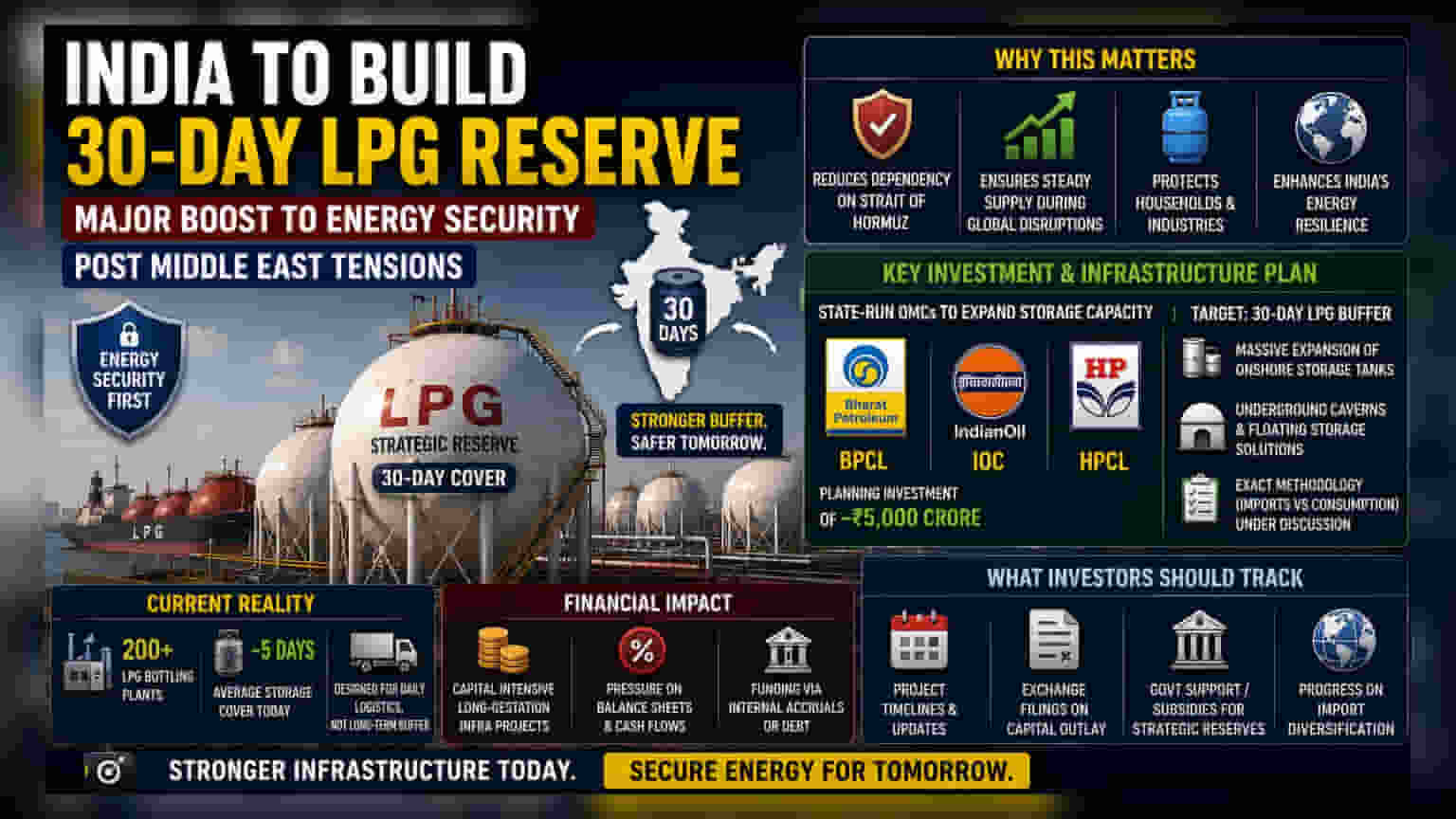
India plans to create a 30-day strategic LPG reserve to secure energy supplies amid global shipping risks. State-run oil marketing companies, including BPCL, IOC, and HPCL, are set to undertake significant capital expenditure to expand storage infrastructure. This move aims to insulate the country from supply chain disruptions, though investors will watch the impact on capital spending and cash flow.
What Happened
The Indian government is planning to build a 30-day strategic Liquefied Petroleum Gas (LPG) reserve to bolster national energy security. This move follows recent geopolitical tensions in the Middle East, which highlighted India's dependency on the Strait of Hormuz for a majority of its LPG imports. To achieve this, state-run Oil Marketing Companies (OMCs) like Bharat Petroleum Corporation Ltd (BPCL), Indian Oil Corporation (IOC), and Hindustan Petroleum Corporation Ltd (HPCL) are set to ramp up their infrastructure. Reports indicate that BPCL alone is planning an investment of approximately ₹5,000 crore to significantly increase its storage capacity.
Why This Matters For OMCs
For investors, this initiative signals a shift toward a more robust, but capital-intensive, infrastructure model for OMCs. Currently, India’s average LPG storage cover is relatively low, often averaging around five days at bottling plants. Moving to a 30-day buffer requires a massive expansion of onshore storage facilities and potentially the development of underground caverns or floating storage solutions. This will increase capital spending for these companies over the coming years. While this strengthens the long-term energy security of the country, it also puts pressure on the balance sheets of these state-run giants, which are already managing substantial operational costs and fluctuating global energy prices.
The Operational Reality
India currently manages a network of over 200 LPG bottling plants, but the storage capacity at these locations is primarily designed for daily logistics rather than long-term strategic buffering. The industry is still discussing the exact methodology to define this 30-day reserve, specifically whether it will be based on total imports or consumption. Depending on the final model, the infrastructure requirements could vary. OMCs are simultaneously looking to diversify their import sources—including long-term contracts with suppliers in the United States and increasing purchases from other regions—to reduce reliance on Middle Eastern supply chains, which could theoretically lower the total volume of storage needed.
Managing The Financial Impact
Investors may note that this is a long-gestation project. Unlike immediate revenue-generating assets, storage facilities are utility-like infrastructure. The funding for these projects will likely come from internal accruals or debt. Investors will need to assess how this increased capital spending impacts the cash flow available for other business needs, such as renewable energy pivots or dividend payments. The key for these companies will be balancing the mandate for energy security with the need to maintain healthy return ratios.
What Investors Should Track
Moving forward, the primary monitorables for shareholders will be the specific project timelines and the funding strategy adopted by the individual OMCs. Investors should watch for further exchange filings detailing the allocation of capital for these storage projects. Additionally, any updates on government support or subsidies for creating these strategic reserves could impact how much of the cost is borne by the companies themselves versus the exchequer. Market participants may also track the progress of import diversification efforts, as successfully sourcing energy from more stable regions could influence the final size and cost of the required infrastructure expansion.