

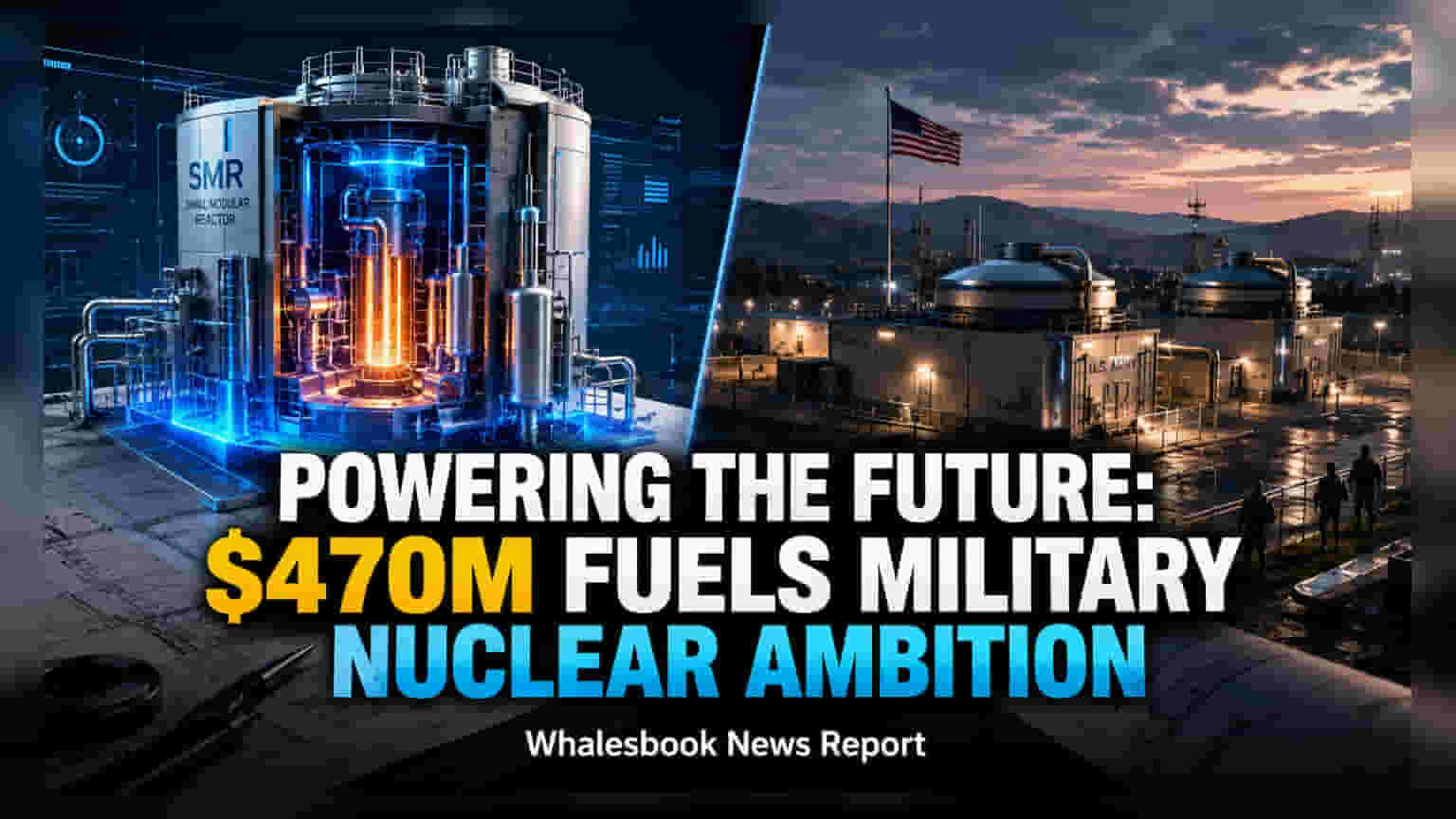
Nuclear technology firm Antares has secured $470 million in new funding to develop small modular reactors for U.S. military bases. The capital, consisting of $370 million in equity and $100 million in debt, aims to support the company’s push toward commercial deployment by 2028. This move highlights rising investor interest in advanced nuclear energy to power AI data centers and defense infrastructure.
Detailed Coverage
Antares, a developer of advanced nuclear technology, has successfully closed a $470 million Series C funding round. The investment includes $370 million in equity and $100 million in debt, led by Paradigm and Caffeinated Capital, with participation from Industrious Ventures, Point72 Ventures, and Shine Capital. The company plans to use these funds to advance its small modular reactor (SMR) technology specifically designed for U.S. military installations.
Technology and Deployment Roadmap
Antares is building small reactors capable of generating between 100 kilowatts and 1 megawatt of power. A key feature of its design is the use of TRISO fuel, which consists of uranium encased in ceramic and carbon shells. This design is intended to prevent meltdowns in high-temperature settings, with cooling managed by helium gas or molten salts. The company’s demonstration reactor, known as Mark-0, achieved criticality at the Idaho National Laboratory on June 4, marking a technical milestone. Antares is currently a finalist in the Pentagon’s Advanced Nuclear Power for Installations program, which seeks to test SMR technology at Air Force bases in Colorado and Montana. The company plans to have an electricity-producing unit running next year, with the first major military deployments targeted for 2028.
Investment Context and Sector Trends
This funding round brings the total capital raised by Antares to $604 million. The broader nuclear power sector has seen a surge in investment as companies race to address the massive electricity demand generated by artificial intelligence data centers and the push for cleaner, reliable energy sources. Other players in this space, such as X-energy, have also secured significant capital, including a $1 billion initial public offering earlier this year. The industry trend suggests that investors are increasingly betting on fission technology to provide high-density power that traditional renewables cannot always match.
Commercialization and Cost Hurdles
While investor sentiment is strong, the path to commercial viability remains difficult. New SMR technology faces significant challenges, including a lack of established supply chains in the United States and the complexities of scaling up mass manufacturing. Furthermore, cost remains a critical factor; Lazard has estimated that new SMR projects could cost roughly $214 per megawatt-hour, which is substantially higher than most gas-powered alternatives. Antares’s focus on securing contracts with the U.S. military is a strategic move to bypass these immediate commercial pricing pressures, as defense agencies often prioritize energy security and reliability over initial cost. The primary monitorable for investors going forward will be the company’s ability to transition from its successful demonstration phase to large-scale, cost-effective production in a sector that has yet to prove it can deliver energy at competitive prices.