

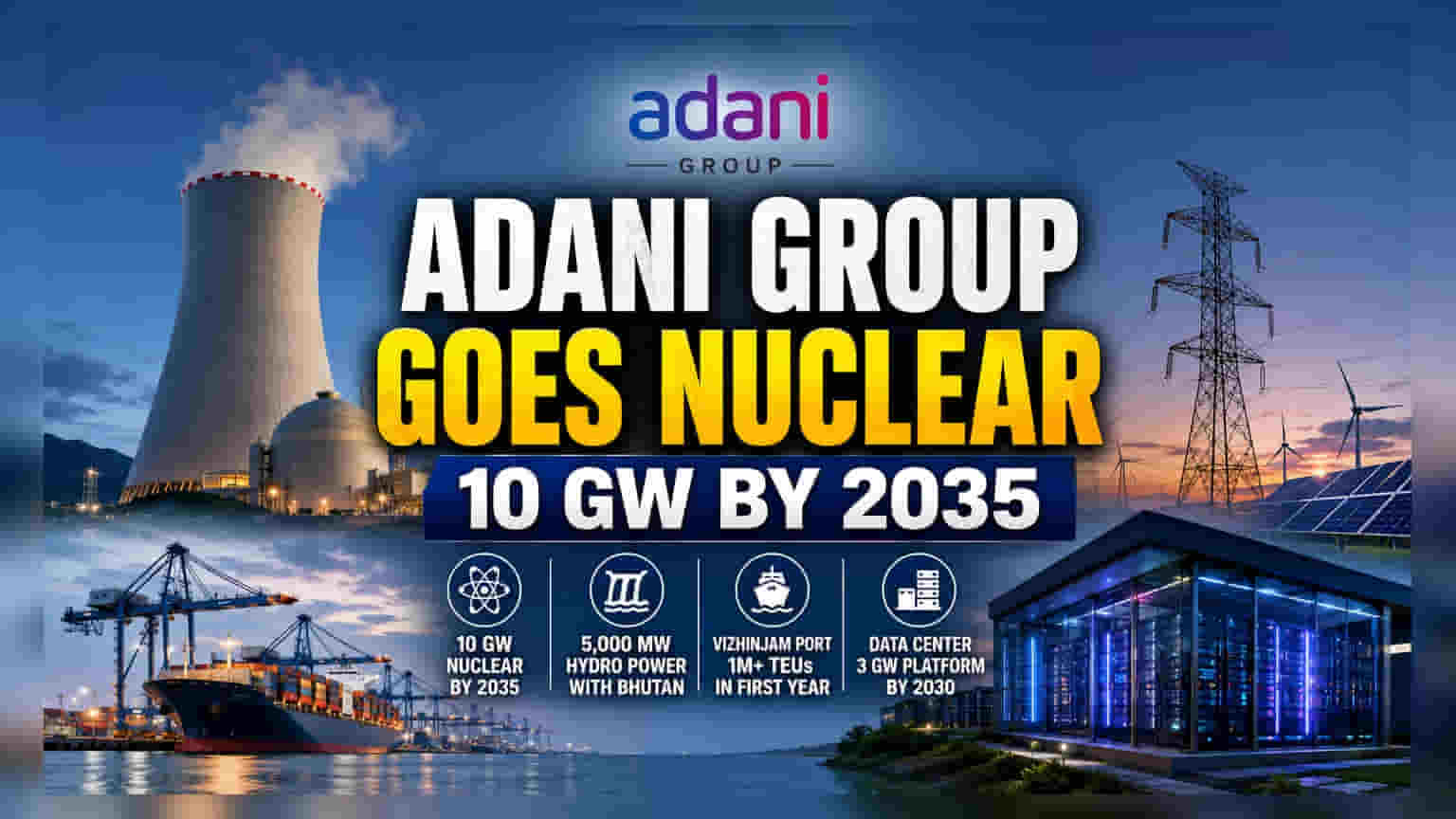
Adani Group has unveiled plans to establish 10 GW of nuclear power capacity by 2035, supported by the private-sector-friendly SHANTI Bill. While this signals a major shift in the energy portfolio, the long gestation periods and high capital requirements of nuclear projects remain critical factors for investors to monitor.
What Happened
The Adani Group has announced a strategic shift to include nuclear energy in its power generation portfolio, with an ambitious goal to develop 10 gigawatts (GW) of capacity by 2035. This announcement follows the enactment of the Sustainable Harnessing and Advancement of Nuclear Energy for Transforming India (SHANTI) Bill in December 2025. The new legislation is designed to open the nuclear energy sector to private participation, covering areas from fuel mining to power generation. The group stated that land has already been identified to support these projects as part of its strategy to meet the country's rising demand for reliable, carbon-free electricity.
The Capital And Execution Challenge
For investors, the move into nuclear energy brings a unique set of challenges compared to the group's established businesses in thermal or renewable energy. Nuclear projects are globally known for their very long construction timelines and high capital intensity. Unlike solar or wind projects, which can be commissioned in months or a few years, nuclear plants typically require a decade or more to become operational. The financial success of such a venture depends on efficient execution, cost management, and timely regulatory approvals. Given the group's ongoing aggressive capital spending program, which saw Rs 1.5 lakh crore deployed in fiscal year 2025-26, the market will likely focus on how the company balances this long-term investment with its overall debt levels and cash flow generation.
Strategic Expansion Across Infrastructure
The 10 GW nuclear goal is part of a broader, rapid infrastructure expansion. Adani Power is currently working toward a 45 GW generation capacity target within a five-year window. Furthermore, the group is diversifying its energy mix through a partnership with Bhutan's Druk Green Power Corporation for 5,000 megawatts of hydropower. These initiatives are being executed alongside significant growth in non-energy segments, such as the Vizhinjam port, which recently achieved a throughput of over 1 million TEUs in its first year, and the expansion of the data center business to a 3 GW platform by 2030, supported by partnerships with global technology firms like Google.
The Regulatory And Sector Context
Historically, the nuclear power sector in India has been dominated by the public sector, primarily the Nuclear Power Corporation of India (NPCIL). The SHANTI Bill changes the structural dynamics of the industry by allowing private companies to enter the value chain. While this creates a new growth area, it also introduces regulatory complexity. Investors should track how the government structures the operational guidelines, safety norms, and pricing policies for private players. The long-term profitability of such projects will be highly sensitive to these regulatory details and the initial capital cost per megawatt.
What Investors Should Track
Moving forward, the key monitorables include the timeline for land acquisition and regulatory clearances for the first set of nuclear projects. Investors may also look for details regarding the funding structure, such as whether these projects are funded through internal accruals or new debt, and how this impacts the consolidated balance sheet. Additionally, watching the pace of execution at the Vizhinjam port and the progress of the data center MoU will provide insight into the group's capability to deliver large-scale, capital-intensive projects simultaneously.