

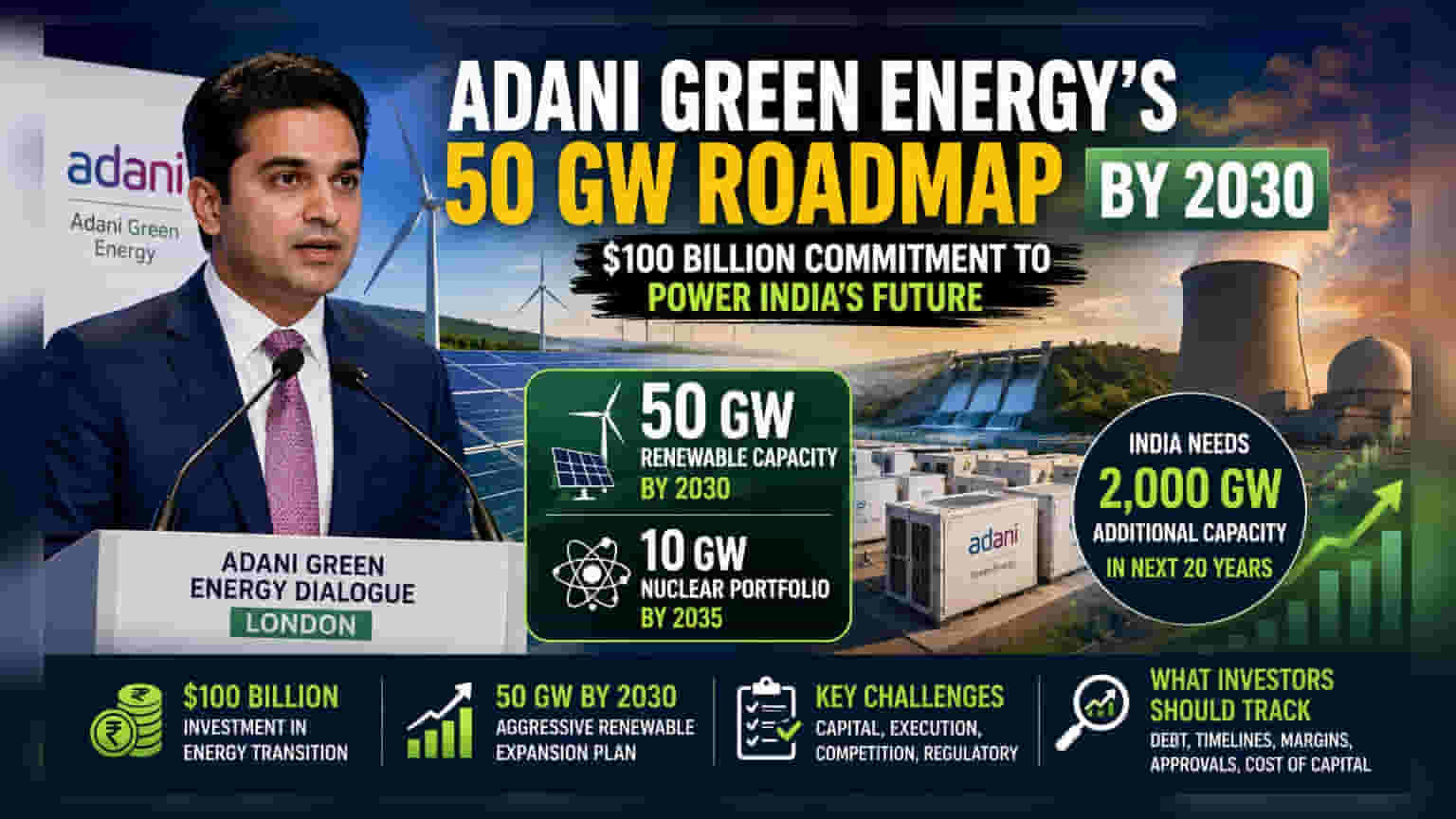
Adani Green Energy aims to reach 50 GW of renewable capacity by 2030 as part of the broader group's $100 billion energy transition plan. While this reflects an aggressive expansion strategy, investors are closely watching the balance between high capital spending, debt management, and the ability to execute large-scale infrastructure projects in a competitive energy market.
What Happened
Sagar Adani, Executive Director of Adani Green Energy, recently outlined the company's roadmap for a massive expansion in renewable energy at the Adani Green Energy Dialogue in London. The company is targeting an installed renewable capacity of 50 GW by 2030. This initiative is part of a larger $100 billion commitment by the Adani Group toward energy transition projects, which includes not just solar and wind energy, but also plans for a 10 GW nuclear portfolio by 2035.
The company emphasized that this shift is essential to meet India's projected electricity demand, which the company estimates will require an additional 2,000 GW of capacity over the next two decades. The strategy focuses on reducing dependence on imported fuels by diversifying the power mix to include hydro, thermal, and nuclear power alongside renewables.
The Capital Spending Challenge
For investors, the most significant factor in such an aggressive growth plan is the funding requirement. A $100 billion investment commitment is a major undertaking. Large-scale renewable projects require heavy upfront capital spending. While this strategy helps in scaling the business, it also implies a heavy reliance on borrowings or internal cash generation.
Investors typically watch how companies manage this debt. A high debt level can increase interest costs and put pressure on cash flows, especially if project commissioning is delayed or if the expected returns from the projects take longer to materialize than anticipated. Maintaining a healthy balance between expansion and debt control will be a key area for analysis.
Execution Risks And Competition
Building 50 GW of capacity is a complex task. It involves significant operational hurdles, including land acquisition, grid connectivity, and regulatory clearances. Delays in these areas are common in large infrastructure projects and can lead to cost overruns.
Furthermore, the renewable energy sector in India is becoming increasingly competitive. Peers like Tata Power and JSW Energy are also aggressively expanding their renewable footprints. This competition often leads to intense bidding for government tenders, which can squeeze profit margins if companies bid too aggressively to win projects. The ability to maintain profitability while scaling operations will be a critical test for the company.
Sector Dynamics
The broader energy sector is currently seeing a strong push for electrification, supported by government policies. However, the sector also faces risks related to the availability of raw materials, supply chain volatility, and changes in government regulations. Investors must track whether the company can sustain its margins amidst these sector-wide challenges and whether the power produced by these new projects finds long-term takers at profitable rates.
What Investors Should Track
Moving forward, shareholders may watch for updates on the commissioning timeline for the 50 GW capacity. Key indicators will include the debt-to-equity ratio, the status of major project approvals, and any shifts in the cost of capital. Additionally, management commentary on project bidding and the company's ability to maintain healthy profit margins in a competitive market will provide a clearer picture of the strategy's success.