 Whalesbook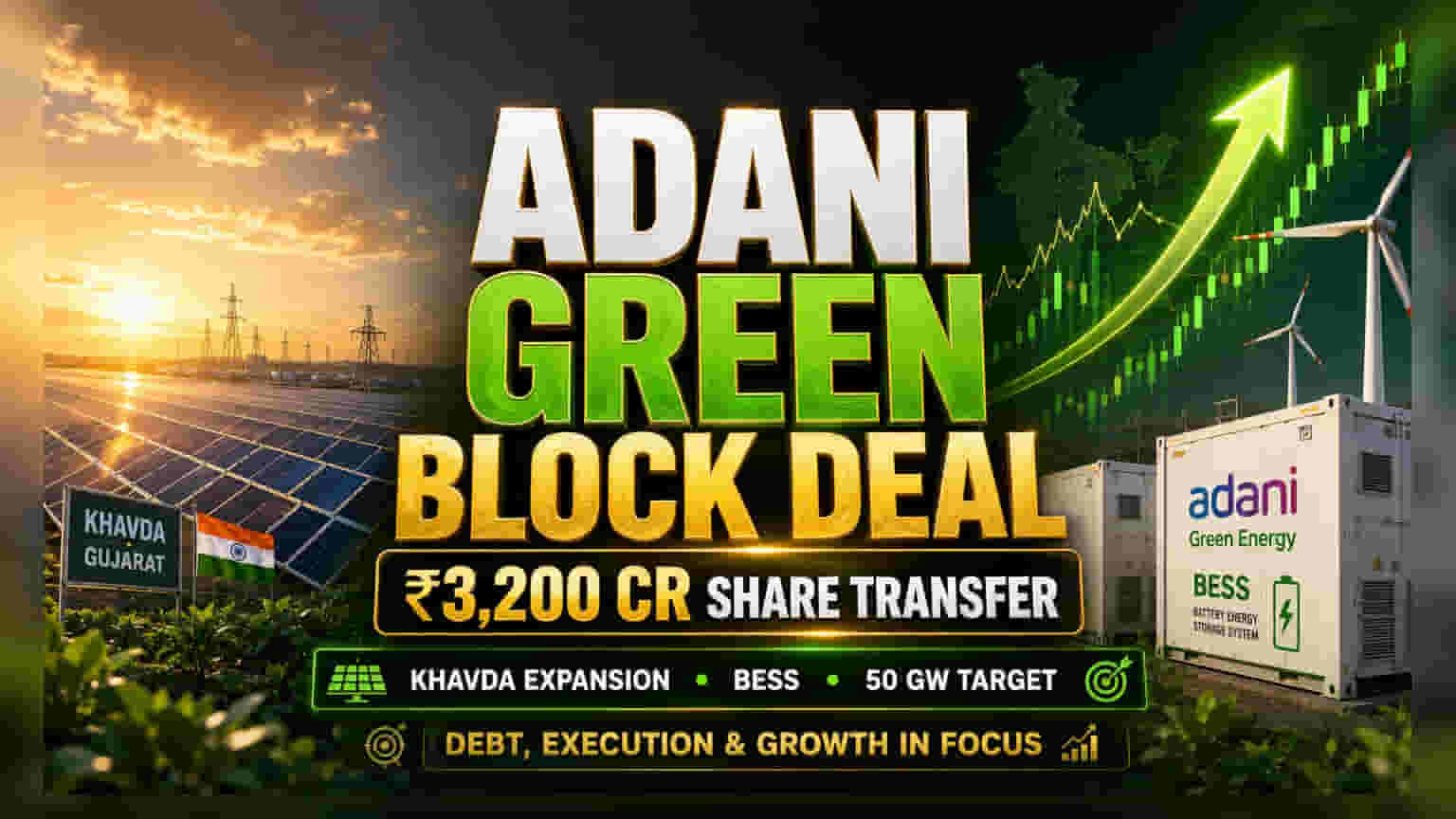


What Happened
Adani Green Energy Limited (AGEL) recently saw a block deal valued at approximately Rs 3,200 crore, involving the transfer of around 2.1 crore shares, or roughly 1.3% of the company's equity. This transaction took place amid a period of active market movement for the company, pushing the stock toward its 52-week high. The news follows the company's continued efforts to scale its renewable energy footprint, with a long-term goal of reaching 50 GW of installed capacity by 2030.
Scaling the Khavda Project
The core of the company's growth strategy remains the massive Khavda Renewable Energy Park in Gujarat. As of early June 2026, the company has reached an operational renewable energy capacity of approximately 19.8 GW, with the Khavda site serving as a primary driver. This site is significant not only for its scale but also for the integration of battery energy storage systems (BESS), which are designed to support round-the-clock power supply and improve grid reliability. The expansion of BESS capacity is seen as a way to potentially command better tariffs during peak demand periods, although this strategy requires high capital investment.
The Debt And Financial Context
While the operational expansion is rapid, investors should consider the company's financial profile. As of March 2026, Adani Green Energy carried a total debt of approximately Rs 101,153 crore. High capital spending, typical of large-scale infrastructure projects, naturally leads to significant borrowing. The company’s ability to manage this debt while continuing to execute its 50 GW target will be a critical factor for long-term sustainability. While the company reports steady operational growth, the high debt-to-equity ratio remains a point of focus for analysts and rating agencies.
Risk Factors And Market Outlook
Investors should be aware of the inherent risks in the renewable energy sector, particularly for large, debt-funded projects. Execution risk is a primary factor; delays in land acquisition, infrastructure development, or grid connectivity can impact returns. Furthermore, the stock's valuation has been a topic of discussion among market observers, with some analysts noting a premium valuation compared to broader market trends. Regulatory changes, interest rate fluctuations, and potential shifts in government policy regarding renewable energy procurement could also influence the company's profitability and cash flow.
How Investors May Read This
Market participants often view block deals as a mechanism for institutional investors to adjust their portfolios. While such transactions can lead to short-term volatility, the broader investor focus usually remains on the company's underlying fundamentals. The key monitorable for the business is whether the operational capacity at sites like Khavda can deliver the projected earnings growth needed to service the heavy debt load. Investors may track future earnings results, updates on debt reduction, and the actual commissioning timelines of new project phases to assess the company’s progress toward its long-term targets.