 Whalesbook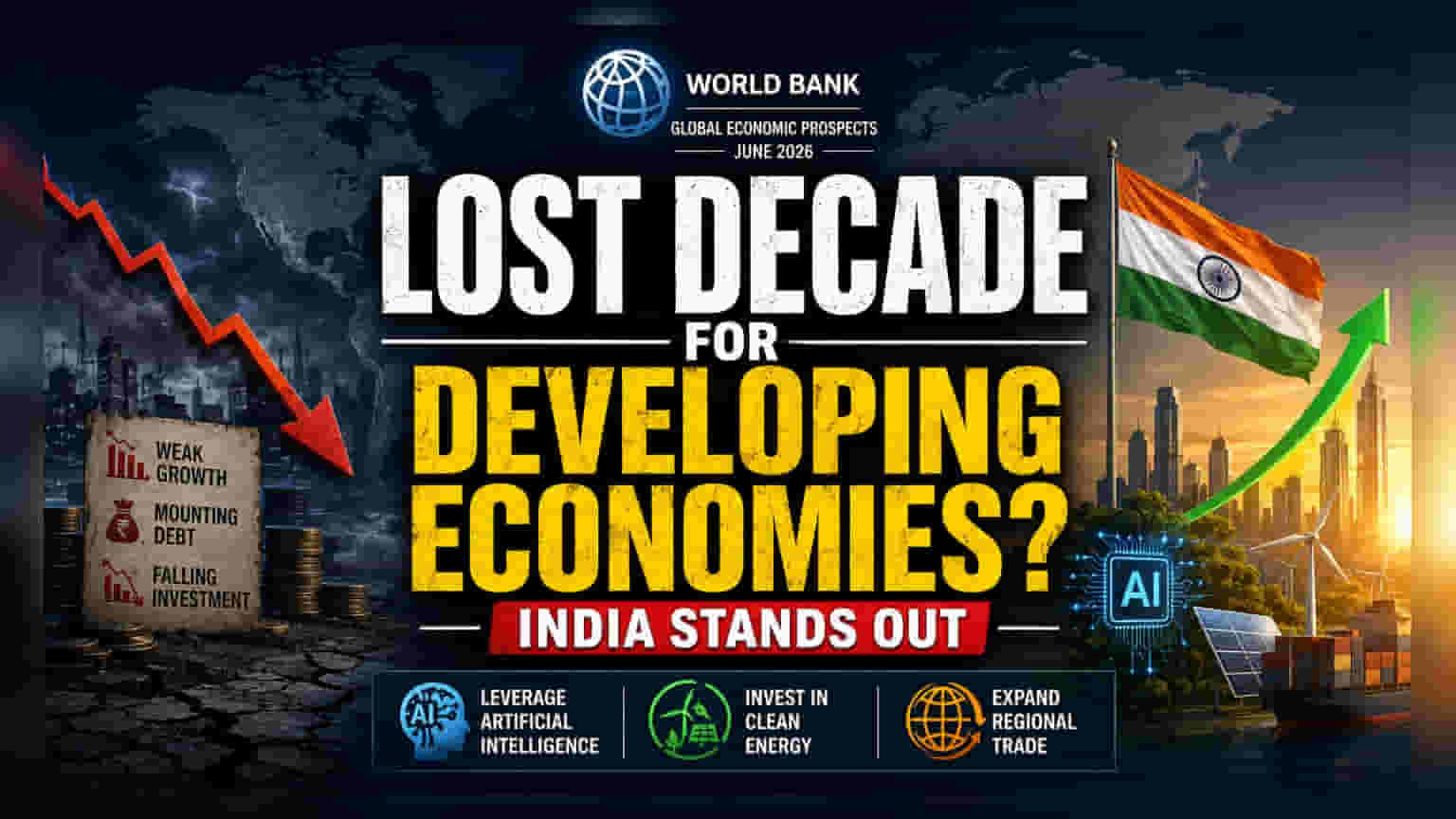


The World Bank warns the 2020s could be a 'lost decade' for many developing nations due to high debt and slow growth. However, the report highlights that India is an outlier, successfully maintaining income growth compared to advanced economies unlike many of its peers.
What Happened
The World Bank released its June 2026 'Global Economic Prospects' report, issuing a stark warning that the 2020s are at risk of becoming a 'lost decade' for a large number of developing economies. The report identifies a combination of persistent weak growth, mounting government debt, and a significant drop in investment as the primary factors stalling progress. For these nations, the gap in income levels between them and wealthier, advanced economies is not closing, a trend that has worsened since the start of the COVID-19 pandemic.
Why This Matters For Investors
For Indian investors, understanding global macro trends is essential as they influence everything from export demand to foreign investment inflows. The report provides a cautionary tale about the challenges facing many developing regions. When global growth slows and fiscal space shrinks, emerging markets often face currency volatility and reduced foreign capital participation. However, the report explicitly notes that India and China are exceptions to this stagnation trend. This distinction is vital, as it highlights India's relative resilience in a challenging global economic landscape.
India As An Outlier
The report offers a nuanced view by separating India and China from the broader group of developing economies. While many emerging markets are struggling to reach pre-pandemic income levels, India has maintained a different trajectory regarding income convergence with advanced economies. This separation suggests that despite global headwinds, India's domestic economic drivers have provided a buffer that many other developing nations currently lack.
Opportunities For Future Growth
The World Bank’s assessment is not entirely negative. It points to specific areas where countries can reverse the trend of stagnation. The report emphasizes that the path forward lies in leveraging artificial intelligence (AI), increasing investments in clean energy, and expanding regional trade. For investors, this serves as a roadmap of sectors that may receive policy support and private capital in the coming years. Companies that are positioned to benefit from these three themes—AI adoption, the green energy transition, and domestic or regional trade expansion—may see more sustainable long-term demand.
How Investors May Read This
Investors may look at this data as a backdrop for portfolio strategy. While the broader global environment looks difficult for many developing nations, the report validates the argument for focusing on markets with stronger domestic growth drivers. The challenge for many countries mentioned in the report is high debt and low investment. Investors often monitor these metrics closely when assessing sovereign risk and the potential for currency depreciation in developing markets.
What Investors Should Track
Moving forward, market participants may keep a close watch on how these global trends impact India's export-oriented sectors. If the rest of the world remains in a 'lost decade' of slow growth, demand for Indian goods and services could be affected. Additionally, investors may monitor the pace of infrastructure development, workforce skill enhancement, and business reforms, as these are identified by the World Bank as critical factors for sustaining India's growth relative to the global average. The focus will remain on whether domestic policy and private investment can continue to shield the economy from external global pressures.