

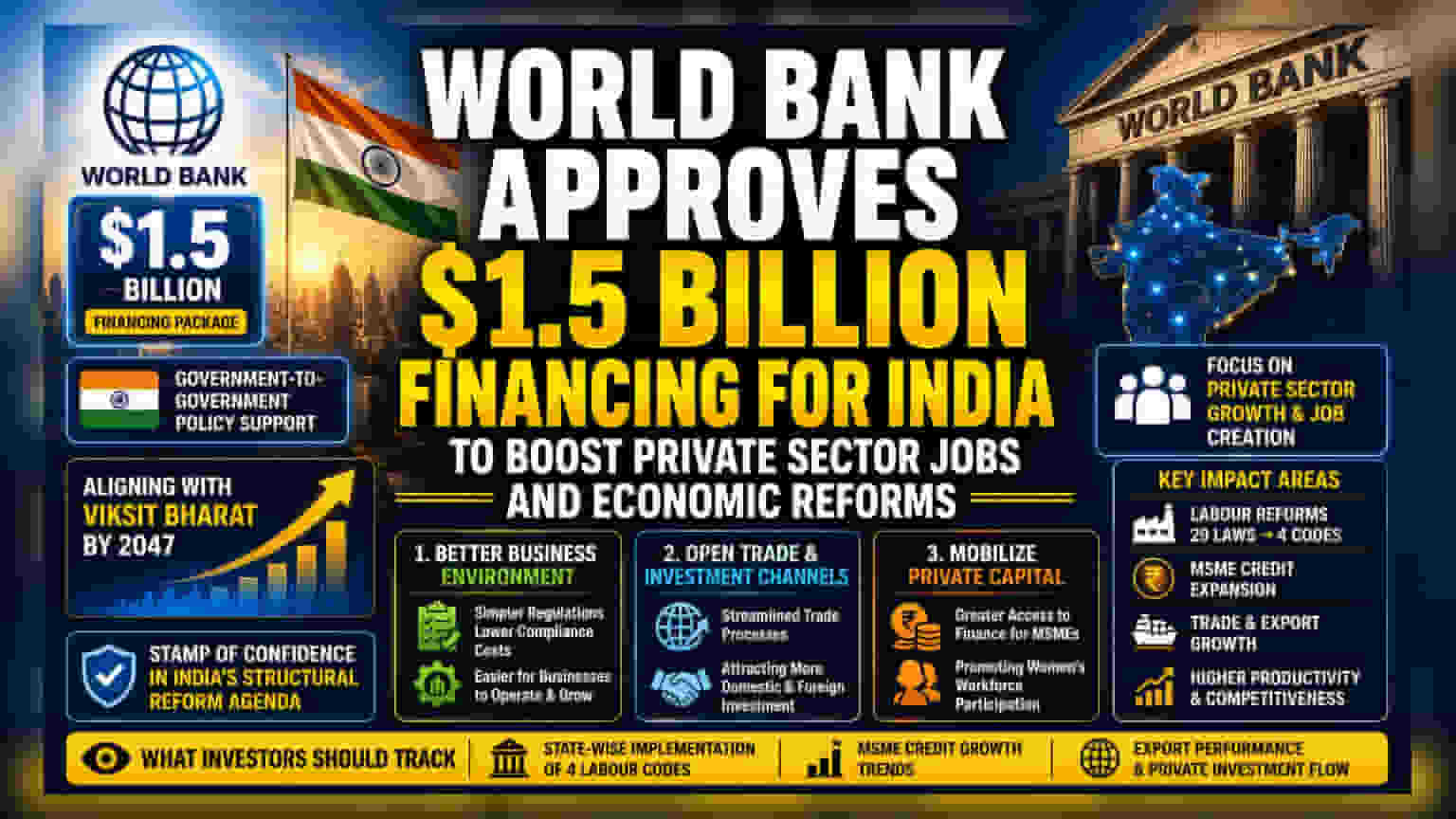
The World Bank has approved $1.5 billion in policy financing to support India's structural reforms, including labor code consolidation and trade improvements. This move is aimed at accelerating private sector job creation and enhancing the overall ease of doing business. For investors, this signals continued policy stability and potential for improved operational efficiency across several industry sectors.
What Happened
The World Bank has approved a $1.5 billion financing package for India, titled the 'Boosting Job Creation in the Private Sector Development Policy Financing (DPF)'. This funding is not for a specific company or project but is government-to-government policy support. It aims to accelerate structural reforms that encourage private sector participation in the economy. The program, which aligns with India's long-term 'Viksit Bharat by 2047' vision, focuses on three key pillars: creating a better business-enabling environment, opening up trade and investment channels, and mobilizing private capital.
Why It Matters For Businesses
For the Indian stock market and business ecosystem, this funding validates the government's ongoing effort to simplify regulations. A core part of the supported agenda is the consolidation of 29 existing labor laws into four simplified Labour Codes. While these were initially passed in November 2025, the World Bank’s involvement underscores the importance of their full implementation.
For businesses, particularly in manufacturing and services, these reforms are intended to reduce compliance costs, update outdated regulations, and create a more flexible environment for hiring. By streamlining trade and investment processes, the policy framework aims to make it easier for both domestic and foreign firms to operate, potentially improving the ease of doing business index for private players.
The Economic And Fiscal Impact
This financing from the World Bank acts as a stamp of confidence in India’s structural reform trajectory. The program emphasizes increasing female workforce participation and expanding credit access for Micro, Small, and Medium Enterprises (MSMEs), often through coordination with bodies like the International Finance Corporation (IFC). Increased credit flow to MSMEs can strengthen the broader supply chain, as these entities are critical suppliers to larger listed companies in sectors like automotive, textiles, and engineering.
Potential Risks And Realities
While this financing provides a framework for growth, investors should distinguish between policy intent and ground-level execution. The primary risk associated with such structural reforms is the timeline for full implementation. Labor and trade regulations often involve complex coordination between the central government and various states. Any delay in state-level adoption or challenges in the transition to the new labor codes could temporarily lead to operational friction for companies.
Additionally, while this funding supports the broader economy, it does not guarantee immediate corporate earnings growth. The actual benefit to company profit margins will depend on whether these reforms lead to sustained demand, higher productivity, and reduced operational costs in the long run, rather than just regulatory ease.
What Investors Should Track
Investors tracking the macroeconomic impact should monitor the official notification and implementation status of the four Labour Codes at the state level. Any updates on new rules, sector-specific exemptions, or timelines for state-wide enforcement will be key indicators of how quickly the intended business efficiency gains will materialize. Furthermore, market participants may watch for trends in MSME credit growth and export data, which would serve as real-time evidence of the program’s success in fostering private sector expansion.