 Whalesbook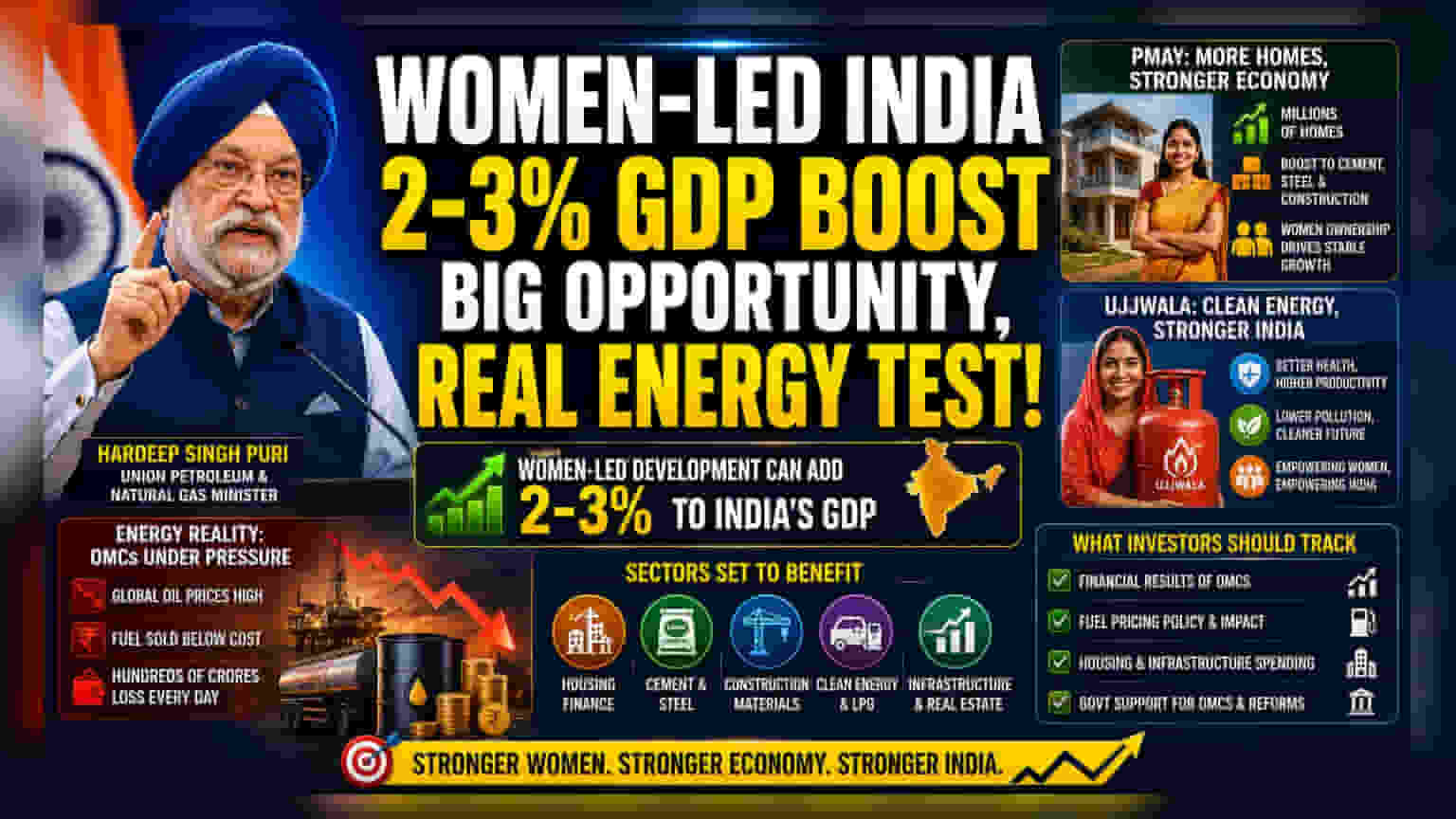


Union Minister Hardeep Singh Puri projects a 2-3% GDP boost from 'women-led' development policies. While the push for housing and clean energy aims to drive growth, investors are monitoring the financial health of state-run oil companies, which continue to absorb high costs to keep fuel prices stable.
What Happened
Union Petroleum and Natural Gas Minister Hardeep Singh Puri recently highlighted a strategic shift in India’s policy approach, moving from "women-centric" to "women-led" development. The Minister projected that this transition could provide a significant boost to India’s economic output, potentially adding 2-3% to the country’s GDP. The comments underscore the government's focus on initiatives like the Pradhan Mantri Awas Yojana (PMAY) and the Ujjwala scheme, which aim to increase asset ownership and clean energy access for women.
Why This Matters For Investors
The government's focus on women-led development is closely tied to several sectors that are significant for the Indian stock market. For instance, the expansion of the Pradhan Mantri Awas Yojana—with plans to add millions of new housing units—creates sustained demand for housing finance, cement, steel, and other construction-related materials. When women are listed as owners or co-owners, it can change consumption patterns, often leading to more stable, long-term household investment decisions.
Similarly, the Ujjwala scheme, while primarily a social welfare initiative, has significant implications for energy consumption patterns. By moving households toward clean energy, the program aims to improve household health and productivity, which economists argue contributes to broader economic resilience.
The Energy Sector Reality
While the Minister’s vision focuses on long-term growth, the energy sector is currently navigating complex financial pressures. Minister Puri, in his capacity as the Petroleum Minister, also addressed the topic of energy security. He noted that the government has consistently worked to insulate Indian households from the volatility of global oil prices.
However, this insulation comes at a fiscal cost. Public-sector Oil Marketing Companies (OMCs) like Indian Oil Corporation (IOC), Bharat Petroleum Corporation (BPCL), and Hindustan Petroleum Corporation (HPCL) have been under significant financial strain. Recent data suggests that these companies have been absorbing massive under-recoveries—often hundreds of crores of rupees per day—by selling fuel below cost to keep retail prices unchanged amid high global crude prices. For investors, this creates a situation where the government's commitment to price stability is a relief for the consumer and the broader economy, but it places intense pressure on the profit margins and balance sheets of these oil retailers.
What Could Go Wrong
The primary risk for investors in this space remains the sustainability of these subsidies. The financial health of OMCs is highly sensitive to global crude oil prices. If international prices remain elevated for an extended period, the mounting daily losses could necessitate further government intervention or a difficult decision to raise retail fuel prices. Any such move could impact inflation and consumer spending, which are key variables for the entire stock market.
What Investors Should Track Next
Investors may want to watch for updates on how the government balances these social and energy goals with the fiscal health of state-owned companies. Key monitorables include:
- The financial results of OMCs to see how they are managing the under-recovery burden.
- Future policy announcements regarding fuel pricing, which will directly impact the energy sector's profitability.
- Updates on infrastructure and housing spending, which signal demand for the broader construction and real estate sectors.
- Any government measures aimed at easing the financial pressure on oil marketing companies, such as excise duty adjustments or direct financial support.