 Whalesbook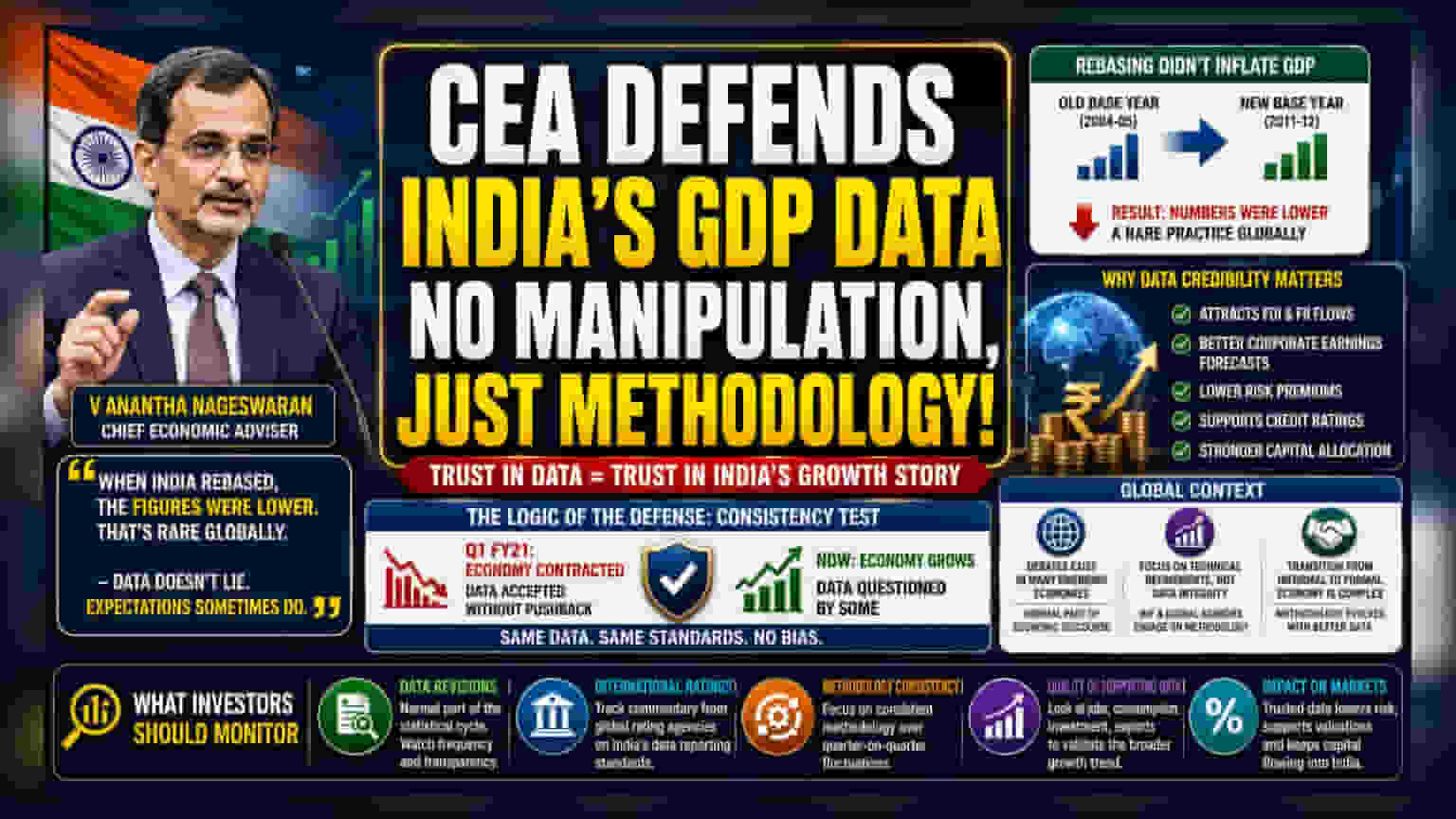


Chief Economic Adviser V Anantha Nageswaran has defended India's GDP calculation methods, rejecting claims that growth figures are artificially inflated. For stock market investors, reliable economic data is a crucial factor for building foreign investor confidence and assessing the country's risk premium.
What Happened
Chief Economic Adviser V Anantha Nageswaran has firmly responded to ongoing debates regarding the credibility of India’s economic growth figures. In a recent statement, the CEA rejected allegations that the government manipulates statistical methodology or base years to inflate Gross Domestic Product (GDP) numbers. He highlighted that when India previously underwent a rebasing exercise, the resulting figures were actually lower, a move he described as rare in international statistical practices. He argued that India follows globally recognized frameworks and that criticisms often arise simply when data fails to meet the expectations of external observers rather than from genuine flaws in the methodology.
Why This Matters For Investors
For stock market investors, the integrity of national economic data is more than just a theoretical debate. It serves as a foundation for how foreign and domestic capital is allocated. When economic statistics are transparent and trusted, they lower the perceived risk for foreign institutional investors (FIIs) and global rating agencies. Reliable data allows for better forecasting of corporate earnings, interest rate trajectories, and overall market risk. If international investors perceive that economic data is manipulated, it can create a 'trust deficit' that may lead to higher risk premiums, potentially causing capital outflows or higher borrowing costs for the country, which ultimately filters down to the corporate sector.
The Logic of the Defense
To support the argument for data reliability, the CEA pointed to the consistency of India’s statistical reporting during difficult times. He noted that when the Indian economy contracted significantly during the first quarter of the 2020-21 fiscal year due to the pandemic, the data was largely accepted by international bodies without significant pushback. The core of his argument is a consistency test: if the market is willing to accept data when it reflects a poor economic reality, it should logically apply the same standard of trust when data reflects growth. He suggested that skepticism often stems from a bias where critics only doubt the numbers when they contradict a negative narrative.
The Global Context
Methodological debates are not unique to India; they are a standard part of economic discourse in many emerging markets. Investors often look at how countries transition from informal to formal economies, as this shift can make GDP measurement complex. Historically, criticism of Indian GDP data has centered on the measurement of the informal sector and the use of different deflators to calculate real growth versus nominal growth. While international agencies like the IMF have engaged in discussions with Indian authorities, these dialogues are usually focused on technical refinements rather than questioning the fundamental honesty of the data. Investors typically view these technical adjustments as a natural evolution of a developing economy’s reporting standards.
What Investors Should Monitor
Moving forward, market participants should continue to look beyond the headline GDP numbers. Investors may track the release of data revisions, which are a normal part of the statistical cycle as more comprehensive information becomes available. A key indicator for market stability is the frequency and transparency of these revisions. Additionally, keeping an eye on commentary from major international credit rating agencies regarding India’s data reporting standards is useful, as these institutions have a direct impact on the country's sovereign credit rating, which in turn influences the cost of capital for Indian companies. Focusing on the consistency of the methodology, rather than individual quarter-on-quarter changes, often provides a clearer picture of the actual economic trend.