 Whalesbook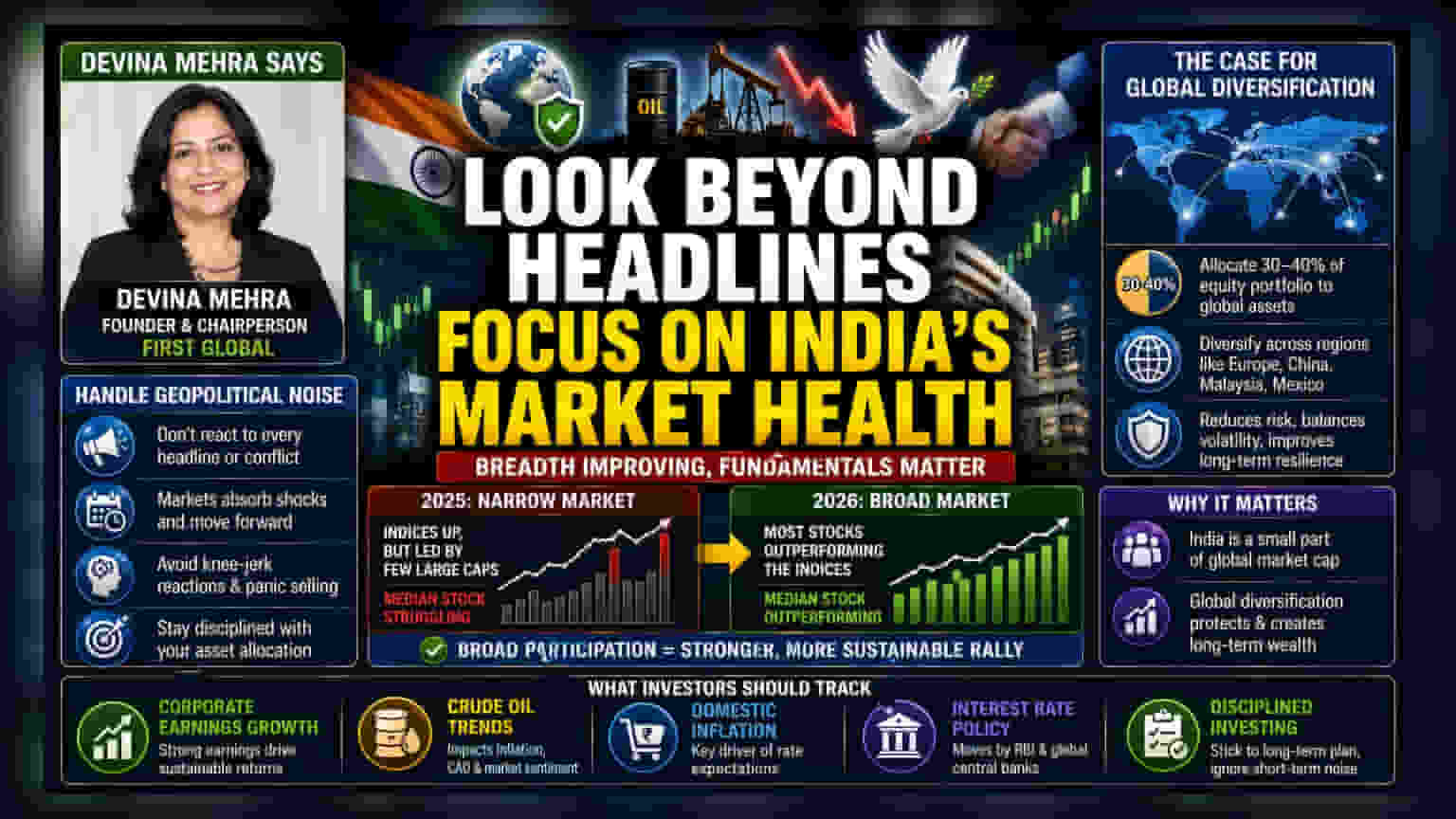


Market expert Devina Mehra suggests that investors should look beyond geopolitical headlines, like US-Iran tensions, and focus on the improvement in market breadth. With more stocks now participating in the rally compared to last year, the market structure is showing healthier signs of broad-based participation.
What Happened
Recent commentary from Devina Mehra, Founder and Chairperson of First Global, shifts the investor focus away from geopolitical headlines and toward the actual health of the Indian equity markets. While global events like a potential US-Iran peace deal are often tracked closely for their impact on oil prices and market sentiment, Mehra suggests these headlines should not be the primary driver of investment decisions.
Instead, the focus should be on the structural shift in how Indian markets are performing. The market is currently seeing broader participation, which is a significant change from the patterns observed throughout the previous year.
The Shift In Market Breadth
One of the most important takeaways for investors is the change in market dynamics. Throughout 2025, Indian indices often showed positive returns, but these gains were frequently led by a handful of large-cap stocks. This meant that while the main numbers went up, the median stock—a better representation of the average portfolio—was actually struggling or declining.
In contrast, the market in 2026 has displayed a reversal of this trend. A majority of stocks are now outperforming the broader indices, which suggests that the current rally is more robust and inclusive. For investors, this shift indicates that the growth is not limited to a few sectors or heavyweights, making the overall market foundation appear more sustainable.
Handling Geopolitical Noise
Geopolitical tension, particularly involving oil-producing regions, often creates anxiety for Indian investors because India is a major importer of crude oil. Price spikes in oil can increase the import bill, widen the current account deficit, and stoke inflation.
However, historical data spanning over a century shows that markets often digest and move past geopolitical conflicts over time. The strategy suggested is to avoid "knee-jerk" reactions—or panic selling—when news of a conflict breaks. Maintaining a disciplined approach to asset allocation, rather than trying to time the market based on breaking news, is often a more effective long-term strategy for wealth creation.
The Case For Global Diversification
Another key point is the importance of global diversification. Focusing solely on domestic equities or a few popular international technology stocks may not provide enough protection during local market downturns.
Because India represents a small fraction of the total global market capitalization, concentrating all investments in one region can increase risk. Diversifying into other regions—such as Europe, China, Malaysia, or Mexico—can help balance portfolio volatility. Strategists often suggest that a significant portion of an equity portfolio, such as 30% to 40%, could be allocated to global assets to create a more resilient long-term investment structure.
What Investors Should Track
Investors looking for the next moves in the market may find it more useful to monitor fundamental indicators rather than reacting to headlines. Key monitorables include corporate earnings growth, trends in crude oil prices, domestic inflation, and interest rate policies set by central banks.
Remaining invested according to one’s long-term asset allocation plan, despite the noise in the news, is often emphasized as the primary tool for managing market volatility. The current improvement in market breadth serves as a reminder to look at the underlying health of companies rather than just the daily movement of the main indices.