

Despite aggressive AI hiring, many Indian companies are missing out on real productivity gains due to poor structural integration. Investors should look past headcount growth and focus on how firms are redesigning workflows to boost profitability.
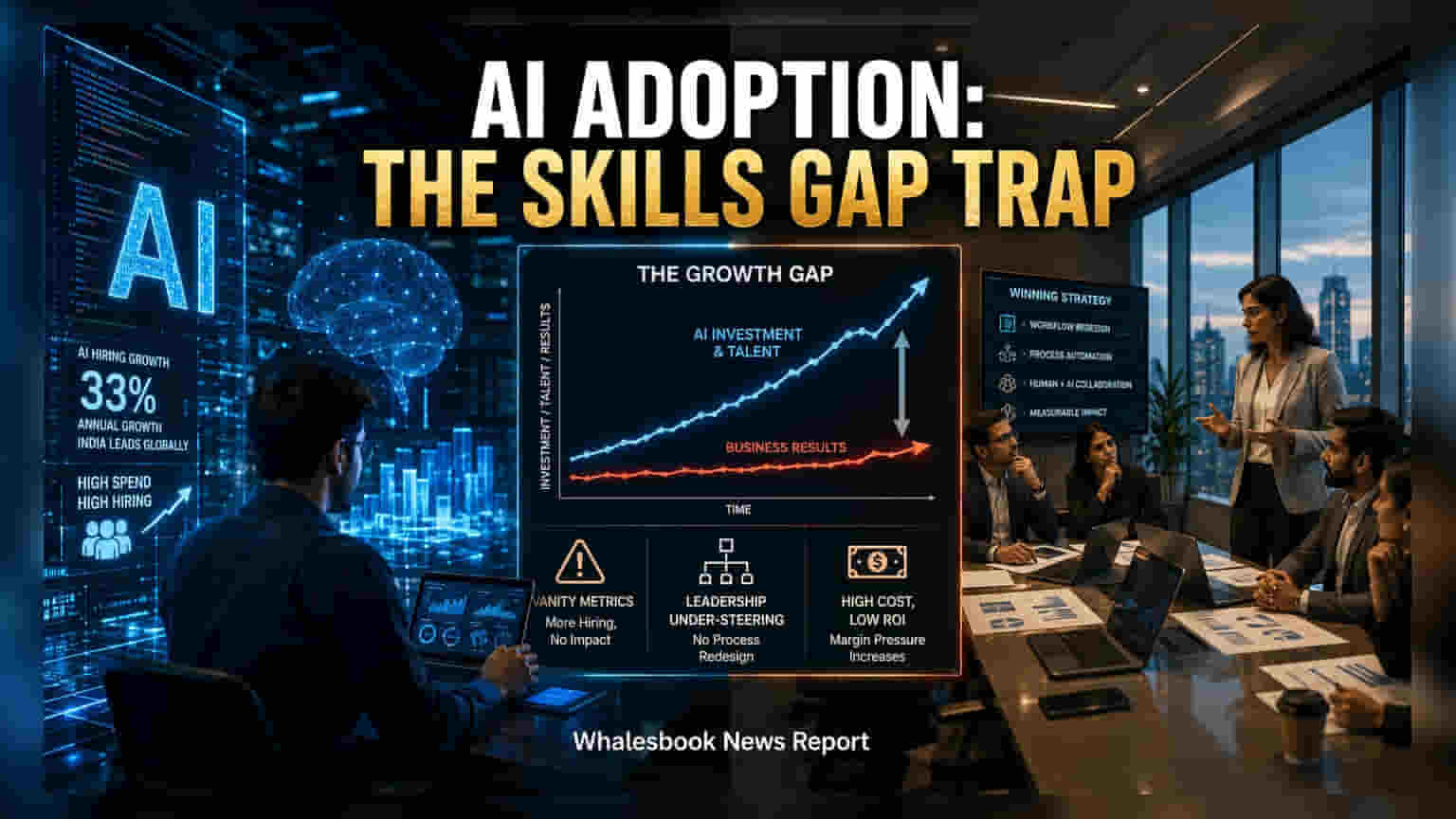
Indian companies are racing to hire artificial intelligence talent, yet a critical gap between initial spending and actual business results is emerging. While the country leads global AI hiring with a 33% annual growth rate, many organizations are struggling to convert this influx of talent into improved bottom-line performance. The core problem is not a lack of technology or staff, but a failure of leadership to redesign the underlying business processes that AI is meant to support.
Most corporate strategies treat AI adoption as a technical upgrade—a simple rollout of new software or the hiring of specialists. This approach often leads to what experts describe as 'vanity metrics,' where companies boost their hiring numbers to signal innovation but fail to provide the internal infrastructure needed to make that talent effective. The 2025 McKinsey 'Superagency in the Workplace' study points to a fundamental bottleneck: leadership under-steering. Executives often expect employees to adapt to AI tools without providing a clear, structural transformation of how daily work is done.
For investors, this trend offers a cautionary lesson on capital allocation. Simply tracking how much a company spends on AI recruitment or how many AI experts it employs can be misleading. A company that hires heavily but keeps its old, inefficient workflows will likely face a squeeze on its profit margins due to high labor costs without the corresponding efficiency gains. True AI-driven productivity requires a shift to task-level analysis, where organizations identify exactly which functions should be automated and which require human oversight.
Looking ahead, the market will likely reward firms that move beyond one-off training sessions toward deep operational changes. Companies that successfully bridge the gap between human potential and machine capability will be better positioned to protect their margins against rising operational costs. Investors should monitor earnings calls for signs of this shift. Specifically, management commentary that focuses on 'workflow redesign' or 'process automation'—rather than just headcount growth—may indicate a more mature and sustainable approach to AI deployment.
Failure to address these structural issues risks creating a digital divide within companies, where expensive AI tools are underutilized and the workforce remains misaligned. For the broader sector, particularly in IT services and manufacturing, the next stage of competition will not be about who hires the most AI engineers, but about who can prove the highest return on investment through smarter, human-integrated processes.