 Whalesbook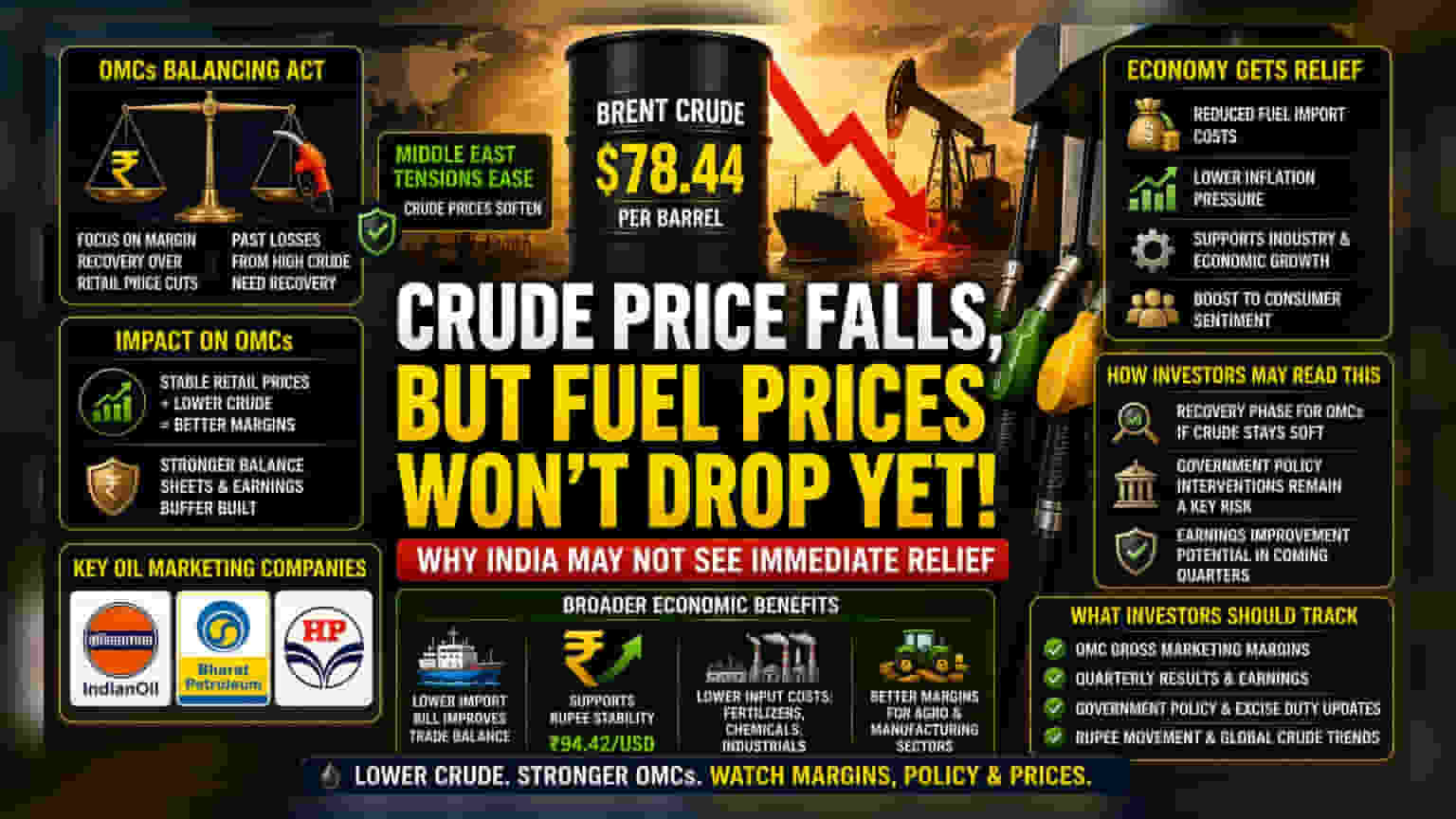


Global crude oil prices have eased to USD 78.44, yet Indian fuel prices may not drop immediately. This article explains why Oil Marketing Companies (OMCs) might prioritize recovering financial margins over passing on the benefit to consumers, what this means for the broader economy, and why investors should track company earnings for margin expansion.
What Happened
Global crude oil prices, represented by the Brent Crude benchmark, have softened to USD 78.44 per barrel following the de-escalation of tensions in the Middle East. Despite this reduction in global costs, Indian consumers may not see an immediate decrease in petrol and diesel prices at the pump. Reports from the National Institute of Public Finance and Policy (NIPFP) highlight that the domestic fuel price structure remains complex, with Oil Marketing Companies (OMCs) currently balancing the need for financial recovery against potential retail price cuts.
Why This Matters For Investors
For investors, the critical factor is the 'marketing margin' of OMCs. These companies—which include major players like Indian Oil Corporation, Bharat Petroleum, and Hindustan Petroleum—often maintain retail fuel prices even when global crude costs fluctuate. When crude prices were higher, these companies often absorbed the costs to prevent inflationary pressure on the economy, which squeezed their profitability.
Now, with crude prices easing, these companies have the opportunity to recover those lost margins. Instead of immediately reducing retail prices for consumers, OMCs may choose to hold prices steady. This allows them to improve their profit margins and strengthen their balance sheets. Investors who follow these stocks typically monitor whether the companies are using this period to build up their earnings buffers or if they are facing pressure from the government to lower prices.
Broader Economic Impact
The easing of crude prices is a significant development for the Indian economy. Since India imports over 80% of its crude oil requirements, a lower import bill directly benefits the country's trade balance. This development can also help stabilize or strengthen the Indian Rupee, which was trading at 94.42 against the dollar in recent updates. Beyond fuel, lower crude prices can lead to cheaper costs for critical industrial and agricultural inputs, such as fertilizers and certain chemicals. This reduction in input costs can be beneficial for the margins of companies in the agriculture and manufacturing sectors, potentially supporting long-term economic growth.
How Investors May Read This
Investors looking at the energy sector may view the current situation as a recovery phase for OMCs. If crude prices remain soft and retail prices stay stable, the expectation would be for improved earnings in the upcoming quarters for these companies. However, this is not a guarantee. The government often plays a role in deciding fuel pricing, and there is always a possibility of policy interventions that could limit these gains if the government decides to prioritize consumer relief over company profits.
What Investors Should Track
Moving forward, the primary monitorable for investors is the commentary from OMCs regarding their gross marketing margins. Quarterly financial results will be the key document to watch, as they will reveal whether the companies are successfully capturing the benefits of lower crude prices to boost their profitability. Additionally, any signals from the government regarding changes to excise duties or retail pricing policies will be crucial, as these can alter the financial outlook for the entire oil marketing sector. Investors should also watch the movement of the Indian Rupee and global crude benchmarks, as these remain the fundamental drivers of the import bill and domestic fuel pricing dynamics.