

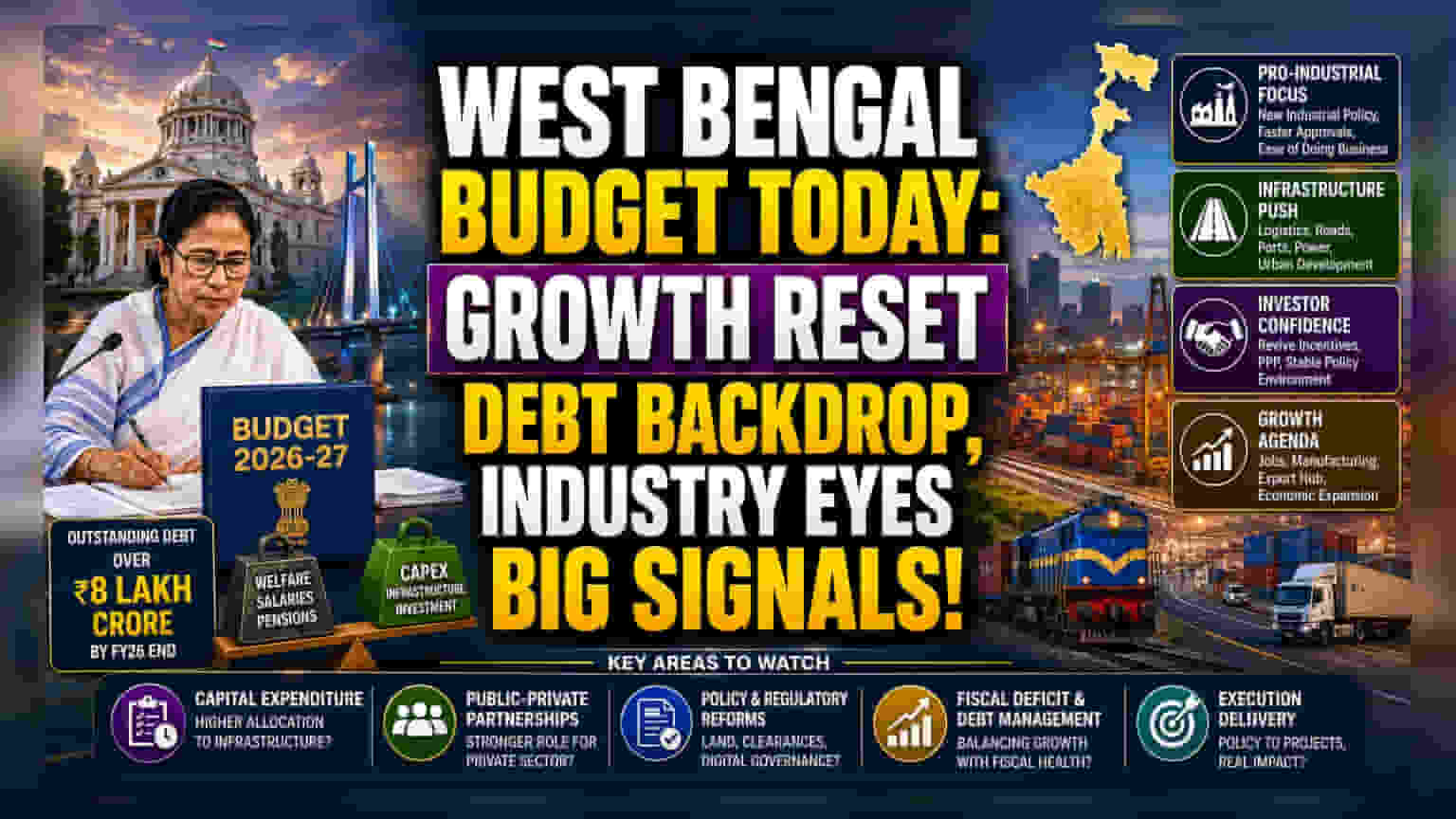
West Bengal’s new government presents its first budget today, aiming to reset the state's economic trajectory. With state debt estimated at over ₹8 lakh crore, the budget faces a difficult balancing act between maintaining welfare schemes and funding industrial development. Industry leaders are closely watching for a roadmap that prioritizes infrastructure, ease of doing business, and a clear industrial policy.
What Happened
West Bengal’s newly elected government is set to present its first full-year budget today. This comes after an interim budget was presented earlier this year, making this the first major fiscal plan under the current administration. The event is a significant marker for the state’s economy, as industry leaders and economic observers await clear signals on how the government intends to shift from the previous focus on welfare-heavy spending toward a more growth-oriented industrial strategy. The budget is expected to outline the administration's vision for infrastructure and private investment, which are considered crucial for the state’s economic recovery.
The Fiscal Balancing Act
For investors and analysts, the central focus of this budget is the state's fiscal health. West Bengal faces a challenging debt situation, with outstanding debt projected to reach over ₹8 lakh crore by the end of the fiscal year. High spending on salaries, pensions, and welfare transfers has limited the capital available for development projects in recent years. Analysts are watching to see how the government balances these rigid expenditure commitments against the need for capital investment—often called 'capex'—in areas like logistics, urban infrastructure, and power. Managing the fiscal deficit while maintaining creditworthiness and attracting new projects is a high-stakes task for the state finance department.
Industry’s Growth Expectations
Leading industry bodies, including the Confederation of Indian Industry (CII) and ASSOCHAM, have used the pre-budget period to advocate for a pro-industrial framework. The key demands center on creating a predictable environment for businesses. Specifically, they are calling for a modern industrial policy to replace older or withdrawn frameworks, faster and digitized regulatory approvals to improve the 'ease of doing business,' and the development of specialized industrial parks. There is also a push to reinstate incentives that were previously rolled back to restore investor confidence. Industry representatives argue that while welfare is necessary, shifting focus toward developmental economics is essential to boost per-capita income and create sustainable jobs.
The Need for Industrial Clarity
West Bengal’s economy, while being the sixth-largest in India, has seen a structural slowdown in industrial growth compared to other major states. The service sector currently dominates the state's output, but the workforce remains heavily dependent on agriculture. To drive meaningful economic expansion, stakeholders are looking for specific policy measures that leverage the state’s strategic location—as a gateway to the Northeast and neighboring countries—to turn it into a logistics and manufacturing hub. Clear, time-bound execution of these plans, rather than just policy announcements, is what the business community is seeking.
What Investors Should Track
Investors and observers should monitor the government’s targets for capital expenditure in the new budget. Higher allocation toward infrastructure, such as road, port, and industrial estate projects, would be a positive indicator of an economic shift. Additionally, the government’s stance on public-private partnerships (PPP) and its commitment to resolving long-standing land and regulatory bottlenecks will provide insight into the state's medium-term growth potential. The final budget figures will reveal whether the state can successfully reconcile its significant debt burden with the aggressive investment push required to catch up with other industrializing states.