

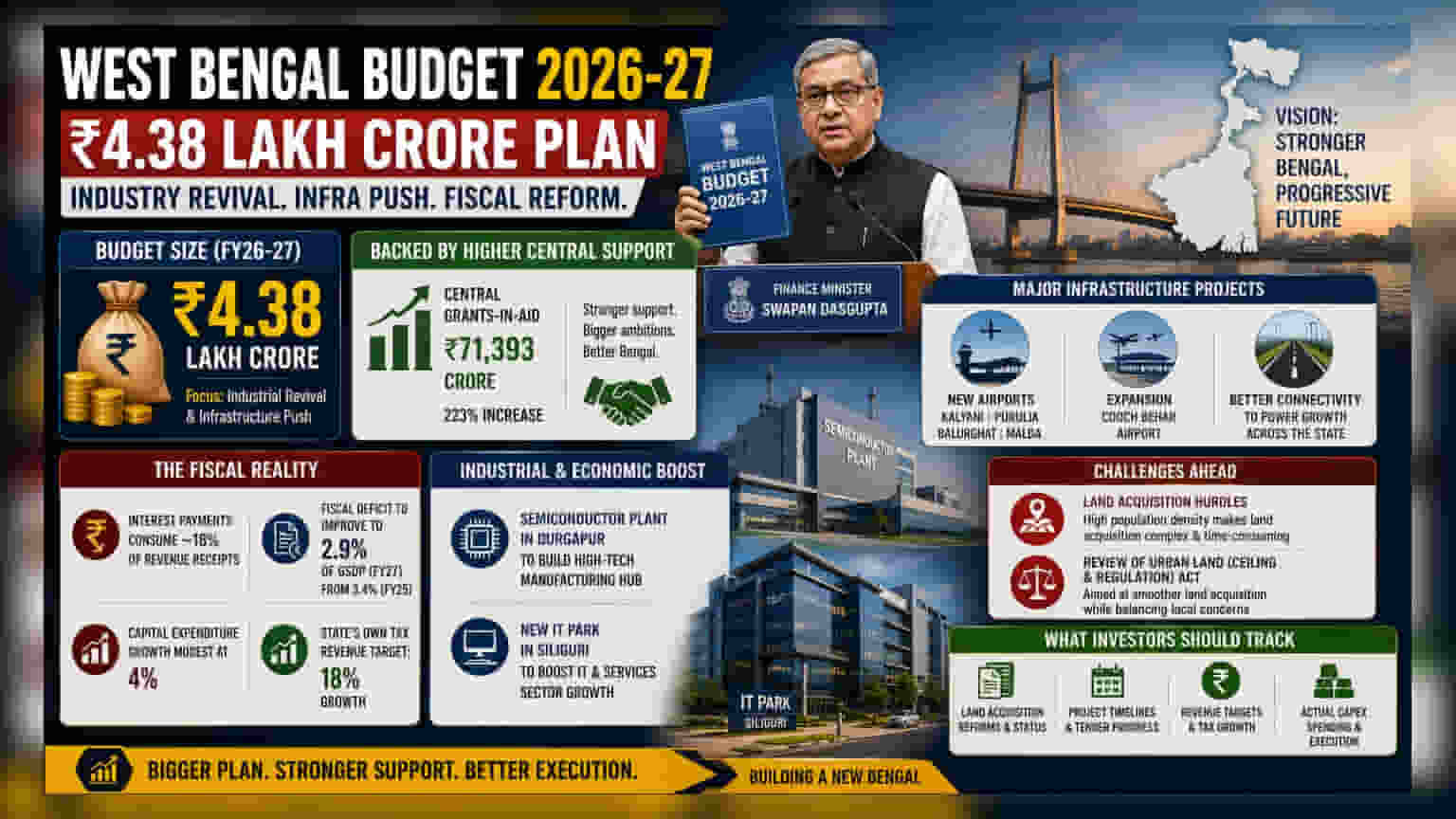
West Bengal has announced a ₹4.38 lakh crore budget for FY27, targeting industrial growth through new airports, IT parks, and a semiconductor plant in Durgapur. Backed by higher central grants, the plan aims to reverse economic stagnation. However, high interest payments continue to pressure capital expenditure, which is set to grow by just 4%.
What Happened
West Bengal's Finance Minister Swapan Dasgupta has unveiled a budget of ₹4.38 lakh crore for the 2026-27 fiscal year. The primary focus of this budget is to revive the state's industrial sector and accelerate infrastructure development after a long period of economic stagnation. The state plans to use a significant increase in central government grants to fund these ambitions.
Infrastructure and Industrial Plans
The government has proposed several major projects to attract private investment and improve connectivity. Key infrastructure plans include the construction of new airports in Kalyani, Purulia, Balurghat, and Malda, along with an expansion of the existing facility in Cooch Behar. On the industrial front, the state is targeting high-tech manufacturing with a planned semiconductor plant in Durgapur and a new IT park in Siliguri. These projects are intended to boost the state's industrial footprint and attract new companies.
The Fiscal Reality Check
While the budget size is large, financial constraints remain a significant factor for investors to consider. A substantial portion of the state’s revenue is committed to debt servicing. Interest payments alone currently consume about 18% of total revenue receipts. Due to this debt burden, the state’s spending on new infrastructure—often referred to as capital expenditure—is growing by a modest 4%.
To manage its finances, the state is relying on a 223% increase in central grants-in-aid, which now total ₹71,393 crore. The government is aiming to improve its fiscal health, projecting a reduction in the fiscal deficit to 2.9% of the Gross State Domestic Product (GSDP) for FY27, compared to 3.4% in FY25.
Risks and Structural Challenges
One of the most persistent hurdles for development projects in West Bengal has been land acquisition. Given the state's high population density, securing land for large-scale infrastructure remains a complex and time-consuming process. The government has indicated it will re-examine the Urban Land (Ceiling and Regulation) Act, likely to make land acquisition smoother for industrial projects. However, the success of this move will depend on implementation and balancing the needs of industrial growth with local concerns.
What Investors Should Track
The ultimate success of these plans depends on effective execution. Investors should monitor a few key areas moving forward:
- Land Acquisition Status: Watch for updates on the revision of land laws and the actual speed of land clearance for the announced airports and industrial parks.
- Project Timelines: Track the actual tender process and the commencement dates for the semiconductor and IT projects, as delays are common in state-level infrastructure.
- Revenue Targets: The budget relies on a projected 18% rise in the state's own tax revenue. Whether this target is met will determine if the government can sustain its spending without relying heavily on central support.
- Actual Capex Spending: Watch if the 4% growth in capital spending actually translates into project completions on the ground.