

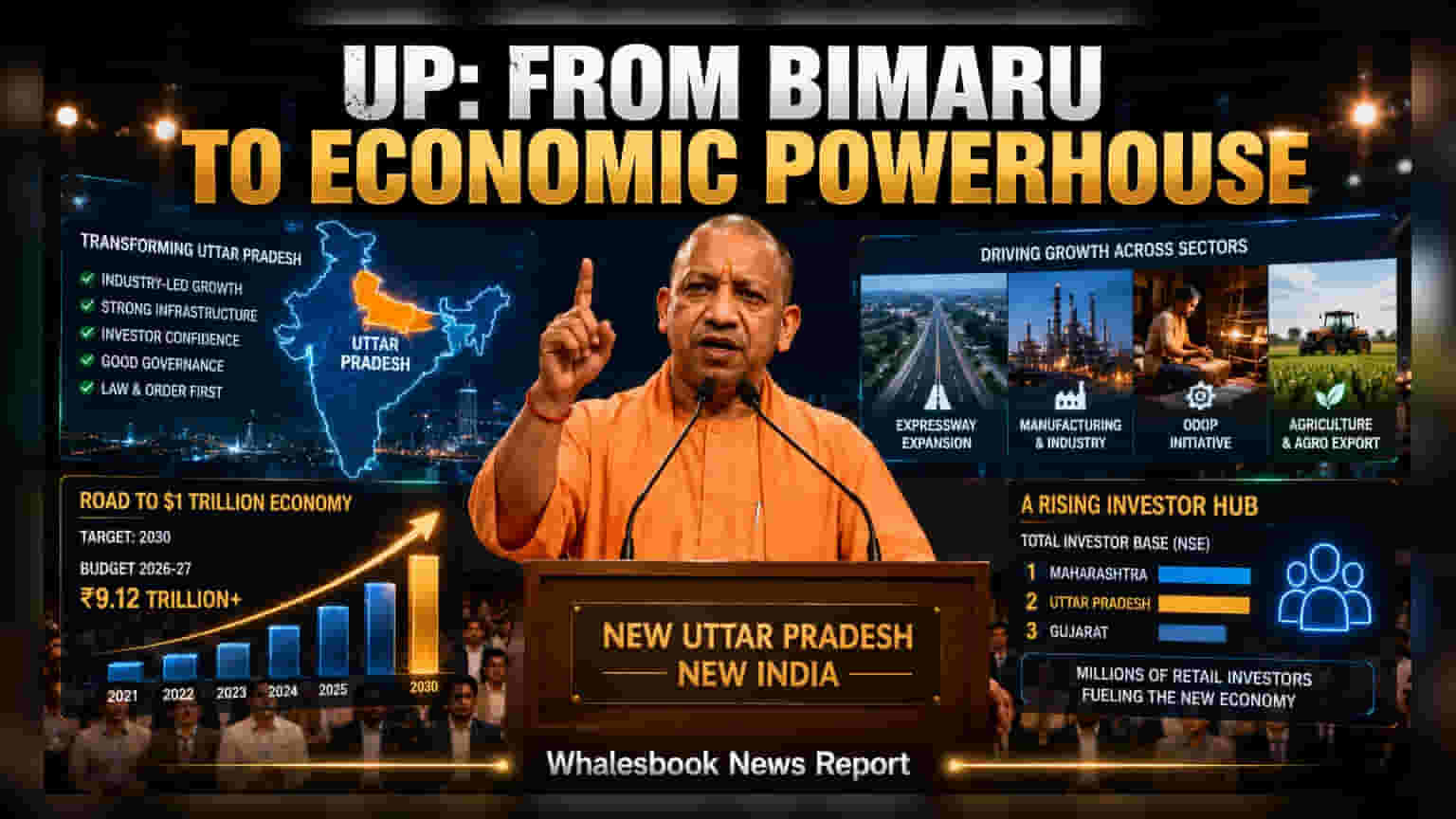
Uttar Pradesh Chief Minister Yogi Adityanath has formally challenged the state’s historical 'BIMARU' status, pointing to a massive infrastructure push and an ambitious $1 trillion economic target by 2030. For investors, the state is emerging as a critical growth engine, ranking second in India for retail investor participation. Future growth will depend on the successful execution of large-scale infrastructure projects and sustained industrial investment.
Uttar Pradesh Chief Minister Yogi Adityanath has officially distanced the state from its historical 'BIMARU' classification—a term used to describe states with lagging economic development—asserting that the region has now transformed into a major contributor to India’s GDP. Speaking at a public event in Mathura, the state administration highlighted its shift toward an industrial-led growth model, driven by infrastructure development and changes in administrative policy.
Targeting a $1 Trillion Economy
The state government’s current economic strategy is anchored by an ambitious target to reach a $1 trillion economy by 2030. To support this, the state presented a budget of over ₹9.12 trillion for the 2026-27 financial year. A significant portion of this allocation is directed toward infrastructure, including the rapid expansion of expressways and regional connectivity, which the government cites as the primary catalyst for restoring investor confidence and attracting private capital.
Central to this strategy is the One District One Product (ODOP) initiative, which aims to boost local manufacturing and exports by promoting specialized goods from every district. The administration reports that these efforts, combined with a stricter law and order policy, have dismantled systemic inefficiencies that previously discouraged industrial expansion.
An Emerging Hub for Retail Investors
For market observers and investors, the shift in Uttar Pradesh’s economic status has been accompanied by a tangible change in the state's financial landscape. Data from the National Stock Exchange (NSE) indicates that Uttar Pradesh has emerged as a major hub for retail investors, currently ranking second only to Maharashtra in terms of total investor base in India. This rise in market participation suggests a growing middle class and increased financial awareness within the state, which often parallels broader industrial and service-sector growth.
The Road Ahead and Key Risks
While the state’s macro-economic narrative reflects rapid expansion, independent analysts and financial observers suggest that sustained growth faces several hurdles. The state’s ambitious economic targets are heavily dependent on the successful execution of long-term capital projects. Any delays in commissioning large-scale infrastructure or gaps in industrial absorption could impact the projected revenue and fiscal health.
Furthermore, critics have frequently pointed to persistent challenges such as per capita income disparities and high youth unemployment rates, which remain elevated compared to the national average. Questions regarding the state’s fiscal management also arise, with some analysts noting that reliance on high government spending requires careful monitoring of debt sustainability over the coming years. Investors and stakeholders will likely track how the state balances its heavy capital expenditure with revenue generation, alongside its ability to attract and sustain large-scale private manufacturing investments through the remainder of the decade.