

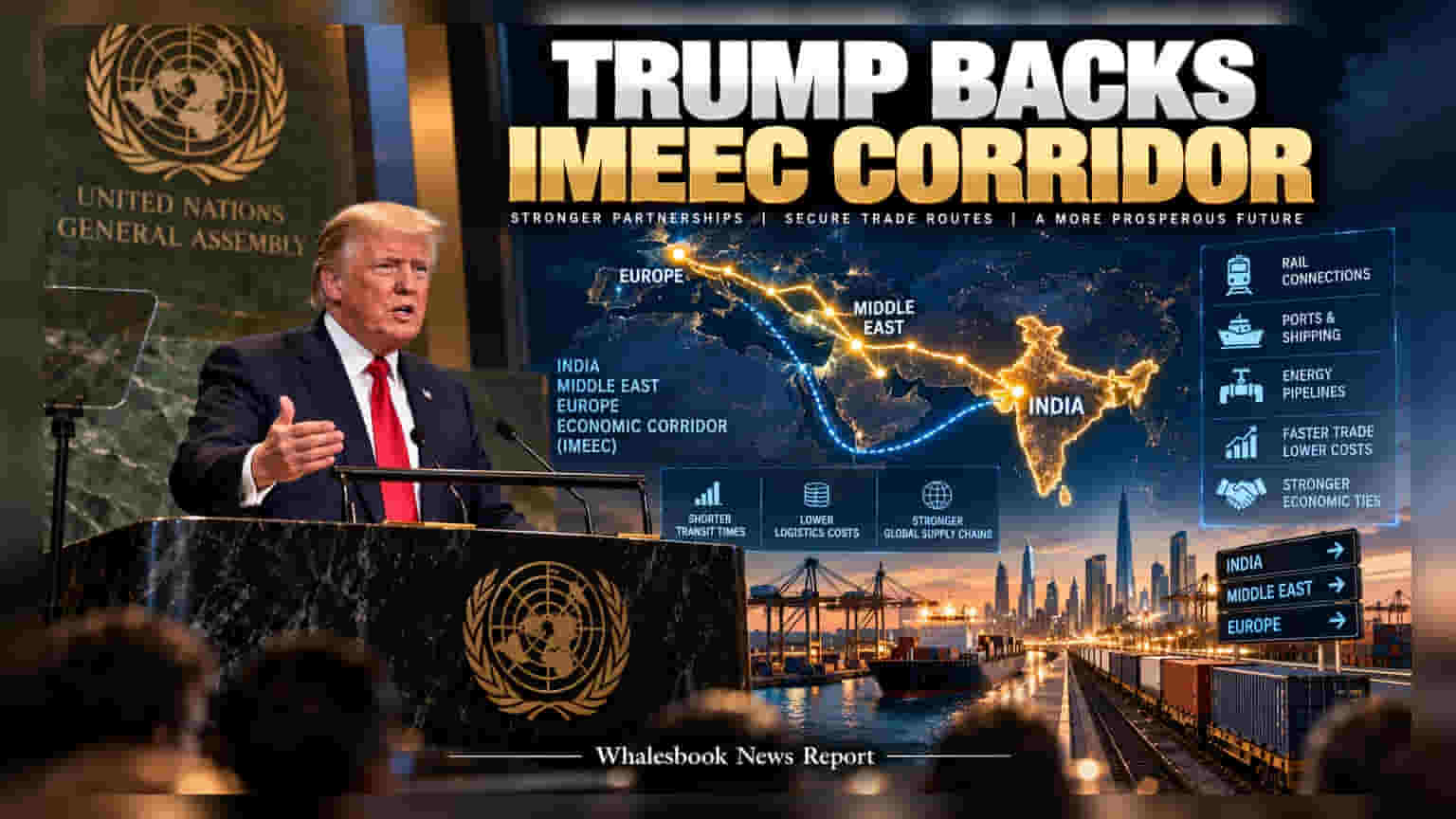
U.S. President Donald Trump has officially supported the India-Middle East-Europe Economic Corridor (IMEEC), emphasizing secure trade and energy supply chains. This long-term initiative aims to connect India, the Middle East, and Europe via rail and maritime networks. For Indian investors, this project could impact infrastructure, logistics, and port-operating firms, though execution risks and regional geopolitical tensions remain important factors to track.
U.S. President Donald Trump formally backed the India-Middle East-Europe Economic Corridor (IMEEC) during his address at the UN General Assembly. His support marks a shift in diplomatic stance, as the administration prioritizes building alternative, secure trade routes that bypass traditional maritime chokepoints. For India, this project is part of a broader push to modernize connectivity between the Indian subcontinent and major markets in Europe.
The IMEEC was originally introduced at the 2023 G20 summit in New Delhi. It is designed as a multimodal transport route integrating shipping lines, rail networks, and pipelines. By creating a direct link, the corridor aims to reduce transit times and lower logistics costs for businesses trading between South Asia, the Middle East, and the European Union.
Strategic Impact on Infrastructure and Logistics
For investors in the Indian stock market, the renewed political focus on this corridor highlights potential opportunities for large-scale infrastructure, port, and logistics companies. The successful implementation of such a project would likely require significant capital expenditure, engineering services, and long-term construction support. Companies with existing expertise in port management, cross-border shipping, and industrial construction are expected to be key participants in building the necessary infrastructure.
However, the project is a long-term undertaking. Unlike short-term trade deals, the economic benefits of a corridor of this scale will depend on the finalization of technical designs, securing multi-national funding, and maintaining stable diplomatic cooperation among all participating countries.
Geopolitical Risks and Execution Challenges
While the prospect of a more stable trade route is positive for supply chain efficiency, the project faces significant risks. The motivation for the corridor stems largely from instability in existing shipping lanes, meaning the success of the IMEEC is deeply tied to the geopolitical climate in the Middle East. Any escalation in regional conflicts could potentially lead to project delays, increased insurance costs for cargo, or disruption in the supply of energy and raw materials.
Furthermore, the complexity of coordinating infrastructure across multiple nations means that execution timelines may stretch over many years. Investors should be cautious about expecting immediate financial returns. The project's progress will depend on the ability of governments to resolve technical bottlenecks and ensure consistent funding.
For shareholders, the key monitorable will be the actual awarding of construction contracts and the progress in diplomatic agreements between India, the UAE, Saudi Arabia, and European nations. As technical and financial plans are finalized, the market will gain better clarity on which domestic firms stand to benefit from specific contract wins or operational roles within this corridor.