

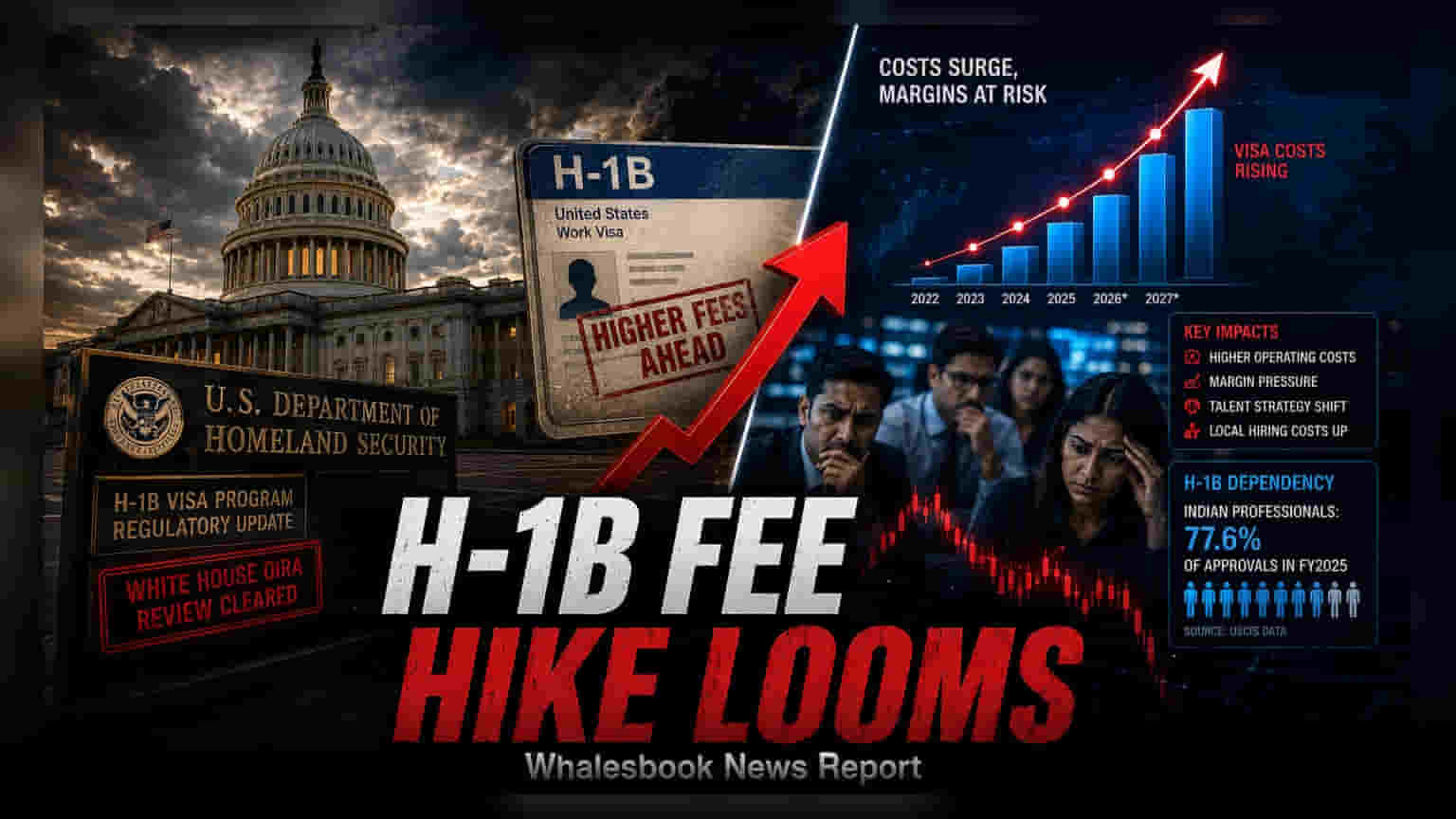
The US Department of Homeland Security has cleared a new H-1B visa fee proposal for regulatory review, creating further cost pressure for the Indian IT sector. With additional biometric fees for extensions taking effect on September 9, 2026, investors are watching for potential impacts on profit margins and the industry's traditional offshore delivery model.
The United States Department of Homeland Security (DHS) has reached a new stage in its regulatory process for the H-1B visa program. A proposal, identified as RIN 1615-AD20, recently cleared the White House Office of Information and Regulatory Affairs (OIRA) review. While the specific fee amounts remain undisclosed until the official publication, the move signals a continued trend of rising regulatory costs for companies that rely on high-skilled foreign labor.
This development is significant for the Indian information technology sector, as Indian professionals accounted for approximately 77.6% of H-1B approvals for continuing employment in the 2025 fiscal year. For Indian IT service providers, which operate on thin margins and often utilize the H-1B program to deploy talent on-site at client locations in the US, any increase in visa fees represents a direct addition to their operating expenses.
Investors are also preparing for an earlier, separate regulatory change. Starting September 9, 2026, an existing 9/11 response and biometric fee—amounting to $4,000 for H-1B extensions and $4,500 for L-1 extensions—will be expanded to cover certain employers with high visa-dependency. This specific fee hike is expected to weigh on the financial results of firms that have not yet fully transitioned to a model with lower visa reliance.
Historically, the tightening of visa norms has forced Indian IT companies to rethink their business strategies. Many firms have already begun accelerating local hiring in the US to reduce dependence on visas. However, local hiring often comes with higher wage costs compared to the traditional offshore-led delivery model. The combination of higher visa fees and increased local compensation costs creates a challenge for maintaining historical operating profit margins.
Market data indicates that the industry is already reacting to these pressures. Eligible H-1B registrations for the 2027 fiscal year dropped by 38.5% to 211,600, reaching a seven-year low. This decline suggests that companies are actively reducing their reliance on the program, likely due to both the higher cost of entry and the unpredictability of the lottery system.
For investors, the most critical factors to track in the coming quarters will be the operating margin guidance provided by IT companies and management commentary regarding their talent sourcing strategy. Analysts will be observing whether firms can pass on these increased costs to clients through higher billing rates or if the burden will remain on the balance sheet, affecting overall profitability.