 Whalesbook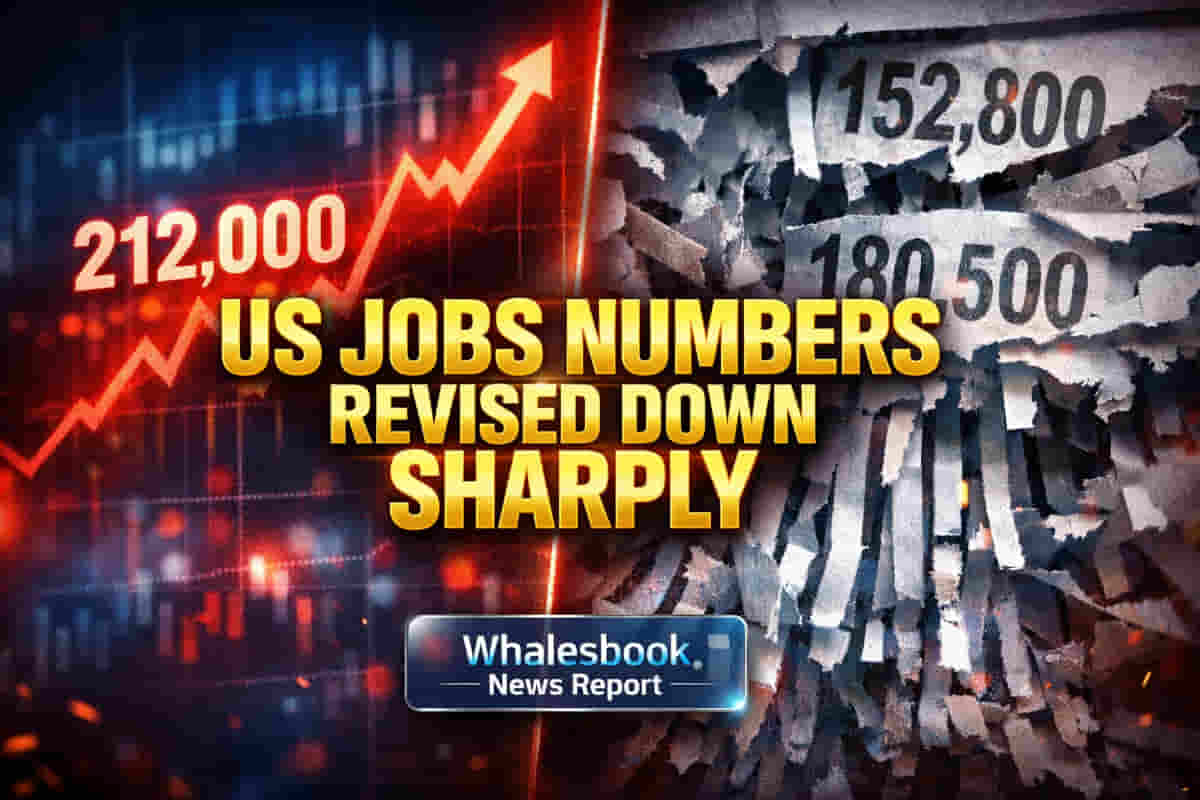
1. THE SEAMLESS LINK
The current labor market scenario, marked by a subtle increase in initial jobless claims and sharp downward revisions to prior job growth, underscores a significant structural shift. This environment, often described as "low-hire, low-fire," suggests a labor market that is decelerating more profoundly than headline unemployment figures might suggest. The difficulty for job seekers in finding new positions, despite historically low unemployment rates, highlights a critical imbalance between available opportunities and the labor pool.
2. THE STRUCTURE (The 'Smart Investor' Analysis)
The Core Catalyst: Claims and Revisions
Initial applications for U.S. unemployment benefits increased by 4,000 to 212,000 for the week ending February 21, 2026, a figure that aligns with analyst expectations. While this modest rise doesn't signal an immediate surge in layoffs, it occurs against a backdrop of significant recalibration in job growth figures. Government revisions have dramatically cut the 2024-2025 payroll numbers, revealing that job creation last year was only 181,000, a stark one-third of the previously reported 584,000. This marks the weakest pace of job creation since 2020 and indicates a significant slowdown from the robust hiring seen in previous years. The labor market's leverage has clearly shifted to employers, with job openings per unemployed person now below 1.0, and time-to-hire lengthening.
The Analytical Deep Dive
The "low-hire, low-fire" equilibrium is increasingly evident. Job openings plummeted to 6.5 million in December 2025, the lowest level since December 2017, and well below market expectations. This contrasts with a more robust job market in prior years where openings often exceeded unemployed individuals. Economists point to persistent uncertainty stemming from trade policies and the lingering effects of the Federal Reserve's interest rate hikes in 2022-2023 as key factors dampening hiring. The ongoing impact of tariffs, estimated to keep the unemployment rate approximately 0.3 percentage points higher by the end of 2026, further constrains the labor market. Analysts are divided on whether the stronger-than-expected January job gains are a genuine recovery sign or an anomaly, potentially delaying anticipated Federal Reserve interest rate cuts. The Federal Reserve itself noted in its January 2026 meeting minutes that while downside risks to employment have moderated, the risk of persistent inflation remains a concern, leading to a pause in rate cuts.
⚠️ THE FORENSIC BEAR CASE (The Hedge Fund View)
The sharp downward revisions to job growth figures raise serious questions about the reliability of official labor market data and the true state of economic momentum. The Bureau of Labor Statistics (BLS) has a history of significant benchmark revisions, with the 2024-2025 adjustments wiping out 1.03 million jobs from previous estimates. This suggests that the narrative of a booming economy may have been overstated, potentially masking underlying weaknesses. The "birth-death model," used to estimate job creation, has been criticized for creating "phantom jobs". Furthermore, companies like UPS have announced substantial job cuts, eliminating 30,000 positions in 2026 and 48,000 in 2025 as they pivot away from certain business relationships. Amazon also announced significant layoffs impacting corporate roles and retail operations. The Washington Post has undertaken sweeping layoffs, cutting one-third of its workforce due to financial challenges and declining readership. These high-profile workforce reductions, occurring alongside falling job openings, highlight a precarious employment situation for many.
4. THE FUTURE OUTLOOK
Looking ahead, the labor market is expected to remain in a "low-hire, low-fire" state through early 2026, characterized by slow but steady hiring and persistent policy uncertainty. While some forecasters anticipate a gradual uptick in hiring later in 2026, supported by potential tax cuts and easing monetary policy, the immediate outlook suggests continued caution. The unemployment rate is projected to stabilize around the mid-4% range, but the increasing difficulty for the unemployed to find new roles suggests that the labor market is not poised for rapid recovery. The Federal Reserve faces a balancing act between managing inflation and supporting employment, with current policy rates suggesting a holding pattern for the near term.