

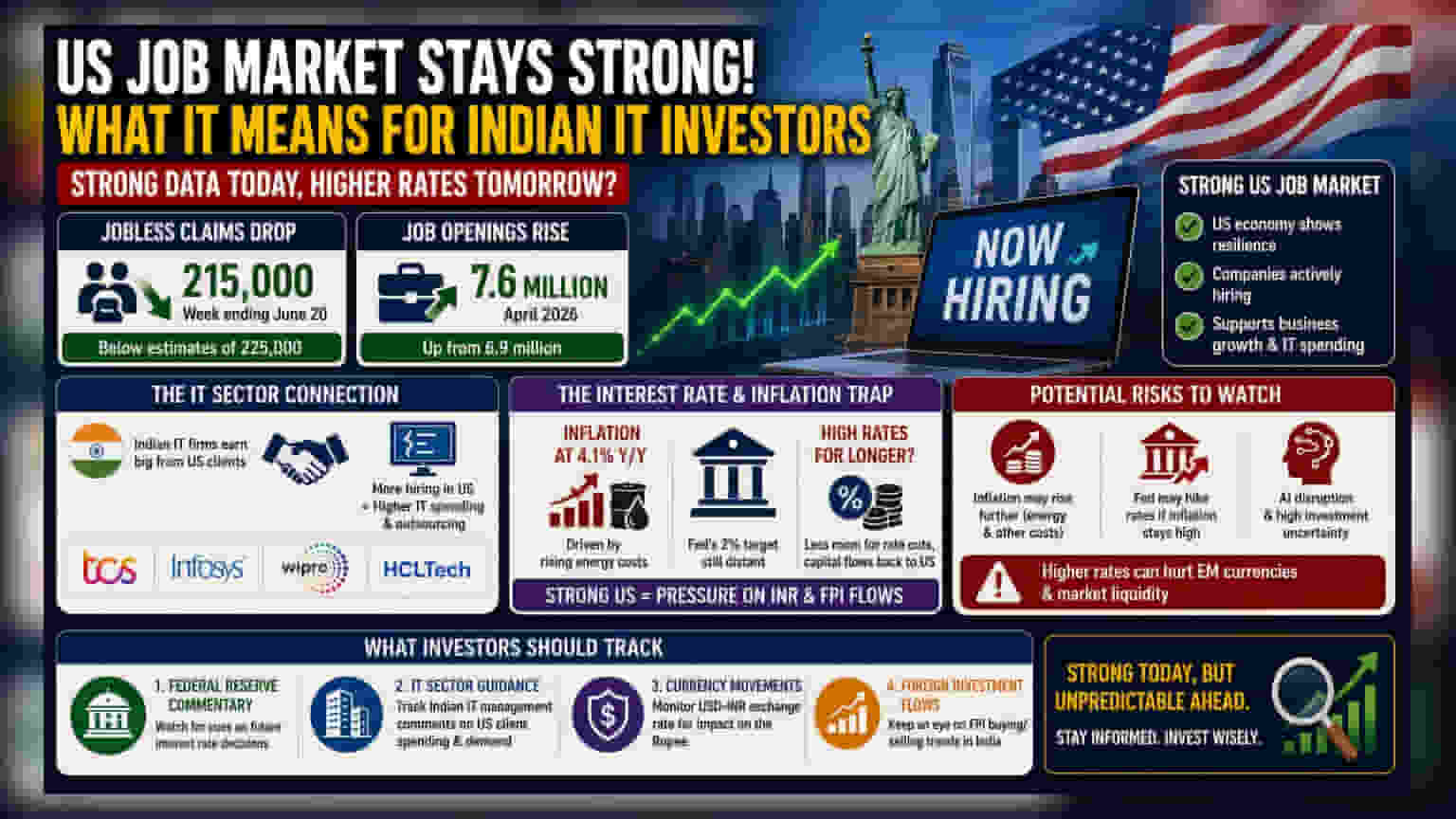
US unemployment claims dropped to 215,000, showing a resilient labor market. For Indian investors, this is a double-edged sword: while it signals potential demand for Indian IT services, it also keeps inflation sticky, which may force the Federal Reserve to hold interest rates high, affecting global fund flows to India.
What Happened
The US labor market continues to show unexpected strength. Recent government data shows that the number of people seeking unemployment benefits dropped to 215,000 for the week ending June 20, falling below analyst expectations of 225,000. Additionally, US job openings rose to 7.6 million in April, up from 6.9 million the previous month.
This data suggests that despite concerns over global tensions and economic uncertainty, American companies are still actively hiring. While this confirms the US economy’s resilience, it also highlights that demand in the world's largest economy remains robust.
The IT Sector Connection
For Indian investors, the health of the US job market is closely linked to the performance of the Indian IT sector. Large Indian IT services companies, such as Tata Consultancy Services, Infosys, Wipro, and HCL Tech, derive a significant portion of their revenue from US-based clients.
When US employers are actively hiring and posting more job openings, it often signals that American businesses are in a growth phase. Historically, this environment tends to support IT spending, as US corporations look to digitize operations or outsource to manage costs. However, investors should note that if high interest rates persist for too long, these same companies might eventually tighten their discretionary technology budgets.
The Interest Rate And Inflation Trap
While a strong job market sounds positive, it presents a challenge for global markets, including India. The US inflation rate has climbed to 4.1% year-over-year, driven partly by rising energy costs. With inflation remaining above the Federal Reserve’s 2% target, the central bank is in a difficult position.
If the US economy remains too strong, it may keep inflation 'sticky'—meaning it stays higher for longer. This gives the Federal Reserve less room to cut interest rates. When US interest rates stay high, global investors often move capital out of emerging markets like India and back into safer US dollar-denominated assets, such as US government bonds. This can put pressure on the Indian Rupee and impact foreign portfolio investment (FPI) flows.
Potential Risks To Watch
Investors should keep an eye on how these factors interact. The main risk is the persistence of inflation. If energy prices or other costs push inflation even higher, the Federal Reserve might be forced to consider rate hikes rather than cuts. Such a move would increase global borrowing costs, potentially hurting emerging market currencies and liquidity.
Furthermore, the rapid integration of artificial intelligence remains an evolving factor. While AI is driving efficiency, the investment required for its development and the potential displacement of certain roles add a layer of unpredictability to future hiring trends.
What Investors Should Track
- Federal Reserve Commentary: Watch for statements from US policymakers regarding future interest rate decisions.
- IT Sector Guidance: Look for comments from Indian IT management regarding client spending intentions in the US.
- Currency Movements: Monitor the USD-INR exchange rate, as persistent US strength can impact the value of the Rupee.
- Foreign Investment Flows: Keep track of FPI buying or selling trends in the Indian equity market, as these are often sensitive to US interest rate expectations.