

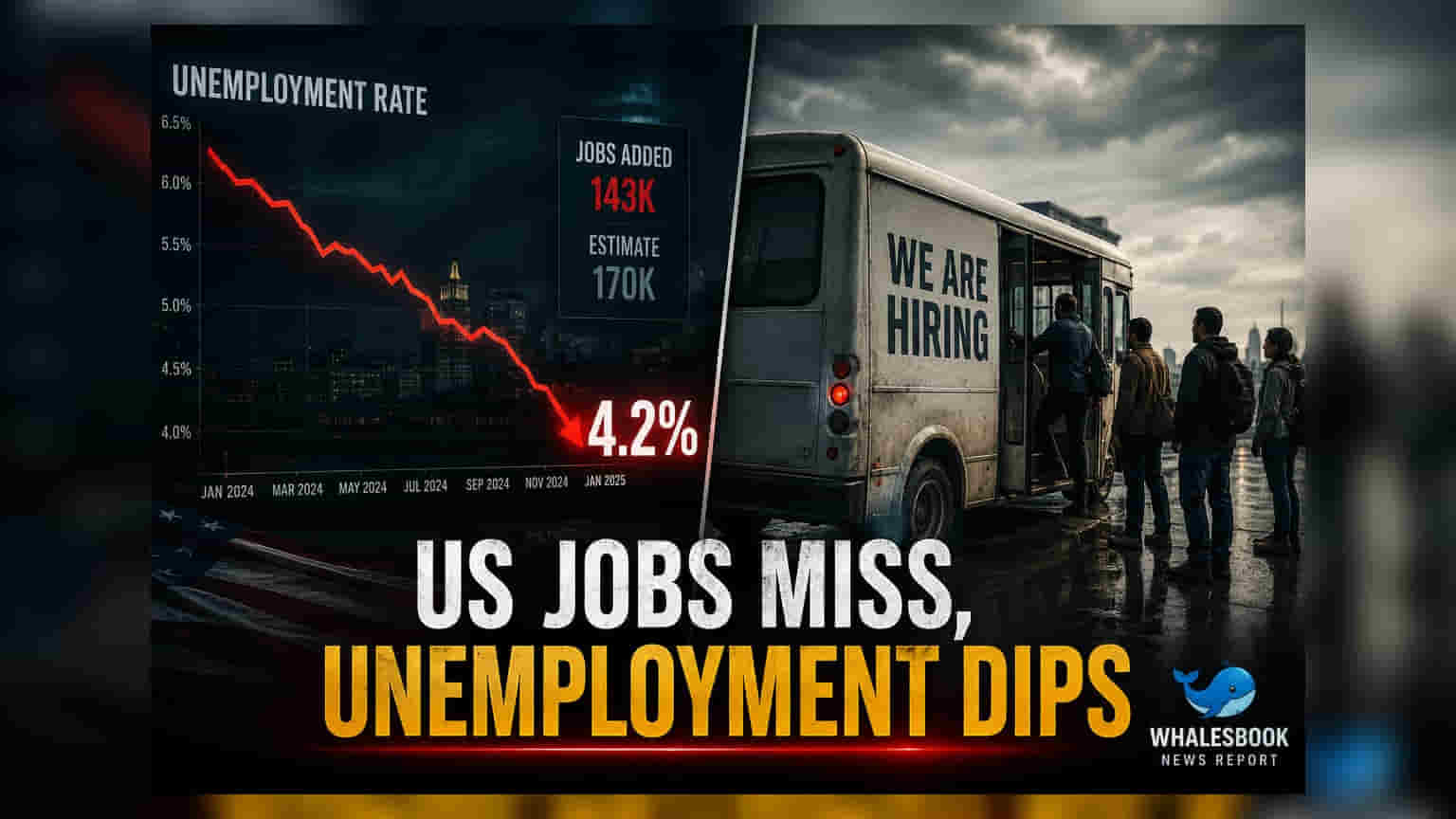
The US added 57,000 jobs in June, significantly missing the 110,000 forecast, while the unemployment rate unexpectedly dropped to 4.2%. This mixed data indicates a cooling labor market, which complicates the Federal Reserve’s future interest rate strategy and may impact global capital flows, including investment trends in the Indian stock market.
What Happened
The US labor market reported a slowdown in June, with employers adding 57,000 jobs. This figure was well below the 110,000 jobs analysts had expected. Additionally, previous months saw downward revisions, with payroll numbers for April and May adjusted lower by a combined 74,000 jobs. Despite the slower pace of hiring, the US unemployment rate unexpectedly fell to 4.2% in June, down from 4.3% in May.
Why This Matters For Indian Investors
Indian investors closely track US economic data because of its impact on global financial markets and the Federal Reserve’s policy decisions. When the US labor market shows signs of cooling, it influences expectations for future interest rates. If the labor market slows too much, the Federal Reserve might reconsider its stance on interest rates, which affects the strength of the US Dollar and global liquidity. A stronger dollar often leads to capital outflows from emerging markets like India, as foreign investors (FIIs) may shift their focus toward US assets.
Understanding The Labor Market Shift
While job growth was lower than expected, the unemployment rate decline is linked to changes in the labor force participation rate, which fell to 61.5%. The employment-population ratio also slipped to 59%. Analysts suggest that constraints in labor force growth mean that fewer new jobs are needed each month to keep the unemployment rate stable. Essentially, the labor market is displaying resilience even as the pace of hiring slows down, which presents a complex picture for policymakers trying to balance inflation and growth.
Sector Performance
The data shows a clear divide between different parts of the economy. The professional and business services sector added 36,000 jobs, while the social assistance and healthcare sectors saw gains of 25,000 and 22,000 jobs, respectively. In contrast, the leisure and hospitality industry reported a loss of 61,000 jobs. This decline in hospitality suggests that seasonal hiring, which is often a key driver for this sector during the summer months, was weaker than in previous years.
What Investors Should Track
Investors will be looking for further clarity from the Federal Reserve regarding its September meeting. While wage growth remains steady at 3.5% year-over-year, the gap between hiring numbers and market expectations will be a key monitorable. Continued monitoring of US wage data, inflation reports, and official Federal Reserve commentary will be important, as these factors will determine the direction of interest rates and, by extension, the sentiment toward emerging market equities.