 Whalesbook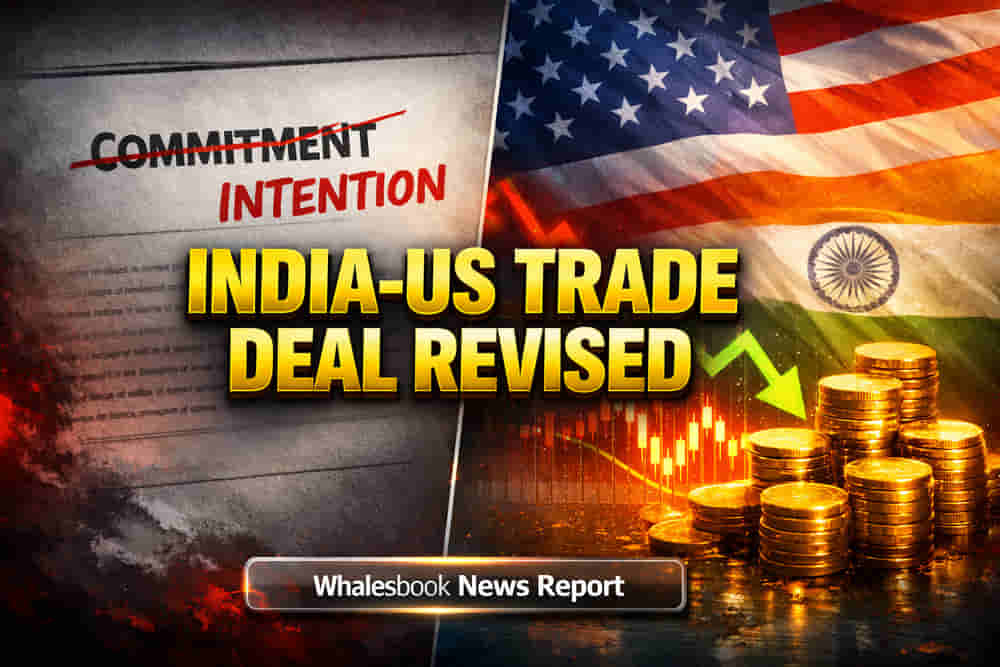


1. THE SEAMLESS LINK
The revised terms signal a strategic quid pro quo: India receives tariff relief on energy imports by altering its geopolitical energy sourcing, while the United States recalibrates its expectations for market access in key sectors. This shift indicates that while immediate trade disputes can be resolved, deeper structural barriers to comprehensive liberalization remain, especially concerning India's domestic industry protection and regulatory autonomy.
2. THE STRUCTURE (The 'Smart Investor' Analysis)
The Tariff Reset and Energy Link
Effective February 7, 2026, the United States has reduced its reciprocal tariff rate on Indian goods from 50% to 18% [5, 8, 15]. Concurrently, the additional 25% tariff imposed in August 2025, stemming from India's oil imports from Russia, has been removed [4, 6, 15]. This tariff rollback was contingent upon India's commitment to cease direct or indirect imports of Russian oil, a condition New Delhi appears to have met, at least in terms of fresh purchases by major refiners [4, 6, 7, 29]. This energy-centric concession forms the bedrock of the immediate tariff de-escalation. However, the broader framework now reflects softer language regarding India's market access commitments [31].
Sectoral Ambiguities and Competitiveness
The initial assertion that India "will purchase over $500 billion of U.S. energy, information and communication technology, agricultural, coal, and other products" has been revised to India "intends" to make these purchases [31]. This subtle but significant shift suggests a less concrete commitment for US exporters. In agriculture, the specific mention of "certain pulses" has been removed from the list of products for tariff reduction [31]. While US agricultural exports to India have seen growth, India's domestic agricultural sector, particularly concerning pulses and certain sensitive products, remains a protected market [5, 21, 32]. Globally, the services sector, especially digital exports, is rapidly growing, with India solidifying its position as a key player [2, 3, 11]. However, US tech firms have noted protectionist postures and challenges related to data localization and digital taxes in India, indicating that the "commitment to negotiate robust bilateral digital trade rules" may be a protracted process, lacking the decisive clarity previously suggested [2, 18, 24, 27]. The US itself has navigated complexities in digital trade policy, underscoring the difficulty in establishing universal rules [27].
Historical Headwinds and Macro Uncertainty
This revised framework emerges against a backdrop of escalating global trade fragmentation and geopolitical risks in early 2026 [19, 33, 34, 40]. Previous trade negotiations between the US and India have historically encountered friction over tariffs, market access, intellectual property, and agricultural trade [30, 46]. The imposition of high tariffs, reaching up to 50% in August 2025, strained bilateral ties and highlighted the US administration's inclination to use tariffs as a strategic tool [35, 43]. The current agreement, while de-escalating immediate tariff conflicts, does not erase the underlying demand for market access from the US and India's focus on nurturing its domestic industries and ensuring energy security, often at different price points [22, 45]. The $500 billion purchase target, once framed as a commitment, is now described as an aspiration, potentially creating an "America First" arms and technology sales dependency rather than organic trade growth [22].
3. ⚠️ THE FORENSIC BEAR CASE (The Hedge Fund View)
The "softening" of the White House factsheet signifies more than a mere update; it points to a potential misalignment of strategic priorities. While the removal of the 25% punitive tariff on Indian goods is a significant concession, it was directly tied to India's energy policy, not a comprehensive liberalization of trade. The shift from India "will purchase" to "intends to purchase" over $500 billion in US goods over five years [31] transforms a stated commitment into a flexible target, creating uncertainty for US exporters and potentially widening India's trade deficit if not balanced by reciprocal growth. Experts have warned that forcing such large purchase volumes could be a "trap" increasing dependency [22].
Furthermore, the omission of "certain pulses" and the dropping of the claim regarding India's removal of digital services taxes highlight persistent regulatory and market access challenges [31]. India's ongoing pursuit of its "Atmanirbhar Bharat" (self-reliant India) strategy suggests a continued preference for protecting domestic sectors, including agriculture and its burgeoning digital economy, against foreign competition [24]. The US insistence on prohibiting duties on electronic transmissions and the pressure to eliminate digital services taxes potentially compromise India's fiscal sovereignty and its ability to nurture its domestic tech industry [27]. The US approach, criticized by some as "economic coercion" [22], may lead to long-term disadvantages for India's regulatory autonomy and its digital sector's growth potential, especially as India seeks to balance US demands with its own economic priorities and relationships [12, 27]. The continued reliance on bilateral agreements and tariffs over multilateral rules also poses risks to the global trading system [40, 46].
4. THE FUTURE OUTLOOK
The interim agreement serves as a precursor to a broader US-India Bilateral Trade Agreement (BTA), with negotiations continuing. The path forward will likely involve further discussions on non-tariff barriers, rules of origin, and sector-specific regulations, particularly in agriculture and digital trade. India's ability to navigate these negotiations while safeguarding its domestic interests, and the US' willingness to accept nuanced market access over outright liberalization, will determine the ultimate success and balance of the future trade relationship.