

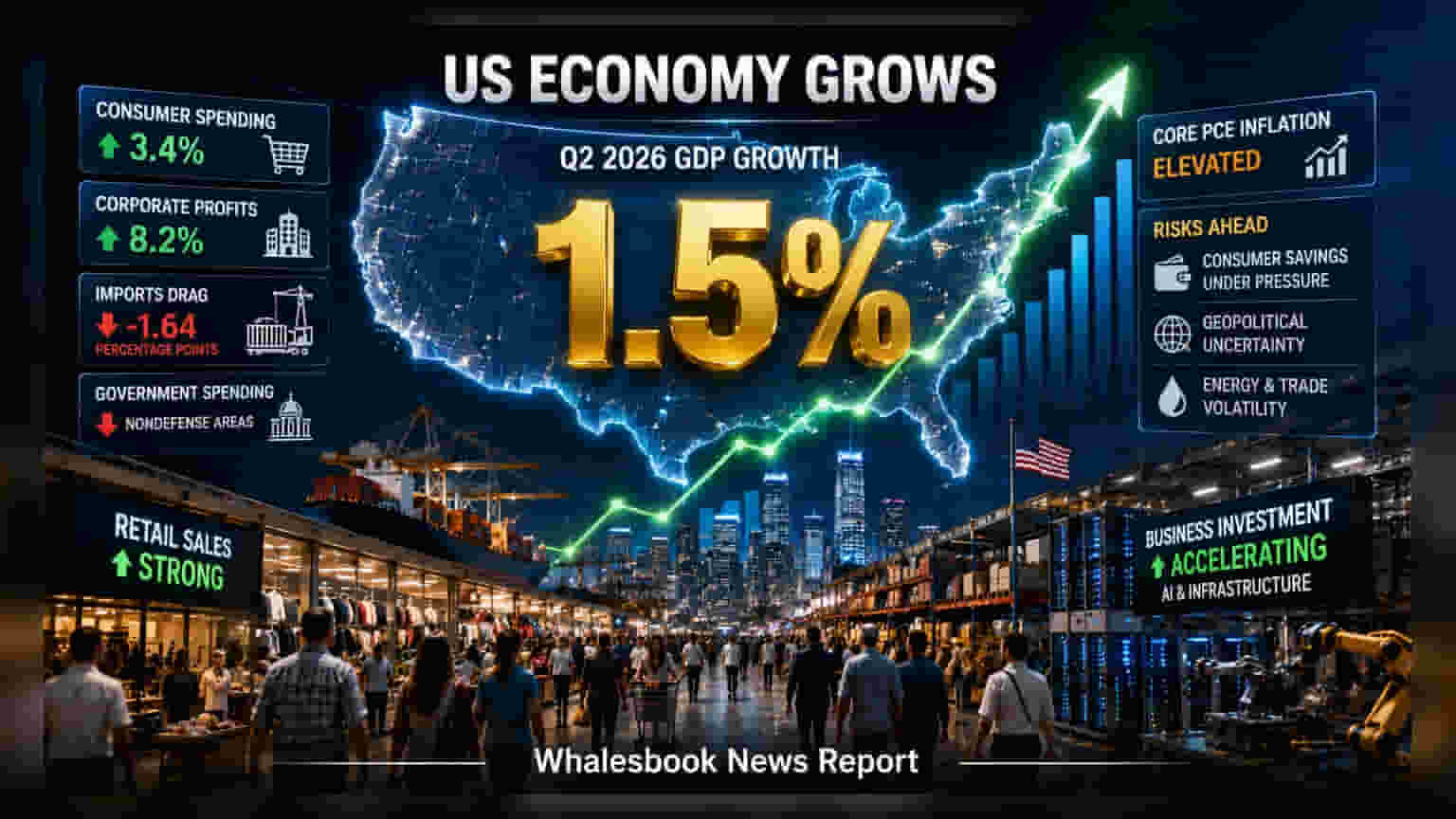
The US economy grew at an annualized rate of 1.5% in the second quarter of 2026. While this is a slowdown from the 2.1% recorded in the first quarter, resilient consumer spending and a jump in corporate profits kept the economy stable. Investors are now balancing these growth signals against persistent inflation concerns and shifts in consumer savings.
The US Bureau of Economic Analysis has confirmed that the economy grew at an annualized rate of 1.5% in the second quarter of 2026. This figure aligns with earlier estimates and highlights a period of moderate growth, even as the pace cooled down from the 2.1% expansion seen in the first quarter of the year.
Consumer and Corporate Strength
Despite the slower headline growth compared to the start of the year, internal data points show resilience in key areas. Consumer spending, which accounts for the vast majority of the US economy, rose by 3.4%. This continued willingness of households to spend has been a major support for economic activity. Additionally, the corporate sector showed significant momentum, with profits surging by 8.2% in the second quarter. This marks a sharp acceleration from the modest 0.5% growth in corporate profits observed in the first quarter. Much of this business activity and investment is linked to infrastructure development, including the expansion of artificial intelligence systems.
Factors Limiting Growth
While consumers and businesses remained active, other factors acted as a drag on the final growth number. A significant increase in imports—partly driven by the demand for advanced computer chips—subtracted 1.64 percentage points from the quarterly GDP calculation. This means that while domestic demand was strong, a large portion of that demand was met by goods produced outside the country. Furthermore, a reduction in government spending, particularly in nondefense areas, also contributed to the overall moderation in the GDP print.
Inflation and Future Risks
Looking ahead, the economic outlook remains mixed due to persistent inflationary pressures. The core Personal Consumption Expenditures (PCE) price index, a metric often monitored by the Federal Reserve, continues to show elevated levels. This sticky inflation complicates future policy decisions for central bankers as they try to balance growth with price stability.
Investors are also tracking risks related to consumer finances. There is growing pressure on the personal saving rate, raising concerns that households may eventually pull back on spending if they feel the need to build up their financial cushions. Additionally, geopolitical uncertainties, particularly those affecting energy prices and trade routes, remain a source of potential volatility for the global and US markets. The market will continue to monitor how these factors interact with consumer behavior and corporate earnings in the coming months.