

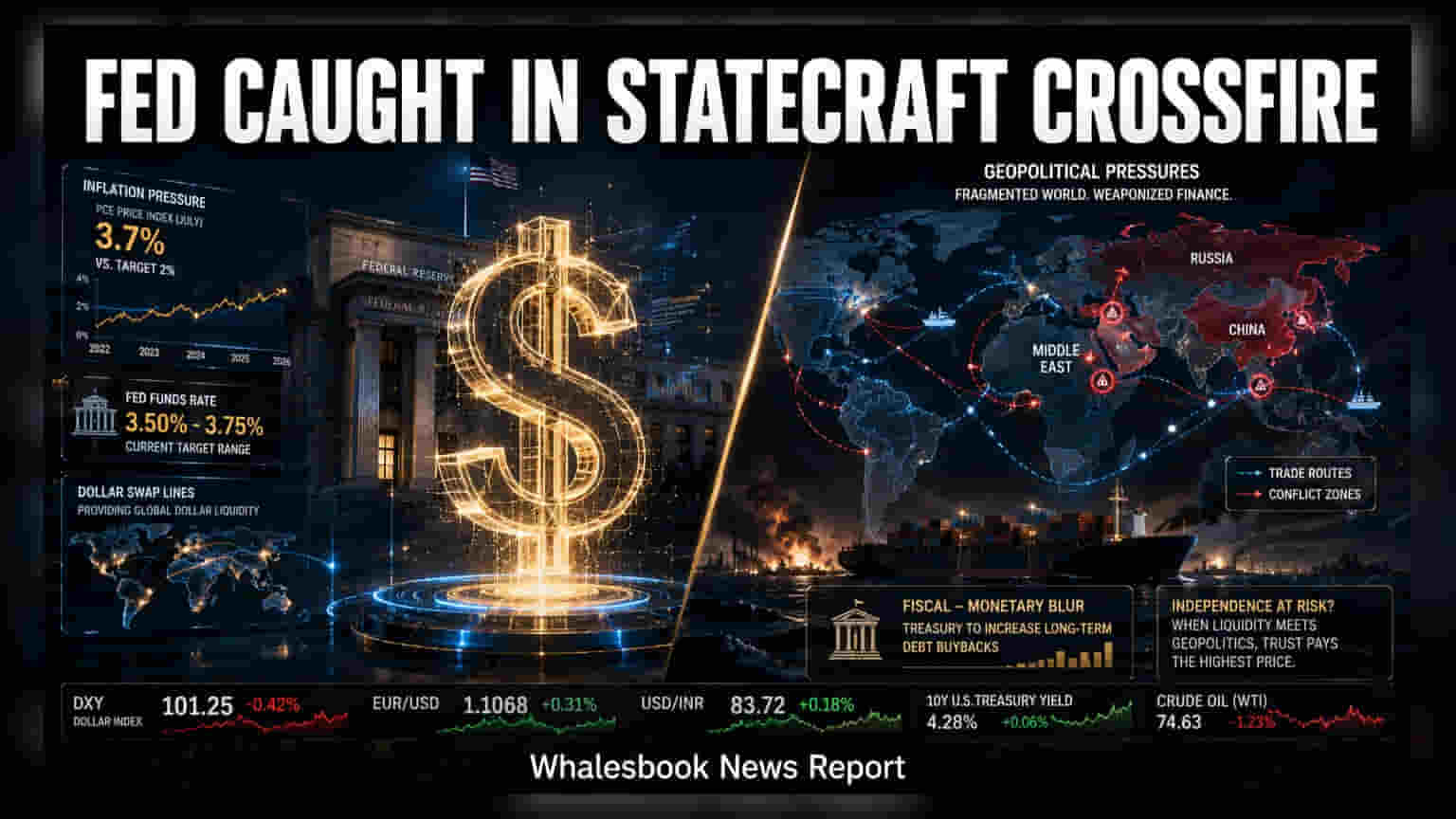
The U.S. Federal Reserve faces rising pressure to use dollar swap lines for geopolitical objectives, challenging its historic independence. With U.S. inflation at 3.7% and the Treasury increasing its role in debt management, global investors are monitoring if this shift risks the dollar’s long-term status as the global reserve currency.
The U.S. Federal Reserve is facing a complex challenge as it balances its traditional duty of maintaining domestic price stability with emerging pressures to use the dollar as a tool of statecraft. As Federal Reserve Chair Kevin Warsh speaks at the Jackson Hole symposium, the conversation has moved beyond typical monetary policy to address the increasing overlap between the central bank’s liquidity tools and U.S. foreign policy objectives.
At the core of this discussion are the central bank’s currency swap lines—mechanisms designed to provide foreign peers with access to dollars during financial emergencies. While these were historically used to stabilize markets during crises like the 2008 collapse, there is mounting debate over whether these facilities are being used to support political allies or counter foreign influence. This shift is occurring against a backdrop of sticky inflation, with the July Personal Consumption Expenditures (PCE) price index at 3.7%, keeping the pressure on the Federal Open Market Committee (FOMC) to manage interest rates, which are currently in the 3.50%-3.75% range.
Further complicating the outlook is the increasing collaboration between the Federal Reserve and the U.S. Treasury. The Treasury has recently announced plans to increase buybacks of long-term government debt, a move that some analysts argue blurs the lines between fiscal policy—handled by the government—and monetary policy, which is the independent domain of the Fed. For global investors, this interaction is critical. If the perception grows that the Federal Reserve is becoming an arm of political strategy rather than an independent institution, it could lead to questions about the dollar's reliability as a global reserve asset.
For international markets, including India, the risks are significant. The U.S. dollar’s role as the primary global reserve currency gives the U.S. significant influence over global trade and capital flows. If geopolitical frictions or the weaponization of financial tools accelerate efforts by other nations to diversify away from the dollar, it could create volatility in currency markets and impact capital flows into emerging economies. The potential for the Federal Reserve to be pulled into political decisions also raises concerns about its ability to maintain focus on its core mandates of stable prices and employment.
Investors will likely track upcoming statements from the Federal Reserve regarding its operational independence and its stance on the use of emergency lending tools for non-financial objectives. Additionally, any signals from the Fed about how it intends to manage the boundary between its monetary policy and the Treasury’s fiscal activities will be an important indicator of whether the central bank can maintain its traditional institutional credibility in an increasingly fragmented global economic environment.