

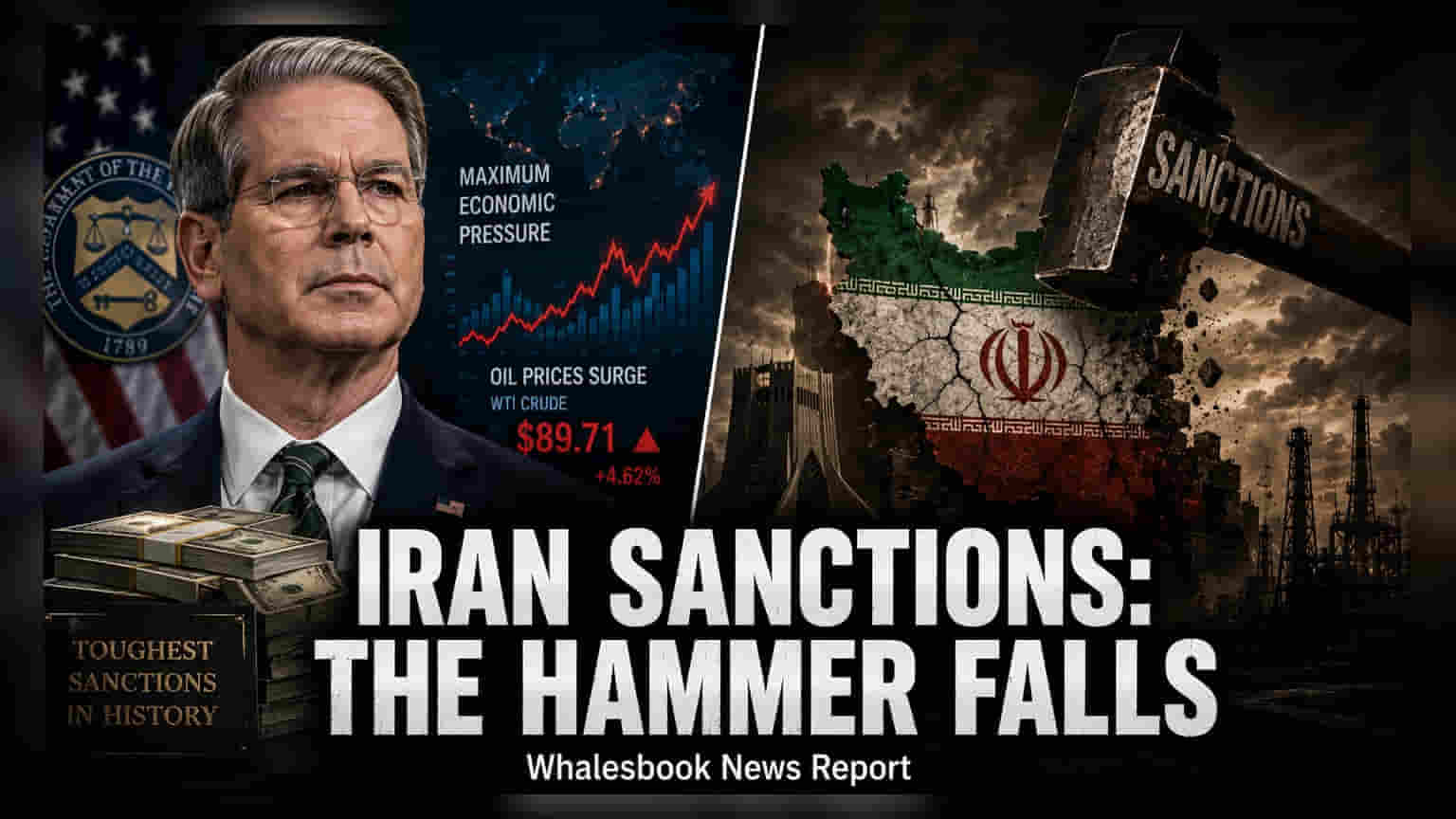
US Treasury Secretary Scott Bessent announced plans for unprecedented sanctions on Iran, aiming to isolate the regime. The news sent global crude oil prices to three-week highs, raising concerns about supply stability. For Indian investors, the development is significant as rising energy costs often impact inflation and the profit margins of fuel-dependent sectors like aviation, paints, and oil marketing companies.
On Thursday, U.S. Treasury Secretary Scott Bessent announced that Washington is preparing to impose the "toughest sanctions in history" against Iran. This policy shift is framed by the administration as a strategy to apply maximum economic pressure, intended to limit Iran’s economic capacity. The administration indicated that these new measures will operate in tandem with a blockade to restrict trade. Further specifics regarding the scope and nature of these sanctions are scheduled for release on Monday, August 24, 2026.
The announcement had an immediate effect on global markets, with crude oil prices climbing to their highest levels in more than three weeks. For Indian investors, this is a critical development. India remains heavily dependent on energy imports, and a sharp or sustained rise in global crude oil prices typically increases the country's import bill, which can put pressure on the current account and domestic inflation.
Several sectors in the Indian stock market are sensitive to fluctuations in crude oil prices. Oil Marketing Companies (OMCs) such as Indian Oil Corporation, BPCL, and HPCL often face margin pressure if they are unable to pass on higher crude costs to consumers. Aviation companies like InterGlobe Aviation and SpiceJet are also highly vulnerable, as jet fuel prices generally rise in line with global crude benchmarks, directly impacting their operating costs. Additionally, industries such as paints and chemicals, which rely on petroleum derivatives as raw materials, may see their profit margins squeezed when input costs increase.
The Treasury’s statement also highlighted an appeal to China for cooperation, with hints that secondary sanctions could be considered if Beijing continues to facilitate Iranian trade. This adds a layer of uncertainty to US-China trade relations, a factor that often influences global market sentiment and investor risk appetite.
As the situation unfolds, market observers will be watching the specific details to be released on Monday. The key points of interest will be whether the sanctions effectively restrict the flow of oil through the Strait of Hormuz and whether the geopolitical tensions between the U.S. and China escalate, potentially affecting broader trade dynamics. Investors will likely monitor how global oil prices react to the official details of the sanctions next week to gauge the potential impact on domestic energy-linked stocks.