 Whalesbook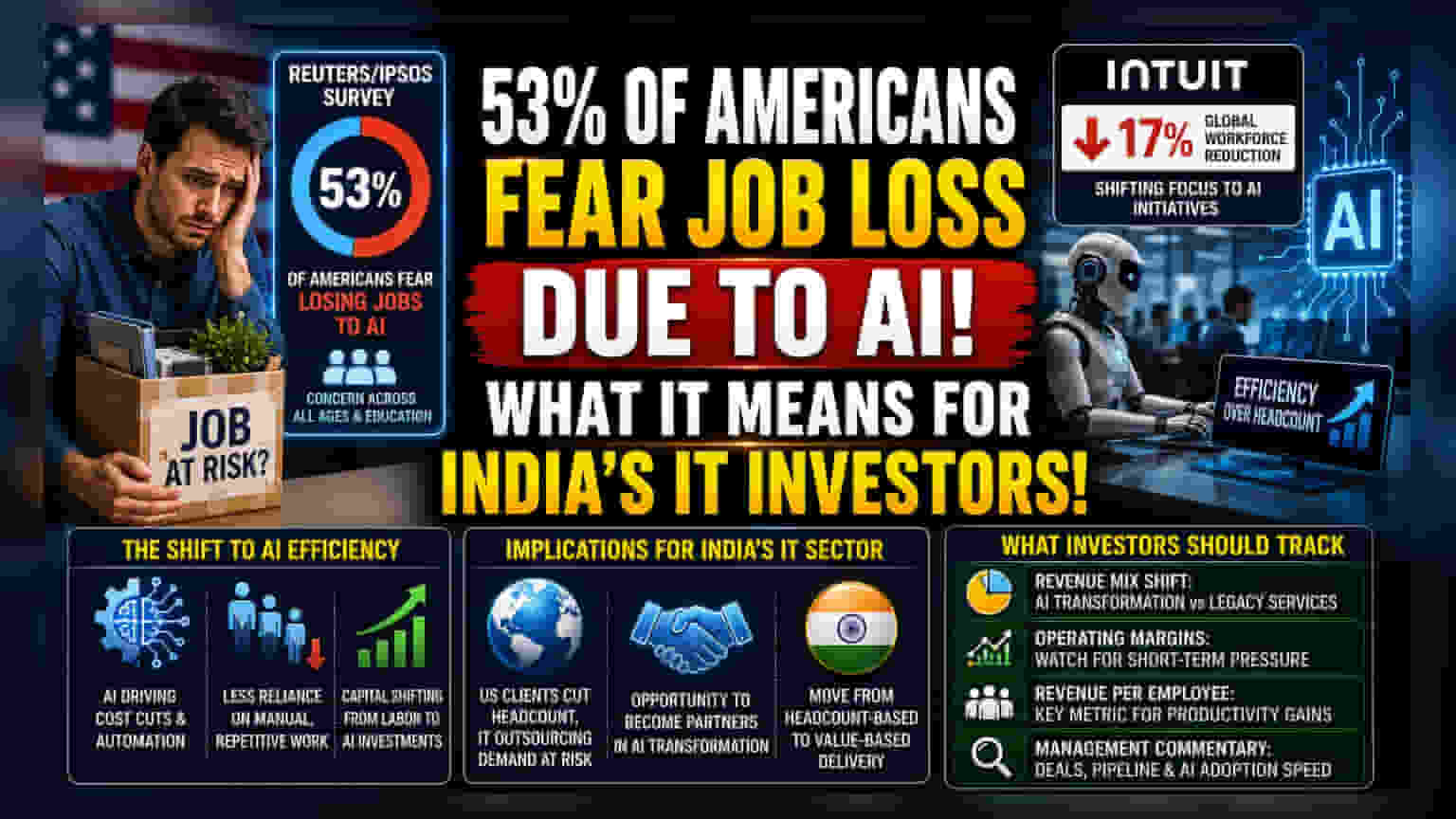


A Reuters/Ipsos survey shows 53% of Americans fear AI-driven job displacement, a sentiment underscored by major tech firms like Intuit cutting staff to focus on AI. For Indian investors, this highlights a critical global shift: companies are aggressively trading headcount for AI efficiency. This trend forces Indian IT exporters to pivot from traditional, headcount-based revenue models to AI-driven service models to protect their margins and relevance in the US market.
What Happened
A recent nationwide survey by Reuters/Ipsos has revealed that a clear majority of Americans, approximately 53%, are concerned about losing their jobs due to the rapid integration of artificial intelligence. This anxiety is widespread across various demographics, regardless of age or education. The survey results arrive at a time when major corporations are already taking steps to restructure their workforces. For instance, Intuit recently announced a 17% reduction in its global workforce, explicitly linking the move to a strategic shift toward prioritizing AI initiatives.
The Shift Toward AI Efficiency
The core of this issue is a push for operational efficiency. Companies are increasingly viewing AI not just as a tool for productivity, but as a mechanism to lower costs by reducing reliance on manual processes. When major US firms pivot their budgets away from traditional labor and toward AI development, the demand structure for service providers changes fundamentally. This is not merely about job loss; it is about a change in how businesses operate and where they allocate capital.
Implications for Indian IT Investors
For Indian investors, the US labor market sentiment is a leading indicator for the Indian Information Technology (IT) sector. Indian IT firms like Tata Consultancy Services, Infosys, and Wipro derive a significant portion of their revenue from US-based clients. If these clients are aggressively cutting headcount to fund AI infrastructure, the demand for traditional IT outsourcing—which relies on scaling headcount—may face pressure.
However, this is not purely negative. While traditional volume-based business may soften, it opens an opportunity for Indian firms to position themselves as partners in their clients' AI transition. The challenge for these companies is to move away from billing based on the number of employees (headcount) and toward value-based billing, where they are paid for the results or efficiency gains their AI tools deliver.
The Risk of Transition
Investors should be aware of the execution risk during this industry-wide transition. Shifting a business model from labor-intensive services to high-end AI consulting requires heavy spending on research, employee training, and new infrastructure. In the short term, this can put pressure on operating margins. Furthermore, if the demand for AI services does not scale fast enough to offset the decline in legacy IT services, revenue growth could be affected.
What Investors Should Track
Going forward, the most important metric for investors in the Indian IT sector will be the shift in revenue composition. Watch for management commentary on how much of their deal pipeline is driven by AI transformation versus traditional maintenance work. Additionally, keep a close eye on operating margins. If companies are forced to cut prices to win AI-driven projects, or if the cost of training staff to be AI-ready exceeds current profit growth, it may signal margin pressure. Finally, monitor the revenue-per-employee metric, which serves as a proxy for how effectively these companies are adopting automation to do more with fewer people.