

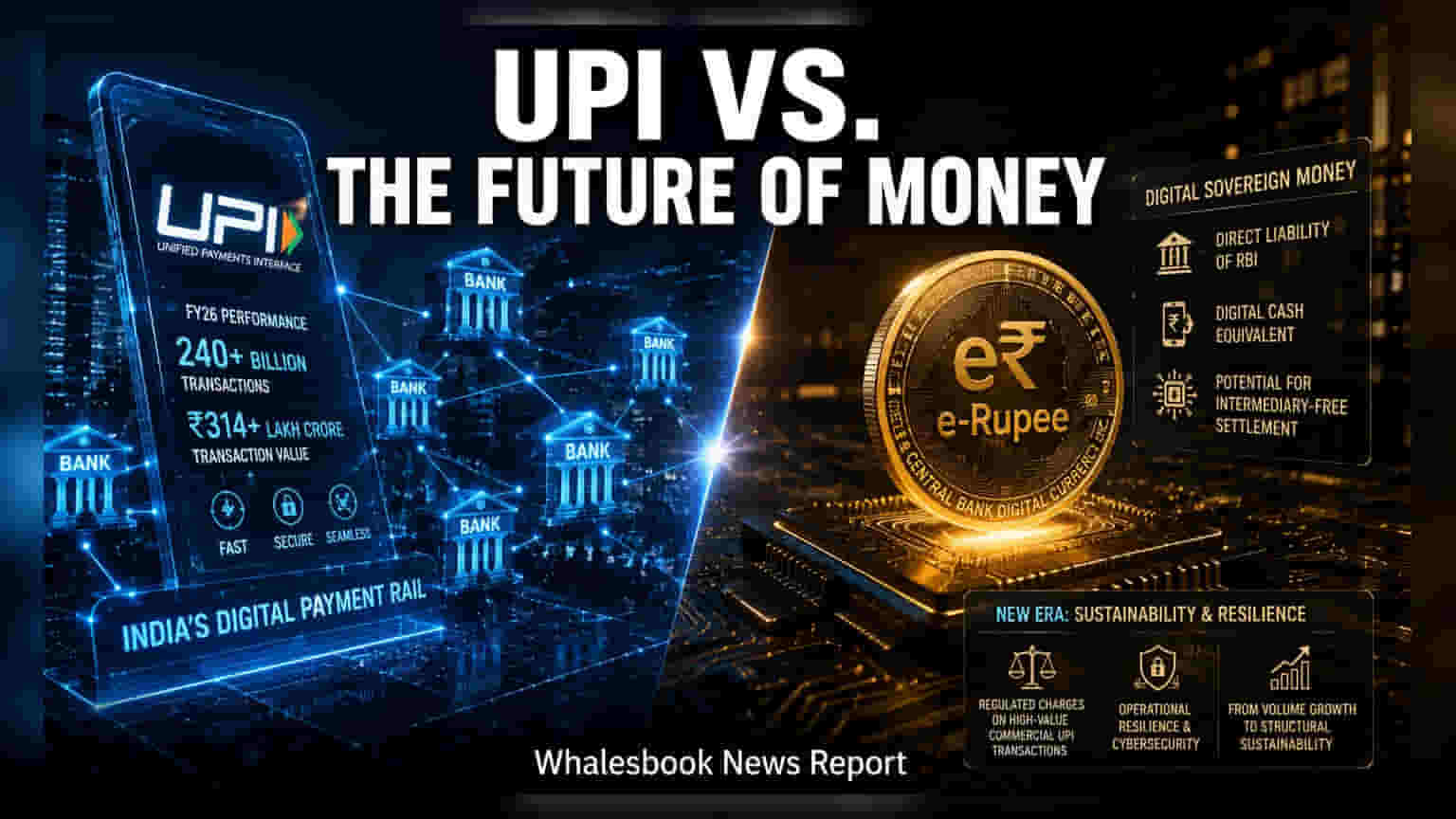
UPI has hit 240 billion annual transactions, yet it serves as a payment rail rather than a store of value. As the RBI pilots the e-Rupee, the August 2026 legislative shift toward commercial monetization marks a critical change for the sustainability of India's digital payment ecosystem.
The Unified Payments Interface has solidified its role as the backbone of India's digital public infrastructure. With annual transaction volumes crossing 240 billion and values exceeding Rs 314 lakh crore in the 2026 financial year, UPI has fundamentally changed how money moves across the country. However, investors and market participants must distinguish between UPI as a payment rail and actual digital money.
While UPI is highly efficient, it acts as a messaging system—an instruction to move money between bank accounts—rather than a sovereign digital asset. The Reserve Bank of India’s e-Rupee, or Central Bank Digital Currency, is distinct because it serves as digital sovereign money. While UPI facilitates the transfer of existing deposits, the e-Rupee functions as a direct digital representation of cash, potentially removing the middleman layer of bank settlement in the future.
This distinction has become more relevant following the passage of the Taxation and Other Laws (Amendment) Bill in August 2026. This legislation marks a significant turning point for the payment ecosystem by allowing regulated charges on high-value commercial UPI transactions. For years, the system operated almost entirely on subsidies, with zero charges for retail consumers. The new legislative framework aims to address the revenue deficit within the payments infrastructure, ensuring that high-value commercial entities contribute to the maintenance and scaling of the network.
Moving away from a state-subsidized model introduces new challenges. As the infrastructure matures, the sector faces transition risks, specifically regarding how to balance commercial viability with the mass adoption that made UPI successful. Furthermore, the massive scale of 240 billion annual transactions places immense pressure on operational resilience. Cybersecurity threats remain a persistent monitorable, as the system must protect an increasing value of money flowing through its digital rails.
The evolution of India's digital payments is now shifting from simple volume growth to structural sustainability. Investors looking at the fintech and banking space should track how the ecosystem adapts to these regulated commercial charges. The success of this transition will determine the future financial health of the payment network and its ability to scale further without relying solely on state support or private absorption of costs.