

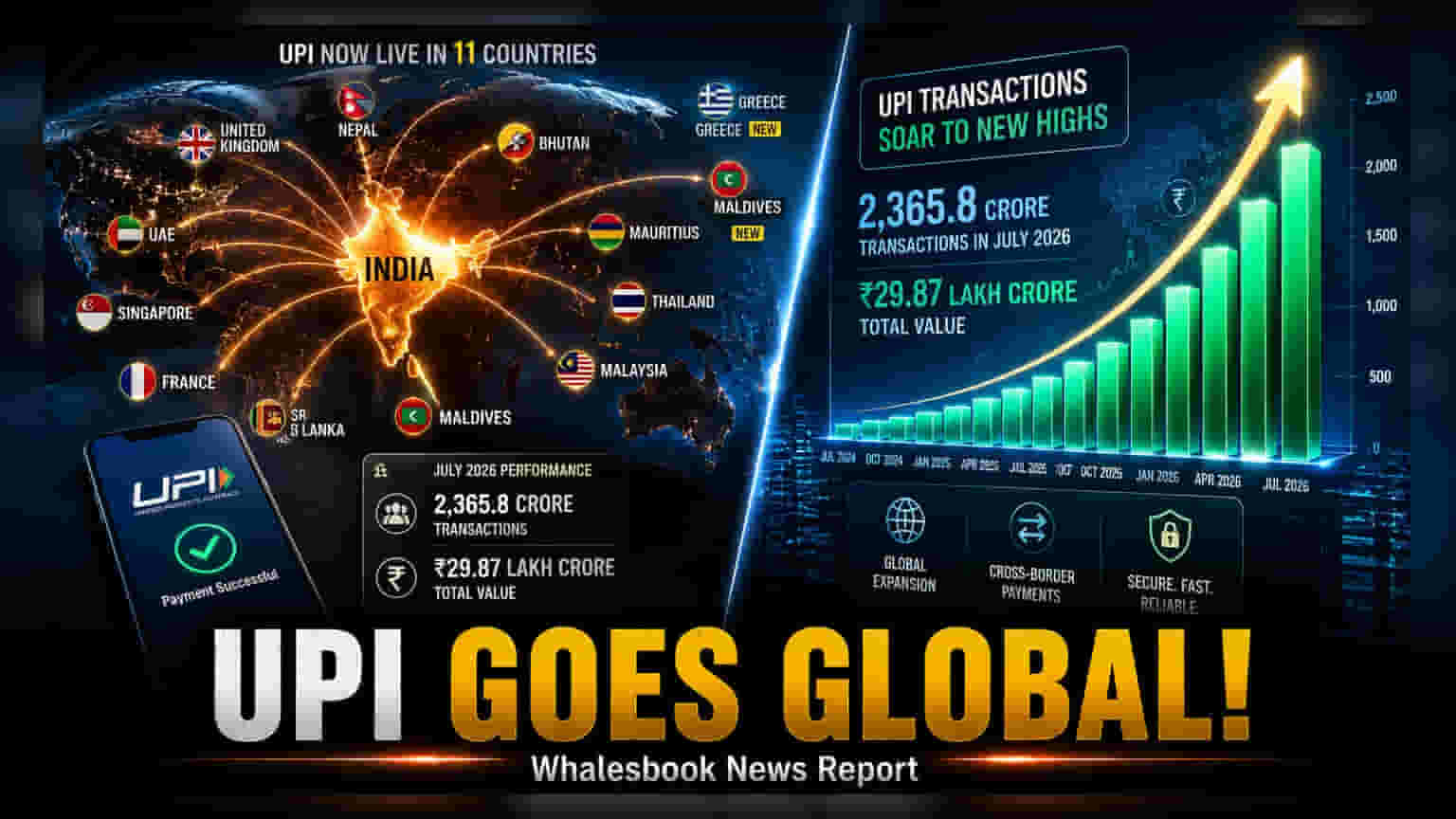
The Unified Payments Interface (UPI) now operates in 11 countries, with Greece and the Maldives as recent additions. In July 2026, transactions reached ₹29.87 lakh crore. While UPI itself is a non-profit system, its rapid adoption is a key indicator for Indian banks and fintech firms that rely on the digital payments ecosystem.
India’s digital payment infrastructure has continued its global expansion, with the Unified Payments Interface (UPI) now available in 11 nations. The addition of Greece and the Maldives marks the latest step in integrating India’s payment system with international markets, allowing for smoother cross-border remittances and merchant payments. In July 2026, the platform processed 2,365.8 crore transactions, totaling ₹29.87 lakh crore, underscoring its deep penetration into the Indian economy.
Why UPI Growth Matters for Investors
It is important for investors to note that UPI, developed by the National Payments Corporation of India (NPCI), is a non-profit digital public infrastructure and not a publicly traded company. Investors cannot buy shares of UPI. However, the platform’s performance is a critical signal for the broader financial services sector. Major banks and listed fintech entities act as the pipes through which these transactions flow. The growth of UPI helps these institutions in three ways: by reducing the cost of handling cash, by enabling customer acquisition for other banking products, and by generating transaction data that helps banks make better decisions when offering loans.
The Revenue Challenge and Regulatory Risks
While volume growth is a positive metric, the business model for private players remains complex. The government currently enforces a zero-charge policy for UPI transactions, meaning there is no Merchant Discount Rate (MDR) for merchants or customers on these payments. This has sparked ongoing discussions about how payment apps can generate sustainable revenue. If the regulatory stance on transaction fees changes, it could significantly alter the profitability of payment service providers.
Another layer of risk involves market concentration. To prevent a monopoly, regulators have imposed volume caps, restricting any single third-party payment app from processing more than 30% of the total volume of UPI transactions. This forces the market to remain fragmented, preventing any single entity from gaining total control, which acts as a check on the market share of dominant players like PhonePe and Google Pay. Additionally, as with all digital systems, the sector faces constant pressure to manage cybersecurity vulnerabilities and maintain uptime as transaction loads increase.
Looking Ahead
Moving forward, the primary monitorables for the sector will be the pace of international adoption, the rollout of new features like UPI Lite for small transactions, and any shift in the government's policy regarding transaction fees. Investors interested in the digital payments space will likely continue to track whether banks can effectively convert the high volume of UPI transactions into profitable financial products, such as credit cards or personal loans, which remains the long-term goal for many lenders in the ecosystem.