

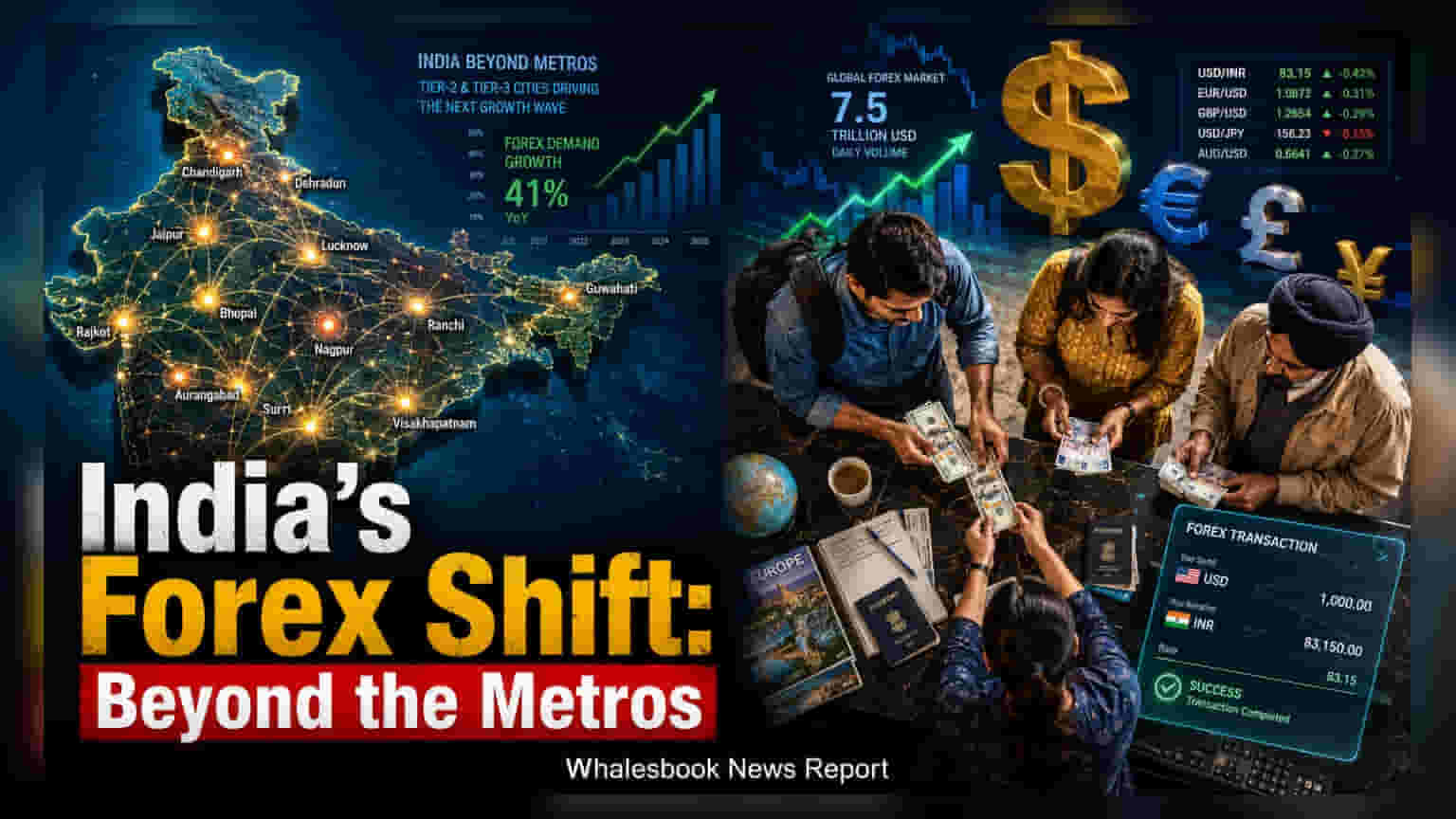
India’s foreign exchange market is shifting as Tier-2 and Tier-3 cities now account for 53% of total demand, according to the Thomas Cook India Forex Report 2026. While leisure travel demand is rising, investors should note the company’s recent Q1 FY27 financial results, where consolidated income dropped 12% amid geopolitical tensions in the Middle East.
A new report from Thomas Cook India has highlighted a significant change in the Indian travel landscape, showing that foreign exchange demand is no longer concentrated in major metropolitan areas. According to the company's 'India Forex Report 2026,' Tier-2 and Tier-3 cities now account for 53% of total forex transactions, while major Tier-1 cities make up the remaining 47%. This trend reflects a broader increase in disposable income and travel aspirations among residents of smaller urban centers.
Leisure travel remains the primary driver of this demand, accounting for 57% of all forex transactions, followed by corporate travel at 27% and student travel at 16%. The data suggests that younger travelers are powering this growth, with Millennials and Gen X, specifically those between the ages of 25 and 60, responsible for nearly 75% of total demand.
While this geographical shift points to long-term growth opportunities in travel, the company's financial performance presents a more mixed picture. In its Q1 FY27 financial results, Thomas Cook India reported a consolidated net profit of ₹71.90 crore, a marginal decline of 0.21% compared to the previous year. More notably, the company's consolidated total income fell to ₹21.53 billion, representing a 12% decline year-on-year.
The decline in income highlights the challenges the travel sector faces from external factors. Management has pointed to geopolitical instability in the Middle East and the GCC region as key reasons for the pressure on performance. Because subsidiaries like Desert Adventures and DEI have significant exposure to these regions, airspace disruptions and the resulting operational impact have weighed on the overall top-line performance.
To manage these pressures, the company is doubling down on digital transformation. The report indicates that digital-first channels now represent 25% of all forex transactions, with usage of DIY (Do-It-Yourself) platforms surging 50% year-on-year. This shift to online solutions is a strategic attempt to lower operational costs and improve margins, though branch-assisted transactions still account for the majority of the business at 75%.
For investors, the key monitorables moving forward will include the company's ability to navigate geopolitical risks in the Middle East, which continue to create uncertainty for international travel services. Additionally, tracking whether the growth in digital adoption and the expansion into Tier-2 and Tier-3 markets can successfully offset the current revenue pressures remains essential for assessing future profitability.