

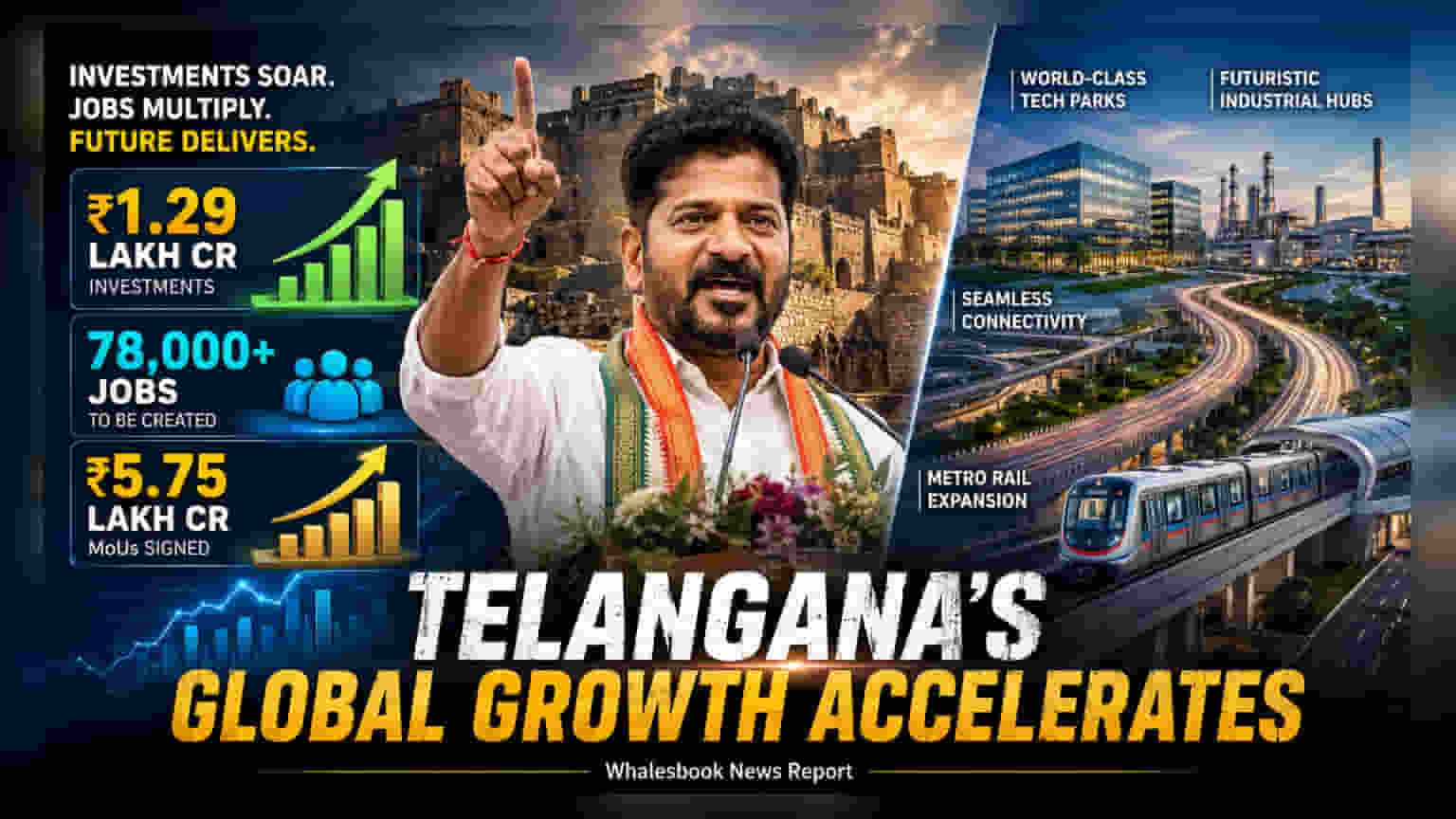
Telangana Chief Minister A. Revanth Reddy has unveiled a major economic roadmap prioritizing industrial expansion, infrastructure, and job creation. The state is leveraging recent investment commitments worth ₹5.75 lakh crore to bolster sectors like life sciences, semiconductors, and technology, aiming to enhance its position as a global economic hub.
Telangana Chief Minister A. Revanth Reddy has outlined a comprehensive development agenda aimed at strengthening the state’s industrial and economic framework. During the state's 80th Independence Day celebrations, the government emphasized a strategic focus on infrastructure, high-growth industrial sectors, and large-scale employment generation to position Telangana as a globally competitive economic powerhouse.
Industrial Growth and Investment Climate
The state has been actively focused on attracting capital, with ₹1.29 lakh crore already secured through the Telangana State Industrial Project Approval and Self-Certification System (TG-iPASS). These commitments are expected to support the creation of over 78,000 jobs. Beyond existing projects, the government has signed Memorandums of Understanding totaling ₹5.75 lakh crore, inked during the Telangana Rising Global Summit-2025. This summit is set to become an annual fixture, designed to maintain a steady flow of international and domestic investment.
To optimize industrial land use, the government is implementing the Hyderabad Industrial Lands Transformation Policy (HILT Policy-2025). This initiative aims to modernize older industrial zones and facilitate the relocation of industries to upgraded parks, which is intended to reduce environmental impact and improve operational efficiency for businesses.
High-Growth Sectors and Technology
Telangana is aggressively targeting niche, high-growth sectors. The 'Next-Gen Life Sciences Policy-2026' is a core part of this strategy, aiming to cement the state's status as a leading global life sciences hub. Additionally, the government is focusing on the semiconductor, electronics, and advanced manufacturing industries to diversify its industrial base.
The technology sector remains a significant driver of the state's economy. IT exports reached ₹3.97 lakh crore in 2025-26, supported by a workforce of 12.14 lakh professionals. Hyderabad continues to expand its role as a key center for Global Capability Centres (GCCs), adding 40 new centers in 2026 to bring the total to over 355. Furthermore, large-scale infrastructure projects are underway to support the digital economy, including an AI-ready cloud infrastructure campus and a major $7 billion investment commitment from Amazon.
Infrastructure Expansion
To support this industrial expansion, the government is prioritizing major infrastructure connectivity. Key projects include the 360-kilometer Regional Ring Road around Hyderabad and the development of 6,092 kilometers of roads using the Hybrid Annuity Model. Urban mobility is also receiving focus, with Metro Rail Phase-2 expansion covering 122.9 kilometers across seven corridors. In the aviation sector, the government is working on reviving the Mamunoor Airport and developing a joint-use airfield in Adilabad to improve regional connectivity.
For investors and businesses, the primary monitorables moving forward will be the execution timeline of these infrastructure projects and the success of the new industrial policies in attracting the pledged investments. The state’s ability to maintain a competitive environment for life sciences and semiconductor manufacturing, alongside the timely completion of transport networks, will be critical for achieving its long-term economic objectives.