 Whalesbook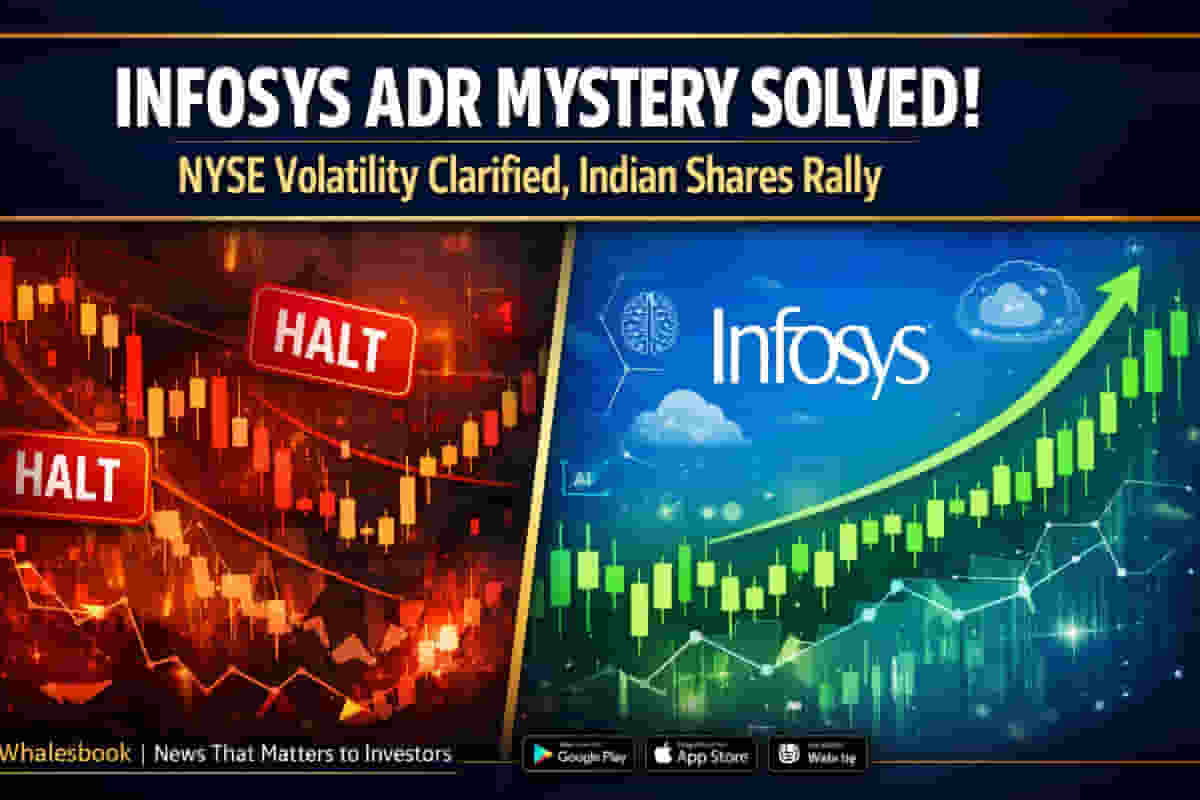
Infosys Shares Climb on ADR Clarification
Infosys Limited's share price experienced a notable jump of over 3% in intraday trading on Monday. This positive movement came after the Bengaluru-based software services firm swiftly addressed market speculation surrounding unusual price action observed in its American Depositary Receipts (ADRs) on the New York Stock Exchange (NYSE).
Unprecedented ADR Volatility
Last week, Infosys's ADRs on the NYSE saw a dramatic surge, soaring as much as 56% to an intraday high of approximately $30. This sharp, unexplained upward movement attracted significant attention and led to two trading halts on the exchange, implemented under mechanisms designed to curb extreme price fluctuations. The unusual activity prompted widespread observation and analysis from market watchers.
Company Issues Transparency Filing
In response to the extraordinary market event, Infosys issued a regulatory clarification. The company stated that there were no material events or corporate announcements that would necessitate such a spike in price and require disclosure under the Securities and Exchange Board of India (Sebi) Listing Obligations and Disclosure Requirements Regulations. Infosys emphasized that this communication was released in the interest of transparency and to preempt unwarranted speculation.
Market Mechanics Over Fundamentals
Analysts and market experts suggested that the outsized moves in the ADRs were not directly tied to the company's underlying fundamentals or recent corporate announcements. Instead, they pointed towards technical and market-structure factors. These potential drivers include phenomena such as short squeezes, periods of low liquidity, the triggering of automated trading algorithms, and trading activity in holiday-thinned markets.
Business Trends Remain Strong
Despite the attention drawn by the ADR volatility on Wall Street, Infosys's core business trends continue to focus on cyclical demand in crucial areas such as digital transformation, cloud computing, and artificial intelligence (AI) related services. The company's stock also benefits from broader positive momentum across the IT services sector.
Investor Confidence Restored
The clarification from Infosys appears to have effectively calmed nerves among domestic investors. This has contributed to the rebound in Infosys's share price on the Bombay Stock Exchange (BSE) and the National Stock Exchange (NSE) in Mumbai, as confidence returns following the preceding week's volatility. The stability brought by the company's statement is expected to allow the market to refocus on Infosys's business performance.
Impact
This incident serves as a clear illustration of how technical market factors can significantly influence stock prices, even for large-cap companies, sometimes independent of fundamental news. For Infosys and its investors, the clarification has helped to stabilize sentiment and prevent potential contagion of concern. The company's fundamental business outlook remains intact, supported by demand in digital services.
Impact rating: 6.
Difficult Terms Explained
- American Depositary Receipts (ADRs): Certificates issued by a U.S. depositary bank that represent a specified number of shares of a foreign company's stock, allowing them to trade on U.S. stock exchanges.
- Bombay Stock Exchange (BSE): One of Asia's oldest stock exchanges, located in Mumbai, India.
- National Stock Exchange (NSE): India's leading stock exchange, also based in Mumbai.
- Sebi (Listing Obligations and Disclosure Requirements) Regulations: Rules set by India's Securities and Exchange Board of India that mandate listed companies to disclose material information promptly and accurately.
- Short Squeezes: A market condition where a heavily shorted stock experiences a rapid price increase, forcing short sellers to buy shares to cover their positions, which further drives the price up.
- Liquidity: The ease with which an asset can be bought or sold in the market without significantly impacting its price. Low liquidity can lead to higher price volatility.
- Technical Factors: Influences on stock prices based on trading patterns, price charts, volume data, and other trading statistics, rather than company fundamentals or economic news.