

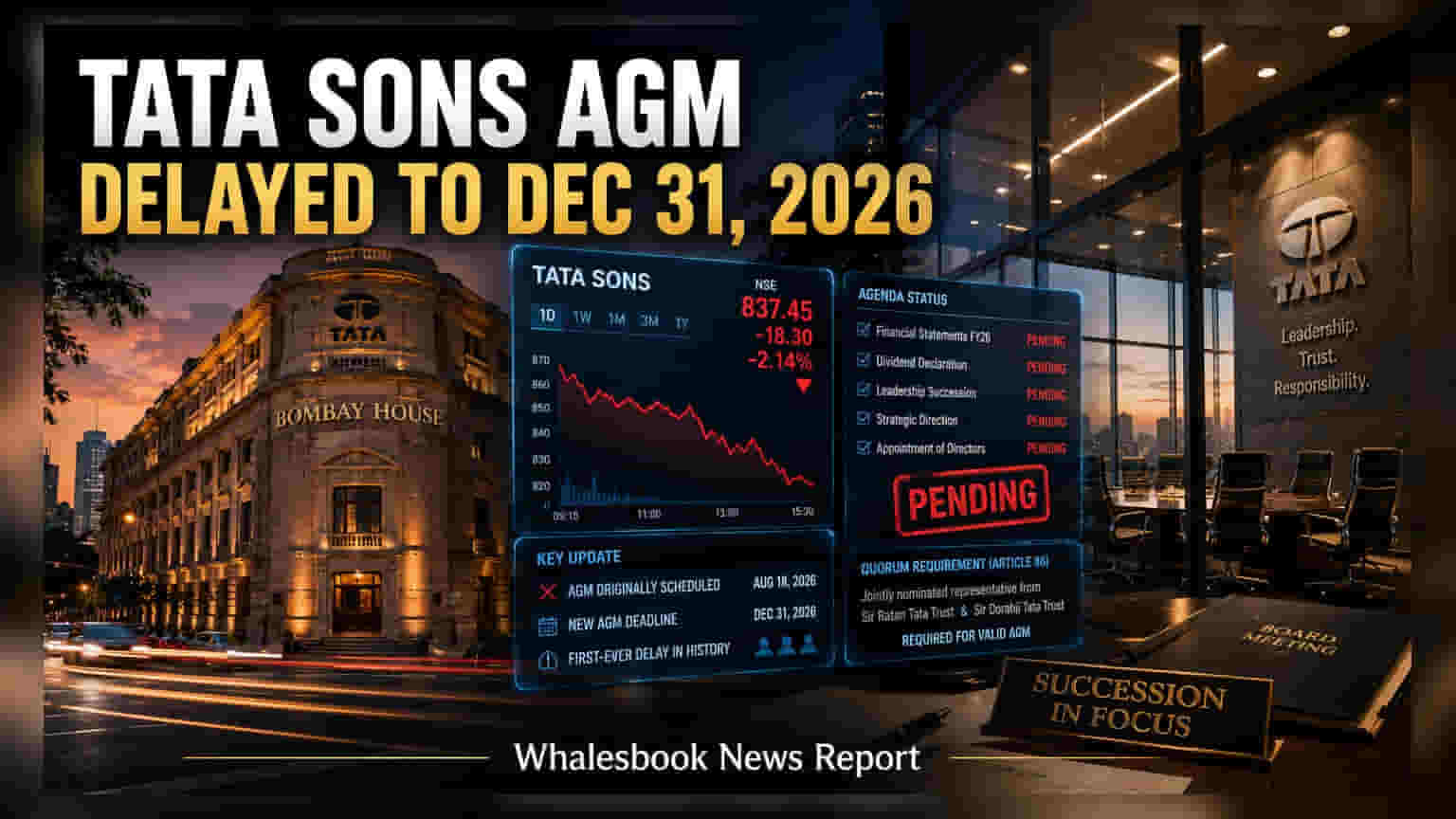
Tata Sons has secured a regulatory extension to hold its Annual General Meeting by December 31, 2026, following an initial adjournment. The delay stems from a governance deadlock involving the Sir Ratan Tata Trust, which currently faces restrictions on holding board meetings. For investors, the situation creates uncertainty regarding leadership succession, as Chairman N. Chandrasekaran has stated he will not seek reappointment when his term ends in early 2027.
Tata Sons has moved its Annual General Meeting (AGM) to a new deadline of December 31, 2026, after the meeting originally scheduled for August 18 could not proceed. This delay is the first of its kind in the company’s history and highlights a complex governance standoff at the top of the group’s holding company structure.
Why the AGM Was Delayed
The root cause of the postponement is a specific requirement in the company’s Articles of Association. Under Article 86, the AGM requires a jointly nominated representative from both the Sir Ratan Tata Trust (SRTT) and the Sir Dorabji Tata Trust (SDTT) to form a valid quorum. Currently, the Sir Ratan Tata Trust is under regulatory restriction by the Maharashtra Charity Commissioner. Due to an ongoing inquiry into its trustee composition, the trust is legally barred from holding board meetings, making it impossible to nominate the required representative.
While the Registrar of Companies has granted an extension until the end of the year to resolve these procedural hurdles, the gridlock prevents the company from formally approving its financial accounts and dividends for the financial year. This has drawn attention to the structural relationship between the Tata Trusts and the holding company, as governance standards at the trust level directly impact the operations of the group’s flagship entity.
Leadership Succession and Investor Uncertainty
The postponement comes at a critical time for the group's leadership. Chairman N. Chandrasekaran has already indicated that he will not seek another term when his current tenure ends in February 2027. This decision, coupled with the inability to hold the AGM, has left a vacuum in the formal succession planning process. The AGM was intended to be a platform to address these high-level leadership transitions and finalize the group's strategic direction.
Although the Maharashtra Charity Commissioner recently dismissed a separate inquiry regarding a 1989 share transfer on September 2, 2026, the primary restrictions on the SRTT regarding its internal governance remain in place. Investors are now focused on when and how these regulatory issues will be resolved to allow the trusts to resume normal board functions.
What Investors Should Monitor
For those invested in the broader Tata Group, the primary monitorable is the resolution of the trustee composition issue. The ability of the Sir Ratan Tata Trust to resume its governance functions is the key trigger for the AGM to proceed. Until the board meeting is successfully held, the formal approval of financial accounts and the crystallization of leadership succession plans will remain on hold. Stakeholders will be watching for any further communication from the company or regulatory updates that could pave the way for a swift resolution of these quorum requirements.