

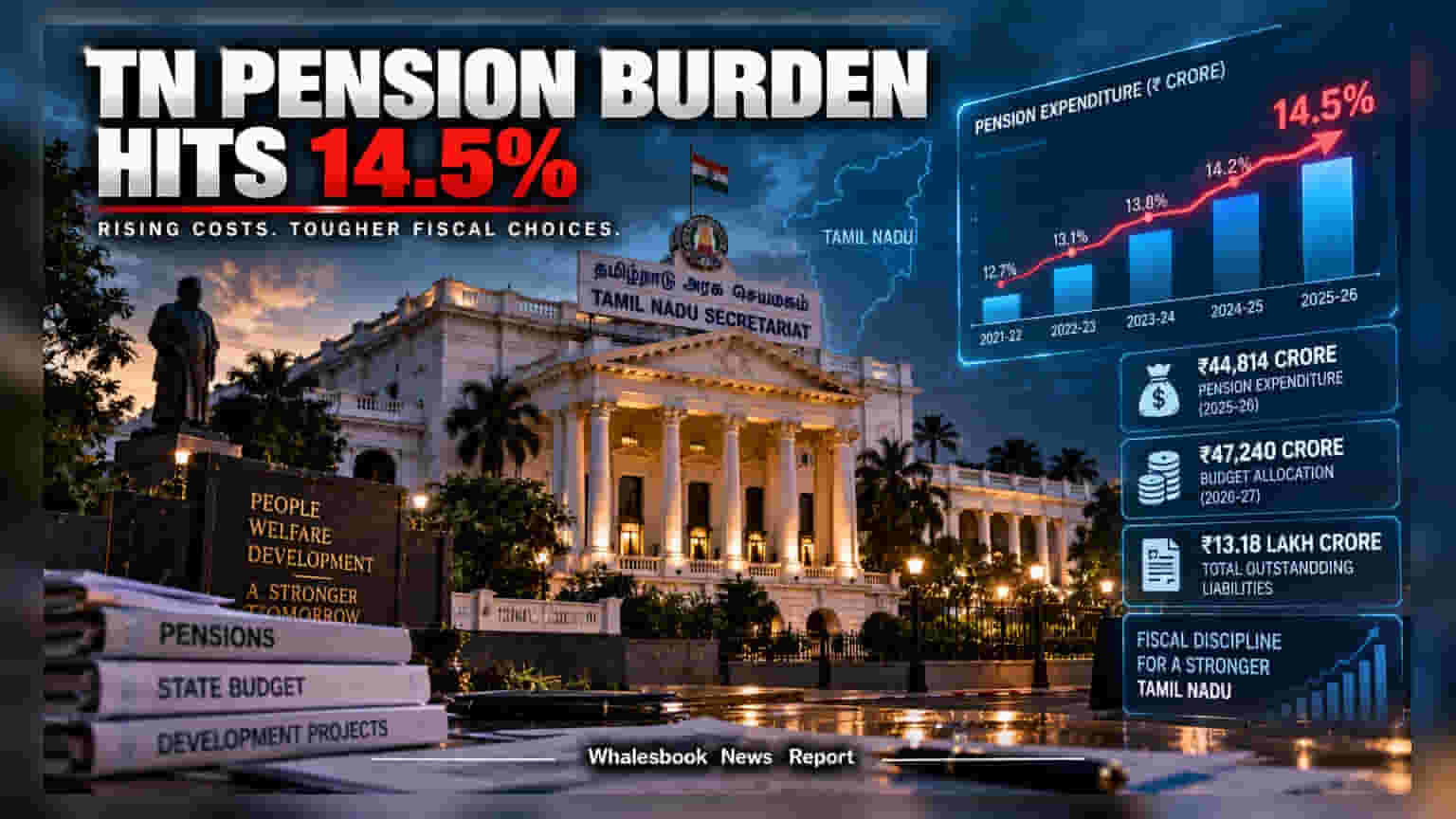
Tamil Nadu’s pension spending has risen to ₹44,814 crore, taking up 14.5% of the state's total revenue. This high level of committed spending highlights the fiscal pressure on the state budget. The government is now rolling out administrative changes to improve liquidity and manage overall debt, which is crucial for maintaining the state's infrastructure and development spending.
The Tamil Nadu government is navigating a challenging fiscal environment as the costs associated with pension and retirement benefits continue to rise. Recent official data indicates that pension expenditures for the 2025-26 period climbed to ₹44,814 crore, representing a 10.2% increase compared to the previous year. This commitment now consumes roughly 14.5% of the state’s total revenue receipts, a steady rise from 12.7% in 2021-22. As committed expenditures—which also include interest payments—rise, the state faces the challenge of maintaining funds for essential development and infrastructure projects.
Fiscal Pressure on State Budget
The rising pension burden is part of a broader fiscal scenario for the state. According to the 2026-27 Budget presented in August 2026, the state has set an allocation of ₹47,240 crore for pension obligations in the coming year. These fixed costs limit the state’s financial flexibility, as a large portion of the budget is effectively spoken for before new development initiatives can be funded. The state’s total outstanding liabilities are currently estimated at approximately ₹13.18 lakh crore, including the debt of state-owned public sector undertakings. To manage these numbers, the government is aiming to keep the fiscal deficit at 3% of the Gross State Domestic Product (GSDP), which requires disciplined revenue management.
New Reforms to Improve Efficiency
To address these fiscal strains, the state has initiated several administrative changes. One major step is the introduction of the Tamil Nadu Assured Pension Scheme (TAPS), which guarantees retirees 50% of their last-drawn basic pay plus dearness allowance. This applies to government servants who joined from January 2026 and those moving from the older Contributory Pension Scheme. The implementation of such schemes often requires careful balancing, as they are partially contingent on ongoing negotiations regarding borrowing limits with the Union government.
Furthermore, the Finance Department has implemented a 'Just-in-Time' payment system. This mechanism is designed to move away from traditional fund parking, where money is released to state-owned entities well before it is needed. Instead, the system ensures funds are distributed only when an obligation is due. By reducing the idle holding of funds, the government aims to lower unnecessary interest liabilities and improve overall cash flow efficiency. Additionally, the government has launched the New Health Insurance Scheme 2026, managed through the United India Insurance Company, to provide coverage for critical illnesses.
Investors and observers should monitor the state's progress in achieving its fiscal deficit targets and its ability to balance these welfare commitments with revenue growth. The key monitorable will be the actual revenue collection figures and the state's ability to maintain capital expenditure levels despite these rising fixed costs. Any delay in central government borrowing approvals or slower-than-expected revenue growth could create further fiscal constraints for the state, impacting its overall investment capacity in the coming quarters.