

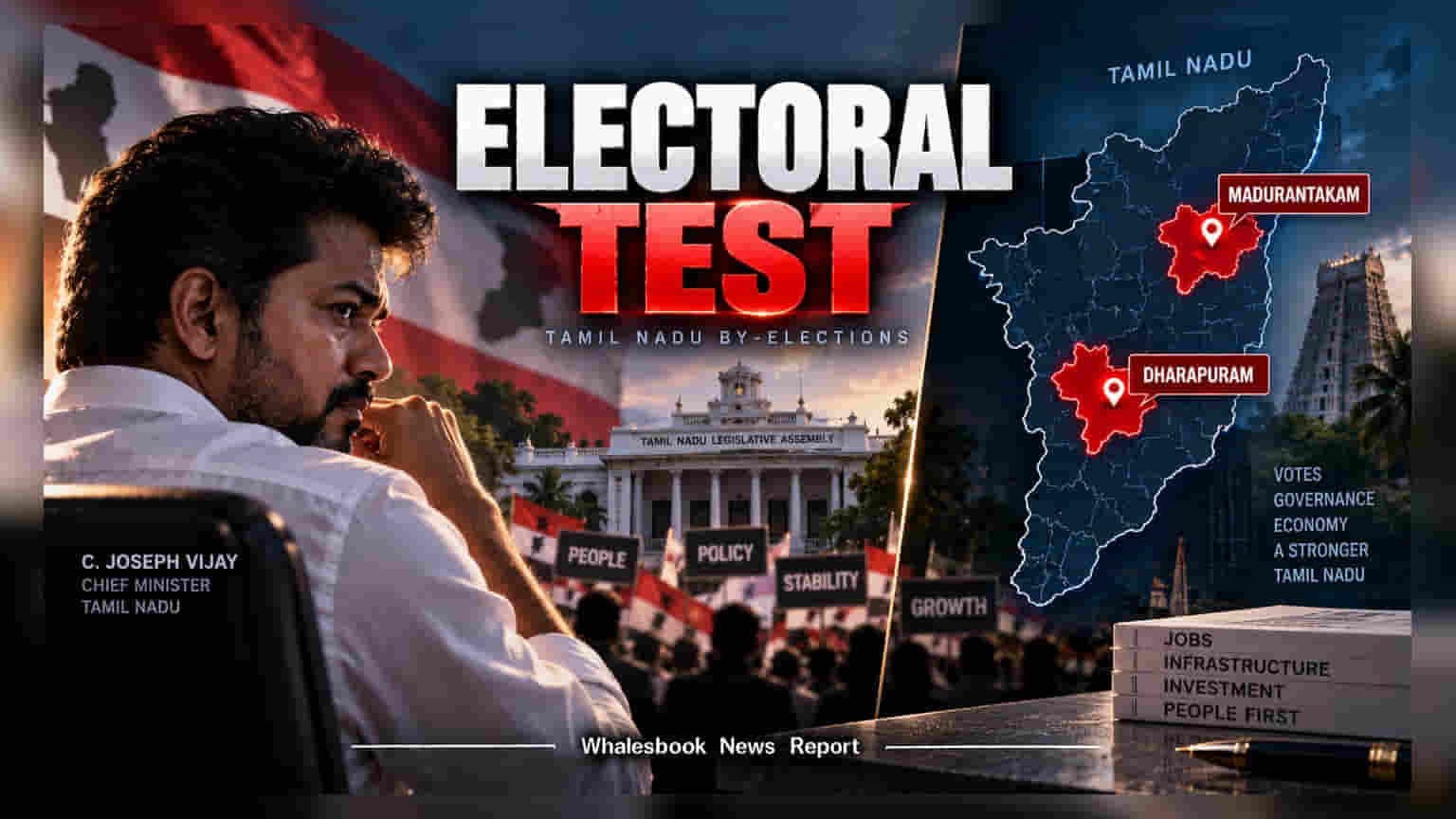
Tamil Nadu will hold by-elections for the Madurantakam and Dharapuram assembly seats on October 6, 2026. For the business and financial community, the outcome is critical as it will test the stability of the Tamilaga Vettri Kazhagam government, which currently navigates a fragile coalition while managing a significant state debt burden.
The state of Tamil Nadu is gearing up for crucial by-elections in the Madurantakam and Dharapuram constituencies on October 6, 2026, with the final results to be declared on October 9. While the event is political, it holds significant weight for the state's economic governance. The ruling Tamilaga Vettri Kazhagam (TVK), led by Chief Minister C. Joseph Vijay, currently governs with 107 seats. To maintain a simple majority in the 234-seat assembly, the government needs 118 seats, forcing it to rely on an external coalition comprising the Congress, VCK, IUML, and Left parties. Investors and business stakeholders often monitor such elections for signals regarding policy continuity and administrative stability.
Fiscal Context and Legislative Stability
The economic health of Tamil Nadu remains a primary concern for the market. The state is currently managing a debt load exceeding ₹10 lakh crore, a figure that necessitates consistent and proactive fiscal management. A stable government with a clear majority is generally seen as better equipped to implement necessary budgetary reforms, manage welfare spending, and maintain a favorable business climate. With the current coalition government facing internal friction—particularly regarding policy directions and prime ministerial endorsements for 2029—the electoral performance of the TVK in these two by-polls will act as a barometer for how much legislative breathing room the administration can secure.
Legal and Political Headwinds
Beyond these two specific by-elections, the legislative composition remains uncertain. By-elections for five other constituencies—Tiruchi East, Ambasamudram, Viralimalai, Perundurai, and Karur—remain stayed by the Madras High Court due to pending election-related litigation. This creates a state of legislative flux, where the exact majority math of the assembly could shift significantly once these legal issues are resolved. The uncertainty surrounding these seats, combined with the ongoing coalition disagreements with partners like the Congress and CPI, complicates the government's ability to drive long-term economic policies without interruption.
For investors and observers tracking the state's economic trajectory, the key monitorable following the October 9 results will be whether the TVK secures enough seats to reduce its reliance on external coalition partners. A more stable legislative position could provide the government with greater autonomy to address the state's fiscal deficit and welfare obligations. Conversely, a poor showing could prolong the period of policy stagnation, as the government continues to balance the competing demands of its coalition allies while attempting to manage the state's substantial debt.