

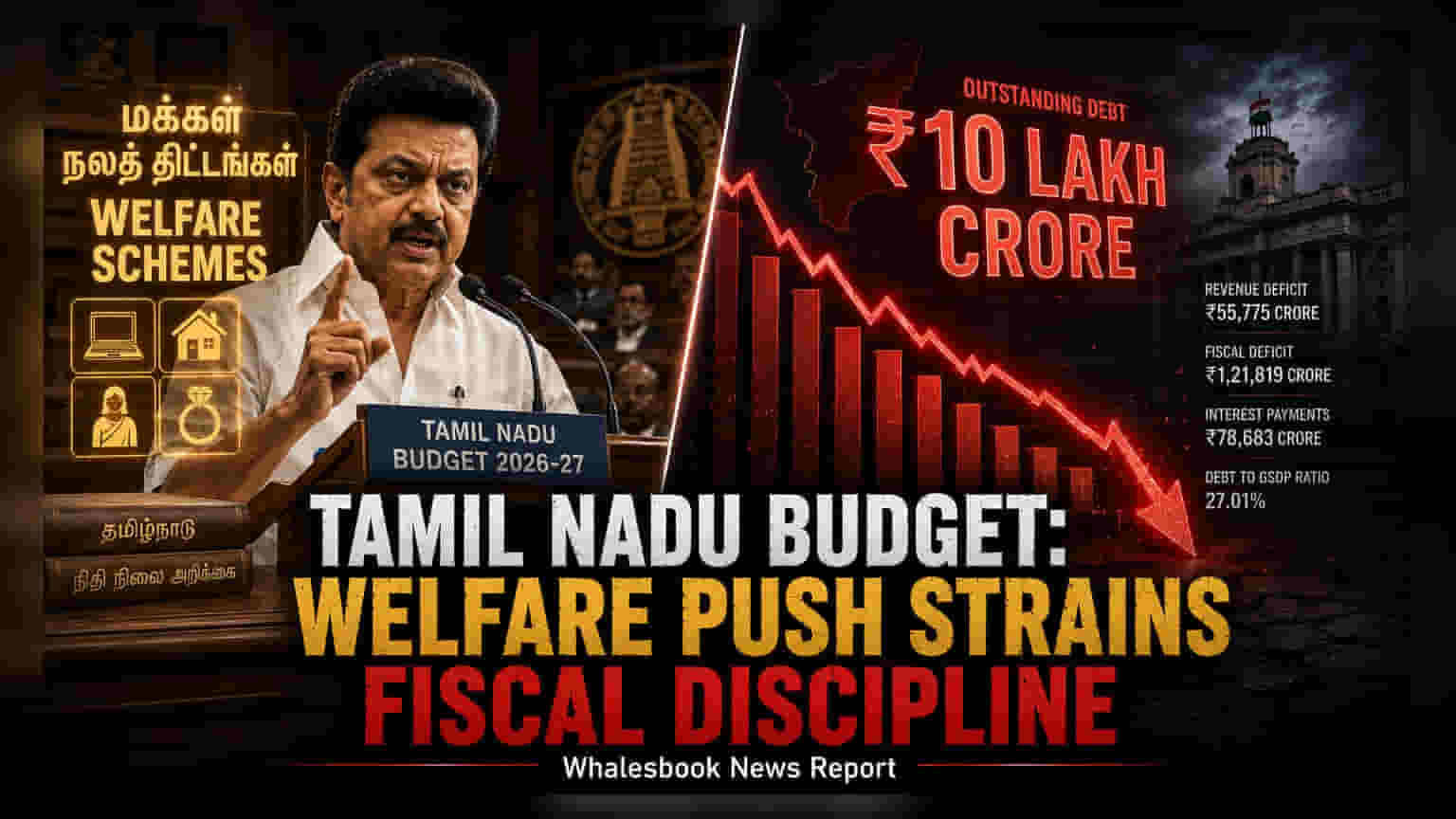
The Tamil Nadu government’s 2026-27 budget projects total debt at nearly ₹11 lakh crore while prioritizing significant welfare spending. Investors are monitoring the state's fiscal health, as heavy interest payments and welfare costs compete with the funds needed for long-term infrastructure and industrial growth.
The Tamil Nadu government, led by the TVK administration, has presented its 2026-27 budget with a focus on balancing extensive welfare promises with urgent fiscal constraints. Finance Minister N. Marie Wilson unveiled a financial roadmap that pegs the state's total outstanding debt at approximately ₹10.98 lakh crore, a figure that continues to draw attention from economists and market observers due to its scale relative to the state's income.
The Fiscal Balancing Act
While the budget aims to move the state toward a $1.5 trillion economy by 2036, it faces immediate pressure from a revenue deficit estimated at ₹55,775 crore. The state has targeted a fiscal deficit of ₹1,21,819 crore, which aligns with the 3% limit allowed under the Fiscal Responsibility Act. However, achieving this target relies heavily on the state's ability to maintain tax revenue growth, which is projected at around 9.78%.
For investors and businesses operating in the state, the primary concern lies in how these numbers impact the actual funds available for capital expenditure—money spent on building roads, power grids, and industrial infrastructure. With estimated interest payments reaching ₹78,683 crore this year, a significant portion of the state's revenue is being diverted toward debt servicing. This leaves limited flexibility for the government to ramp up spending on growth-inducing projects if revenues fall short of these targets.
Welfare Spend and Economic Impact
The budget continues the state's trend of prioritizing direct welfare schemes. Key allocations include ₹2,000 crore for the 'Vetri Laptop Scheme' for college students, ₹812 crore for gold coins and sarees for brides, and ₹560 crore for gold rings for newborns. Additionally, ₹3,500 crore has been set aside for the 'Vetri Veedu Thittam' housing initiative. While these schemes aim to support various sections of society, they add to the state's recurring expenditure.
From a financial perspective, the challenge is that welfare spending is generally non-revenue generating. When this is coupled with a debt-to-GSDP ratio of approximately 27.01%, it limits the state's capacity to absorb any sudden economic shocks. The government has acknowledged these challenges, citing inherited liabilities and systemic leakages in revenue-earning departments as hurdles that need to be addressed to restore fiscal prudence over the next two years.
Investor Monitorables
The long-term fiscal health of the state will depend on its ability to broaden its tax base beyond current levels. The government has indicated a focus on improving compliance and reducing leakages to narrow the fiscal deficit to around 2.8% by FY29. Investors will likely track the actual collection of state taxes in the coming quarters to see if the growth projections are realistic. Another key monitorable is the government's ability to protect capital expenditure budgets from being trimmed in favor of meeting populist welfare commitments, as any reduction in infrastructure investment could impact the state's broader industrial attractiveness.