

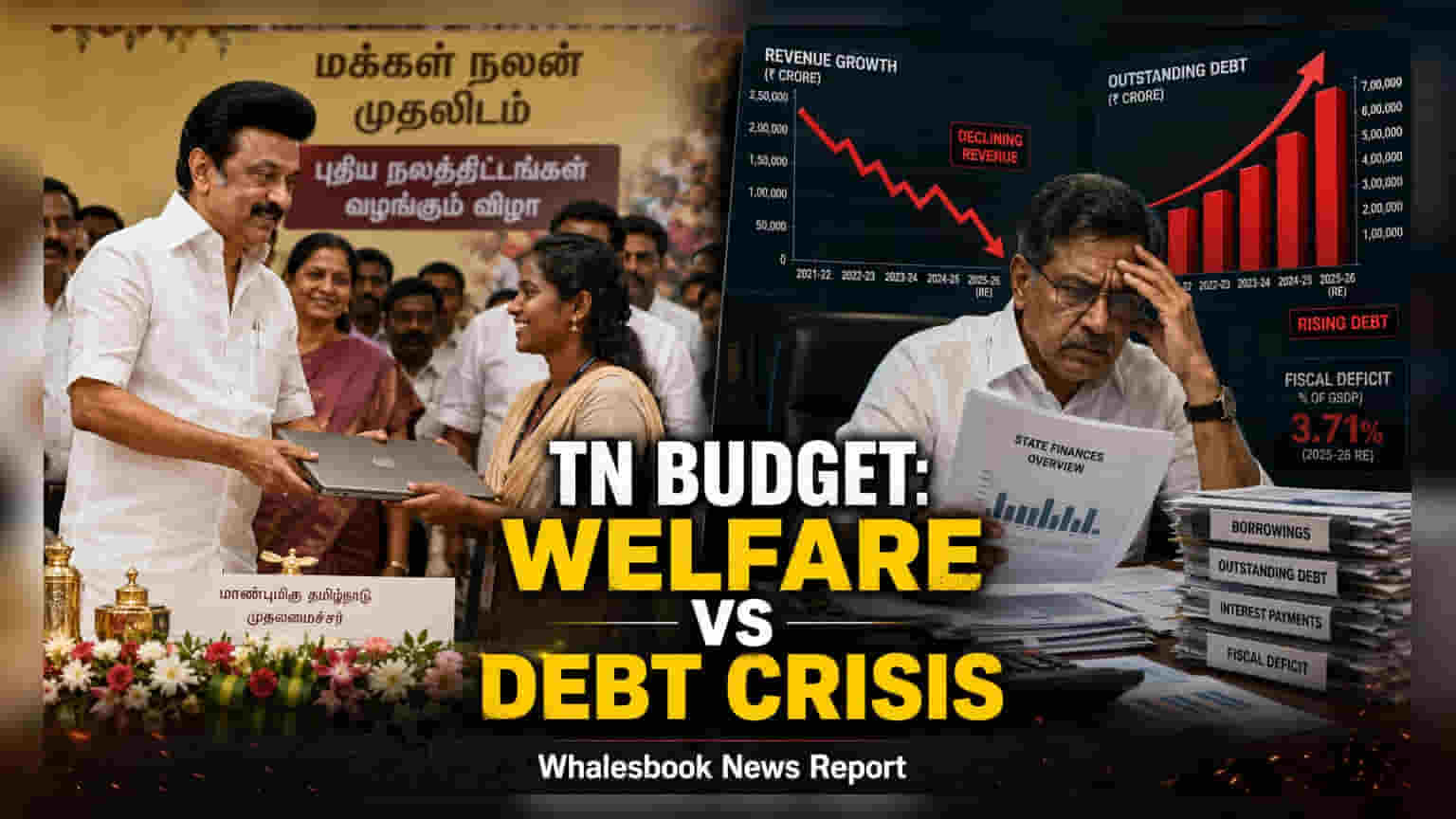
Tamil Nadu's 2026-27 budget prioritizes welfare schemes and tech infrastructure while grappling with a ₹13.18 lakh crore debt burden. Finance Minister N. Marie Wilson outlined a two-year plan to improve fiscal health, targeting a $1.5 trillion economy by 2036. Key updates include a new AI city named 'Arivagam' and initiatives for education, though the state faces challenges in revenue mobilization.
The Tamil Nadu government, led by the Tamilaga Vettri Kazhagam (TVK) party, presented its maiden state budget for the 2026-27 financial year on August 5, 2026. Finance Minister N. Marie Wilson unveiled an ambitious roadmap that attempts to balance expansive welfare commitments with the harsh reality of the state's financial position. The government has openly acknowledged that the state is facing significant fiscal stress, inheriting a total outstanding debt of approximately ₹13.18 lakh crore, including public sector units. To address this, the budget proposes a two-year recovery plan aimed at curbing administrative leakages and restoring financial stability.
At the heart of the budget is a dual focus on social welfare and futuristic industrial growth. The administration has introduced several schemes aimed at women and students, including gold assistance for brides and a 'Vetri Laptop Scheme.' These welfare measures are being framed as essential for social development. Simultaneously, the state has set an ambitious long-term target to grow its economy to $1.5 trillion by 2036. To support this, the government announced the development of 'Arivagam,' which is planned as India's first dedicated AI and innovation city located in Chennai. Other industrial initiatives include the establishment of a Space Industrial Investment Zone in Thoothukudi and Tirunelveli.
From a financial perspective, the government is walking a tightrope. A significant portion of the state's revenue is currently committed to debt servicing, with interest payment obligations projected at ₹78,683 crore for the 2026-27 period. This heavy interest burden limits the funds available for new infrastructure spending. To bridge the gap, the government plans to implement revenue mobilization reforms, including a new liquor cess, and intends to aggressively tackle systemic inefficiencies in tax collection. While the government remains optimistic about long-term growth, the immediate fiscal space remains constrained.
The budget has drawn criticism from political opponents who argue that the proposals lack a concrete, detailed roadmap and rely on re-branding existing initiatives rather than fulfilling major election promises. For investors and market observers, the key monitorable will be the government's ability to execute these large-scale infrastructure projects while meeting its two-year fiscal recovery timeline. Success will largely depend on the effective implementation of these revenue reforms and the ability to control non-essential expenditure while keeping the state's debt metrics in check.