

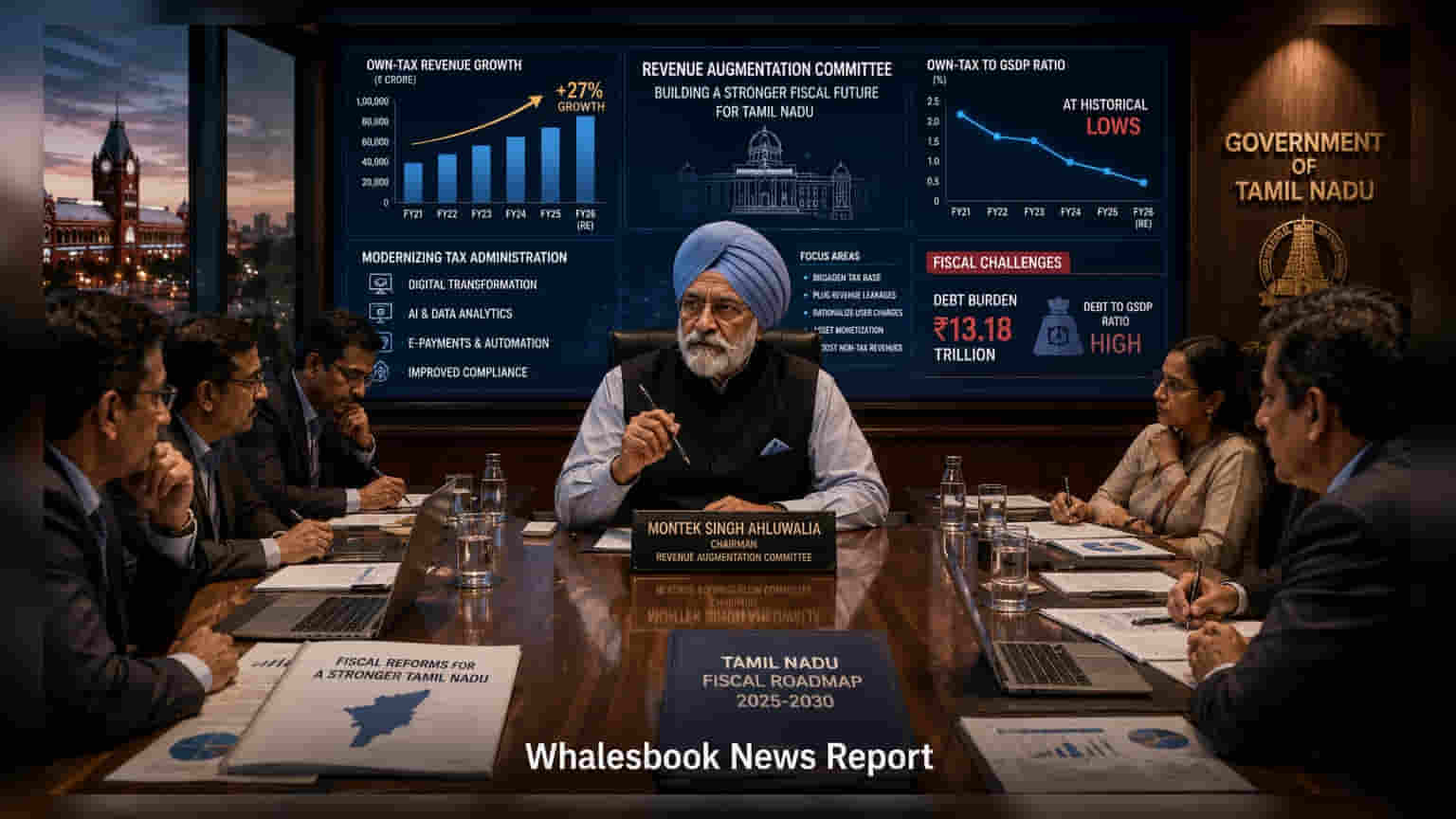
The Tamil Nadu government’s Revenue Augmentation Committee, led by economist Montek Singh Ahluwalia, is consulting industry leaders to improve the state's fiscal health. Tasked with addressing a high debt burden of approximately ₹13.18 trillion, the committee is exploring digital tax reforms and measures to plug revenue leakages to stabilize the state budget.
The Tamil Nadu government has launched a structured effort to improve its fiscal health, led by the newly formed Revenue Augmentation Committee chaired by noted economist Montek Singh Ahluwalia. The committee is currently holding consultations with industry representatives, domain experts, and public finance officials to devise strategies for strengthening the state's tax and non-tax income.
This initiative comes at a critical time for the state’s finances. According to recent government documents and the committee's mandate, Tamil Nadu faces significant fiscal pressure, characterized by a high debt burden estimated at around ₹13.18 trillion. Furthermore, the state’s own-tax-to-GSDP (Gross State Domestic Product) ratio—a key metric for measuring fiscal efficiency—has touched historical lows, prompting the need for structural policy changes.
At the core of the committee’s discussions is the modernization of tax administration. The group is exploring the deployment of advanced digital tools to improve collection efficiency and the implementation of stricter governance protocols to plug existing revenue leakages. Industry players participating in the consultations have advocated for rationalizing guideline values for property and increasing Floor Space Index (FSI) limits, suggesting that these measures could unlock dormant fiscal potential in the state's industrial corridors.
For investors and businesses operating in Tamil Nadu, this committee’s work carries long-term implications. While the primary goal is to stabilize the state budget and reduce the debt-to-GSDP ratio, any resulting policy changes—such as revisions to user charges, tax compliance requirements, or asset monetization strategies—could directly impact the cost of doing business in the state. The committee is also looking at balancing revenue generation with the need to remain an economically competitive destination for new investments.
However, the path to implementation involves clear risks. The effectiveness of these reforms will depend on the government’s ability to execute potentially challenging structural changes without dampening business sentiment or slowing economic activity. There is also the potential for friction if reforms involve upward revisions in taxes or service charges, which stakeholders may resist. Investors should monitor the committee’s final recommendations, specifically regarding which policy changes the government prioritizes and the timeline for their rollout. The next phase will likely involve the synthesis of these expert inputs into actionable state policy.