 Whalesbook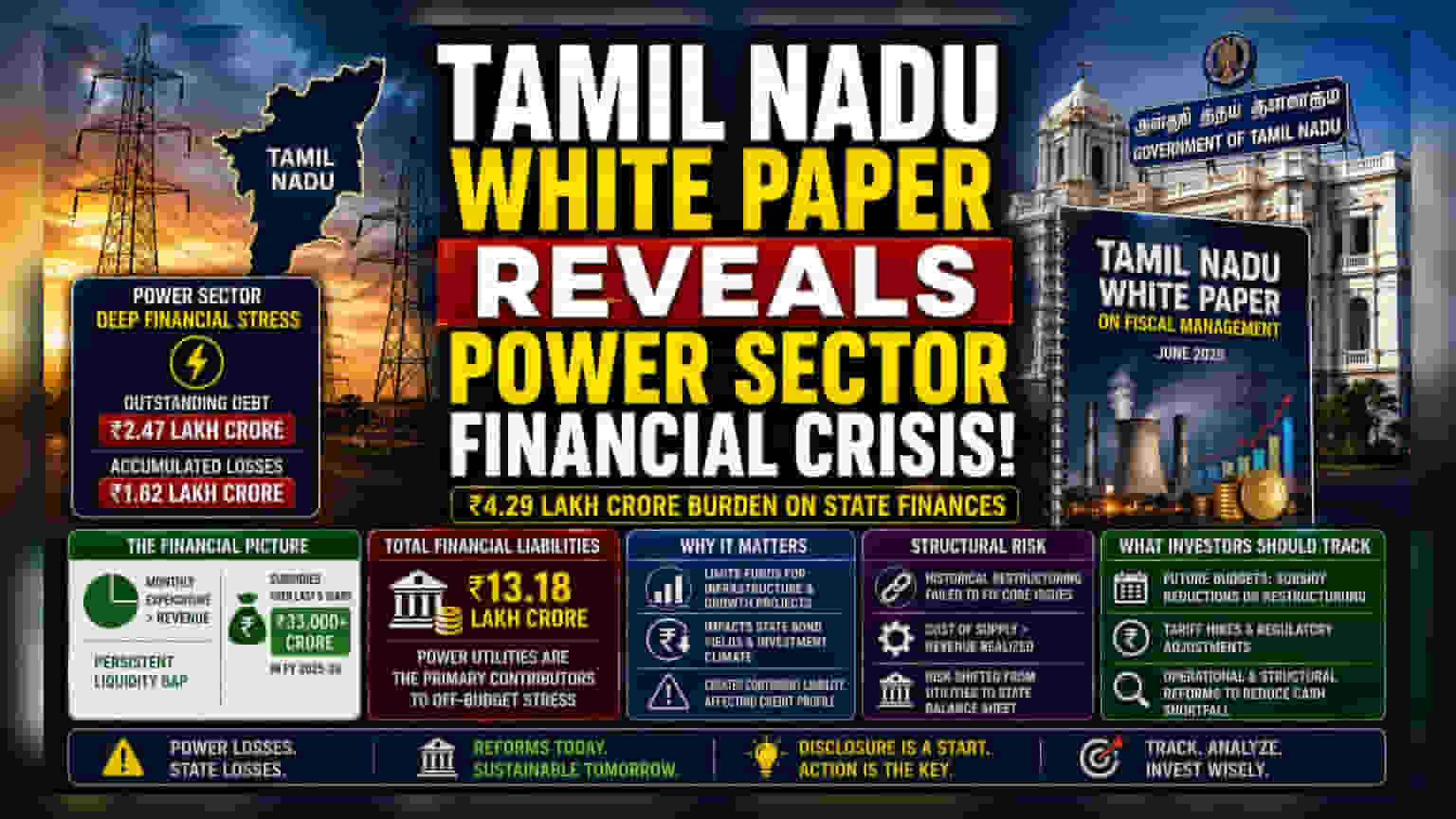


A newly released White Paper by the Tamil Nadu government has highlighted severe fiscal strain in the state's power sector, revealing ₹2.47 lakh crore in debt and ₹1.82 lakh crore in accumulated losses. For investors, this official admission of structural weakness signals a potential tightening of fiscal space for state-level infrastructure and highlights long-standing challenges in DISCOM financial sustainability.
What Happened
The Tamil Nadu government has released a comprehensive White Paper on the state’s fiscal management, formally acknowledging a deep financial crisis within its power sector. The report, presented by Finance Minister N. Marie Wilson, identifies the state’s electricity utilities—forming the TNEB group—as a major source of fiscal risk. The data reveals that these power entities are burdened with approximately ₹2.47 lakh crore in outstanding debt and accumulated losses totaling ₹1.82 lakh crore. The document places the state's total financial liabilities at ₹13.18 lakh crore, emphasizing that power utilities are the primary contributors to this off-budget fiscal stress.
Why This Matters For Investors
For investors monitoring the state's economic health, this disclosure is significant. State-owned distribution companies (DISCOMs) are the backbone of industrial and residential power supply. Persistent financial distress in these entities often forces state governments to divert funds from capital expenditure (roads, industrial parks, and social infrastructure) to bail out the power utilities. When a state faces such a large structural deficit in its power sector, it limits the government’s ability to spend on growth-oriented projects. This fiscal tightness can eventually impact state bond yields and the overall investment climate within the region.
The Financial Picture
The White Paper highlights a persistent liquidity gap within the Tamil Nadu Power Distribution Corporation (TNPDCL). Monthly expenditure significantly outpaces revenue, forcing the utility to rely on short-term borrowings and deferred payments to maintain operations. This cycle creates a dependency on government subsidies, which have seen a marked increase over the past five years. The report notes that government financial assistance to the sector has been substantial, reaching over ₹33,000 crore in the most recent fiscal year alone. This dependency suggests that current tariff structures and operational efficiencies are insufficient to cover the cost of supply, creating a recurring burden on the state’s coffers.
Understanding the Structural Risk
Historically, the power sector in Tamil Nadu has undergone various restructuring attempts, including debt takeovers and financial packages. However, the latest data indicates that these measures have not fully resolved the underlying issues. The core problem remains a mismatch between the cost of power purchase and the revenue realized from consumers. With the sector now unbundled into distribution, generation, and renewable energy entities, the financial performance of each will be critical to watch. The reliance on government support effectively shifts the financial risk from the utility’s balance sheet to the state government's books, creating a contingent liability that could affect the state’s credit profile.
How Investors May Read This
The government's admission acts as a baseline for future policy decisions. Investors may look for whether the administration chooses to pursue politically difficult reforms—such as tariff rationalization or operational restructuring—to improve cost recovery. The lack of concrete reform timelines in the initial disclosure may keep market sentiment cautious regarding state-linked infrastructure projects. The key question for the long term is whether the state can break the cycle of funding losses through debt, or if the financial health of the sector will continue to squeeze the state’s available capital for development.
What Investors Should Track
Investors monitoring this situation should watch for three main triggers. First, future state budget announcements to see if subsidies for power utilities are reduced or restructured. Second, any official updates on tariff hikes or regulatory adjustments that could improve the revenue-per-unit metrics. Third, any announcements regarding structural or operational reforms aimed at reducing the monthly cash shortfall. Monitoring these factors will help assess whether the government’s approach is shifting toward sustainable financial management or continuing historical patterns of liquidity support.